

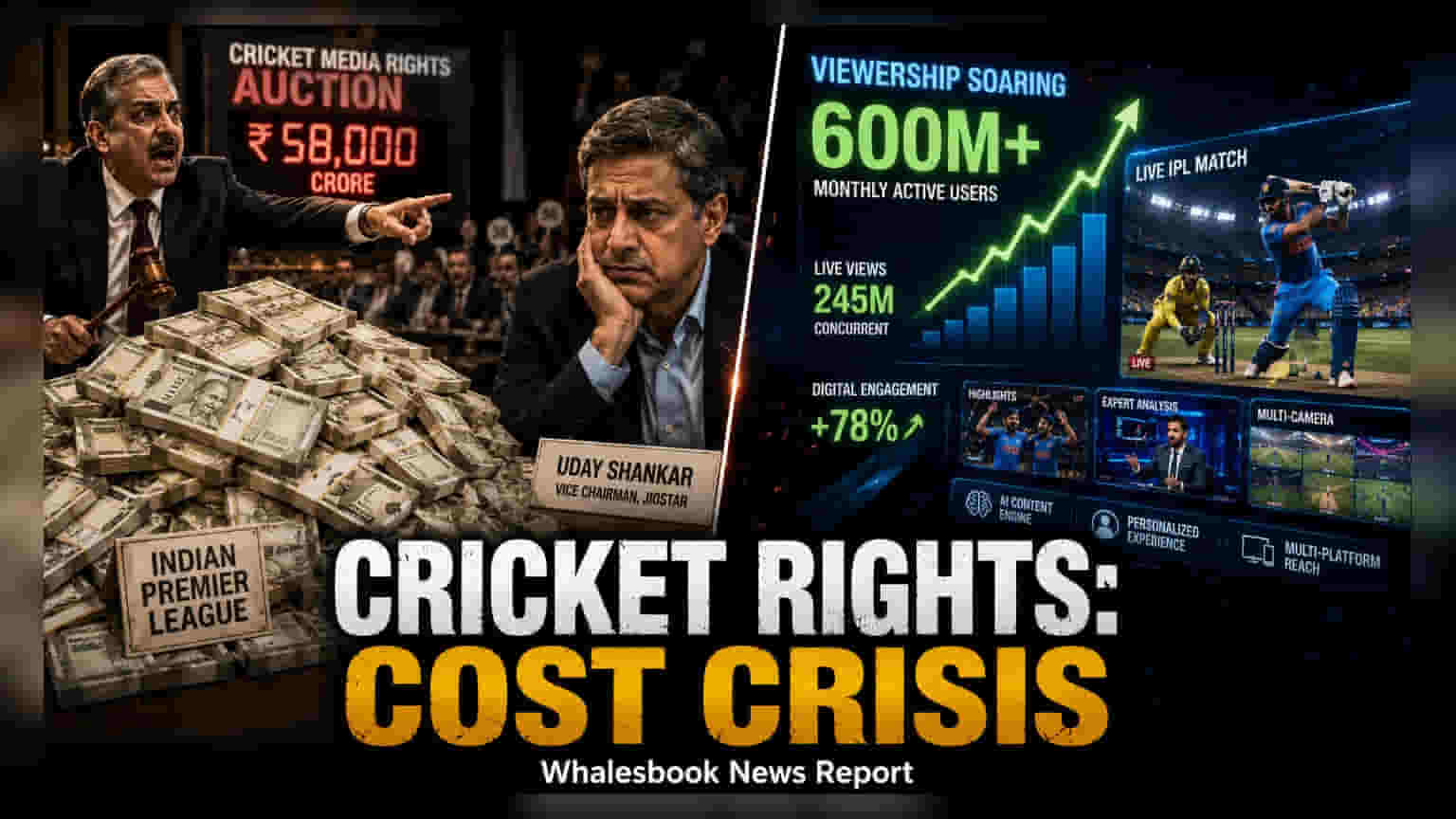
JioStar Vice Chairman Uday Shankar has flagged the unsustainable cost of cricket media rights, highlighting a challenging market environment. While sports remain central to the company's goal of reaching a 600 million user base, the focus is shifting toward financial discipline and monetization. Investors should monitor how the company balances expensive content acquisitions with its long-term profit goals.
JioStar Vice Chairman Uday Shankar recently sparked a conversation on the sustainability of Indian sports media, describing the current market for cricket rights as 'broken' due to escalating costs. During a forum, Shankar noted that while sports remain a powerful vehicle for user acquisition, the financial burden of these rights has reached levels that are increasingly difficult to justify under traditional advertising and subscription business models.
The Strategic Role of Cricket
For JioStar, cricket has functioned as a massive funnel to attract viewers, which the company then converts into entertainment consumers. This strategy has been successful in building a base of 600 million monthly active users across its digital platforms. However, the company is now navigating a transition period where the sheer volume of users must be balanced against the high upfront payments made for properties like the Indian Premier League (IPL) and ICC events.
Shift Toward Financial Discipline
Despite the concerns regarding high rights costs, the company is not retreating from its commitments. JioStar has explicitly clarified that it remains fully committed to its ICC media rights agreements, refuting rumors of an early exit. Furthermore, there are signs of improved cost management. In FY26, the company reported a roughly 31% reduction in its provisions for onerous sports contracts. This reduction indicates a pivot toward more selective bidding and tighter financial control, as seen in the company's decision to acquire media rights for 'The Hundred' 2026—a more targeted approach compared to blanket bidding.
Market and Sector Pressures
The media sector is currently facing significant volatility in advertising revenue, which makes it harder to recover the massive investments made in cricket rights. With fragmented audience behavior across linear television and digital platforms, broadcasters are finding it difficult to rely solely on traditional revenue streams. Shankar suggested that the industry needs to rethink business models, moving beyond 19th-century advertising and subscription frameworks to adapt to a digital-first era.
Looking ahead, the company is betting on content innovation, specifically using artificial intelligence to increase the volume and variety of programming to keep audiences engaged. Brand power is expected to be a key differentiator in a market that is becoming increasingly crowded and expensive.
What Investors Should Track
The most important monitorable for investors will be the company’s ability to improve monetization. While user growth has been strong, the path to sustained profitability depends on whether the company can successfully convert this massive viewership into higher average revenue per user (ARPU) and more efficient advertising returns. Future updates on how the company manages the cost of long-term contracts versus current cash flow will be critical for understanding the health of this business segment.