

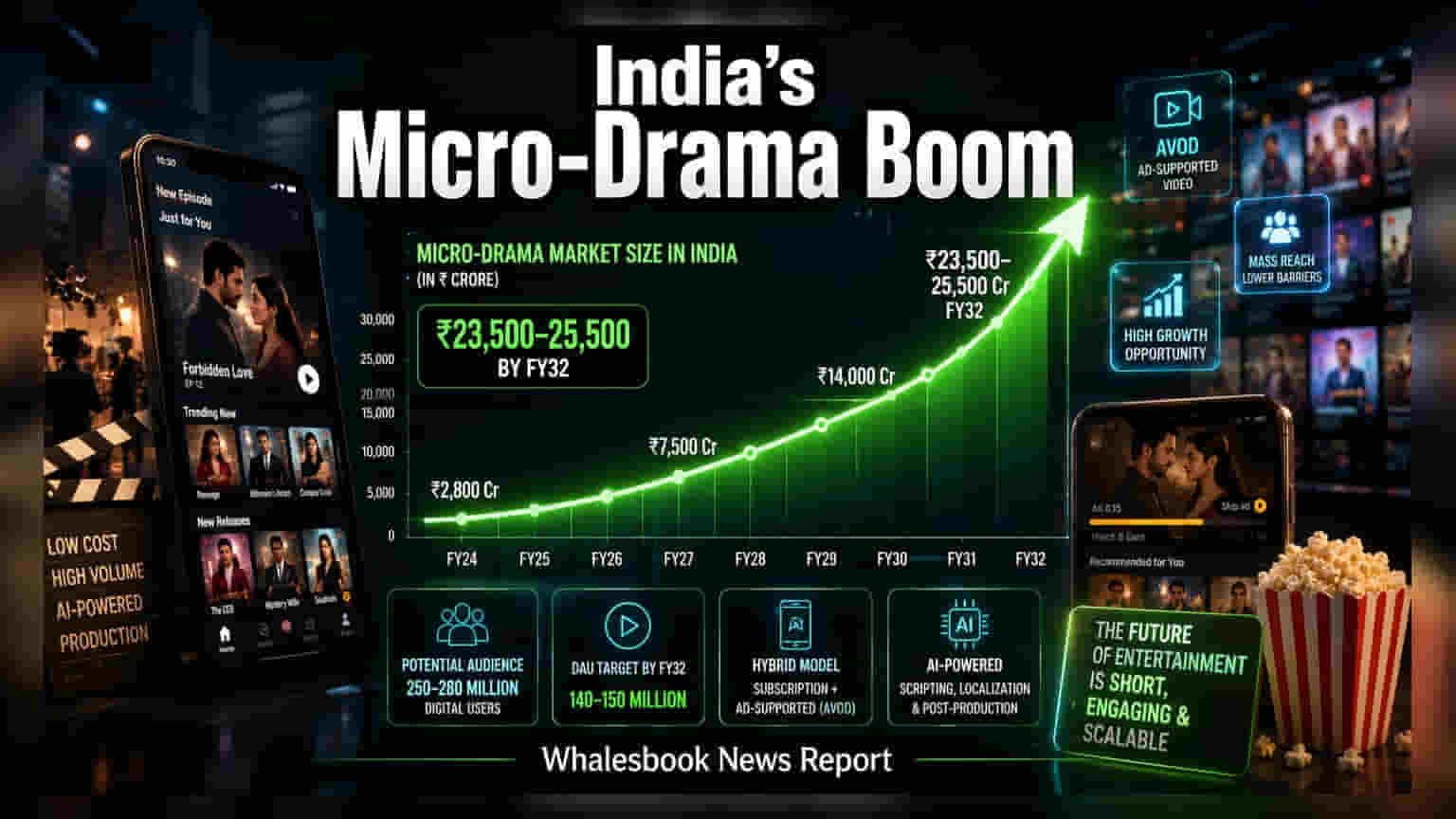
India’s micro-drama industry is forecasted to expand to Rs 25,500 crore by FY32, driven by a strategic shift toward ad-supported video models. Investors should watch how media platforms manage production costs and monetization challenges as they attempt to capture a wider, non-paying user base.
The micro-drama sector in India is bracing for a significant transformation as analysts forecast the market value to climb to Rs 23,500–25,500 crore by FY32. This rapid expansion, highlighted by industry data from Redseer Strategy Consultants, points to a fundamental change in how media platforms are trying to reach the average Indian consumer. While the industry is currently defined by subscription-based access, the growth strategy is now heavily leaning toward hybrid models that combine paid content with ad-supported video-on-demand services, commonly referred to as AVOD.
Why the Industry is Shifting to Ads
Market penetration is the primary driver behind this move. Platforms are finding that limiting content to paying subscribers restricts their total addressable audience to a few million users. By integrating ads, companies hope to unlock access to a potential pool of 250–280 million digital consumers who are more accustomed to free, ad-supported content. The goal is to scale daily active users significantly, with projections suggesting this could reach 140–150 million by FY32.
A key factor supporting this expansion is the cost efficiency of the format. Unlike traditional OTT shows that require massive production budgets and months of filming, micro-dramas are highly scalable. Production costs are often kept lean, sometimes ranging between Rs 20,000 and Rs 50,000 per episode, largely because producers are increasingly using generative AI to accelerate scripting, localization, and post-production workflows. This lower cost structure makes it easier to produce the high volume of content needed to keep ad-supported viewers engaged.
Investor Risks and Challenges
Investors should note that this industry remains in a high-risk, early-stage phase. While the growth potential is high, the path to profitability is not guaranteed. One of the largest hurdles is monetization. Attracting high-paying advertisers requires a massive and consistent user base, and relying on ad revenue alone can be volatile if viewer engagement drops. Many platforms are still struggling to balance the cost of acquiring users with the relatively low revenue earned per viewer.
There is also the reality of payment friction; dependency on UPI-autopay systems can be a hurdle for revenue collection, and users are often reluctant to switch to paid models once they become accustomed to free, ad-supported content. Furthermore, the sector faces stiff competition from established social media giants and traditional streaming services that already dominate consumer attention. Regulatory scrutiny regarding content regulation and user privacy also remains a factor to watch. For listed media companies, the move toward short-form, ad-heavy content will be a key area to monitor, as they must decide whether to build these capabilities in-house or pursue partnerships and acquisitions to stay relevant.