
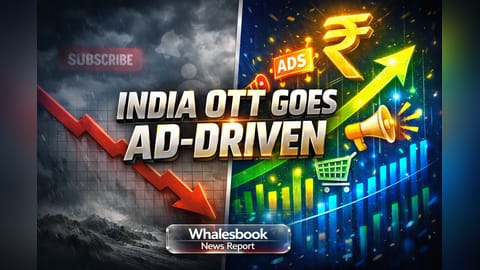
India's OTT streaming market is undergoing a major shift, moving beyond chasing subscriber numbers to focus squarely on profitability. This strategic pivot is driven by price-sensitive consumers and increased investor demands for sustainable revenue.
The Profitability Imperative: A Market Correction
OTT platforms in India are adjusting their strategies, realizing that rapid growth fueled by heavy discounts isn't sustainable for profit. Ormax Media points out that India is only 'subscription-friendly' for about 30-40 million users, showing limits for a purely subscription-based model. This has led to a strategic reset prioritizing revenue and cost control. While over 600 million people use OTT, only about 148 million have paid subscriptions, meaning most use ad-supported or free tiers. The digital ad market, expected to grow 15% yearly to $17-19 billion by 2029, offers a key path for monetization.
Monetization Evolution: Ad-Supported Horizons
India's growing digital advertising market is central to how OTT platforms make money. Hybrid models, mixing subscriptions with ads, are becoming the main strategy. Advertising allows platforms to earn from a much larger audience that might not pay for subscriptions. Media Partners Asia predicts this ad-led growth will drive over 70% of the sector's revenue increase in the next ten years. Major companies are adding ad-supported options. JioHotstar, for example, used free IPL cricket streaming to gain over 300 million users quickly. While Netflix traditionally focuses on subscriptions, it's also exploring ad tiers worldwide. With average revenue per user (ARPU) in India around $0.50 monthly, scale and varied revenue are vital for profitability.
Content Re-Calibration: Balancing Artistry and Commerce
The focus on profitability is reshaping content choices. Platforms now lean towards formats better suited for brand partnerships and sponsorships, like reality shows and documentaries. These 'advertiser-friendly' options often offer more opportunities for brands to connect than expensive scripted series. Data shows theatrical films on OTT platforms are reaching more viewers than original web series, partly because audiences already know about them and marketing costs are lower. While platforms still invest in top-tier originals, content budgets are being trimmed, with per-episode costs reduced. Ormax Media notes that while originals like 'Special Ops S2' and 'Criminal Justice' draw large audiences, people are also watching more theatrical films and non-fiction content.
Cricket: The Unrivaled Engagement Engine
Live sports, especially cricket, is still the top way to engage viewers and a vital tool for Indian OTT platforms. Weekly cricket viewership can hit 150-200 million, far surpassing major films or series. This huge audience not only helps gain new users but also attracts valuable advertising, making sports rights crucial for making money. The high competition and cost of these rights highlight their economic importance, cementing cricket's role in the OTT business model.
The Bear Case: Margin Squeeze and Scalability Hurdles
Despite promising growth, India's OTT market faces major hurdles to sustainable profit. Low ARPU remains a constant problem, worsened by high costs for content, especially premium sports and original series. While digital ads are growing fast at a projected 15% yearly, they must cover rising expenses. Fierce competition from global and local players, including JioHotstar, Netflix, Amazon Prime Video, and regional services, increases user acquisition costs. Relying on big events like the IPL for subscriber spikes also raises concerns about keeping users afterward. Content piracy remains a significant financial drain. The sector is also seeing more consolidation and cautious content spending. A lack of independent viewership measurement makes it hard for advertisers to compare platforms, even as ad budgets increase.
Future Outlook
India's OTT market is maturing, aiming for a balance between growth and sustainability. Future expansion will likely rely on ad-supported models, advanced hybrid monetization, and content choices based on data. The rapid rise in Connected TV (CTV) users, up 87%, signals a move to larger screens and new advertising possibilities. As traditional TV viewership shrinks, more ad money is shifting to digital platforms, increasing OTT competition. Analysts forecast the digital ad market reaching $17-19 billion by 2029, with total digital video and OTT revenue hitting $9.17 billion by 2030. The industry will continue prioritizing smart monetization and building lasting businesses in this changing media environment.