

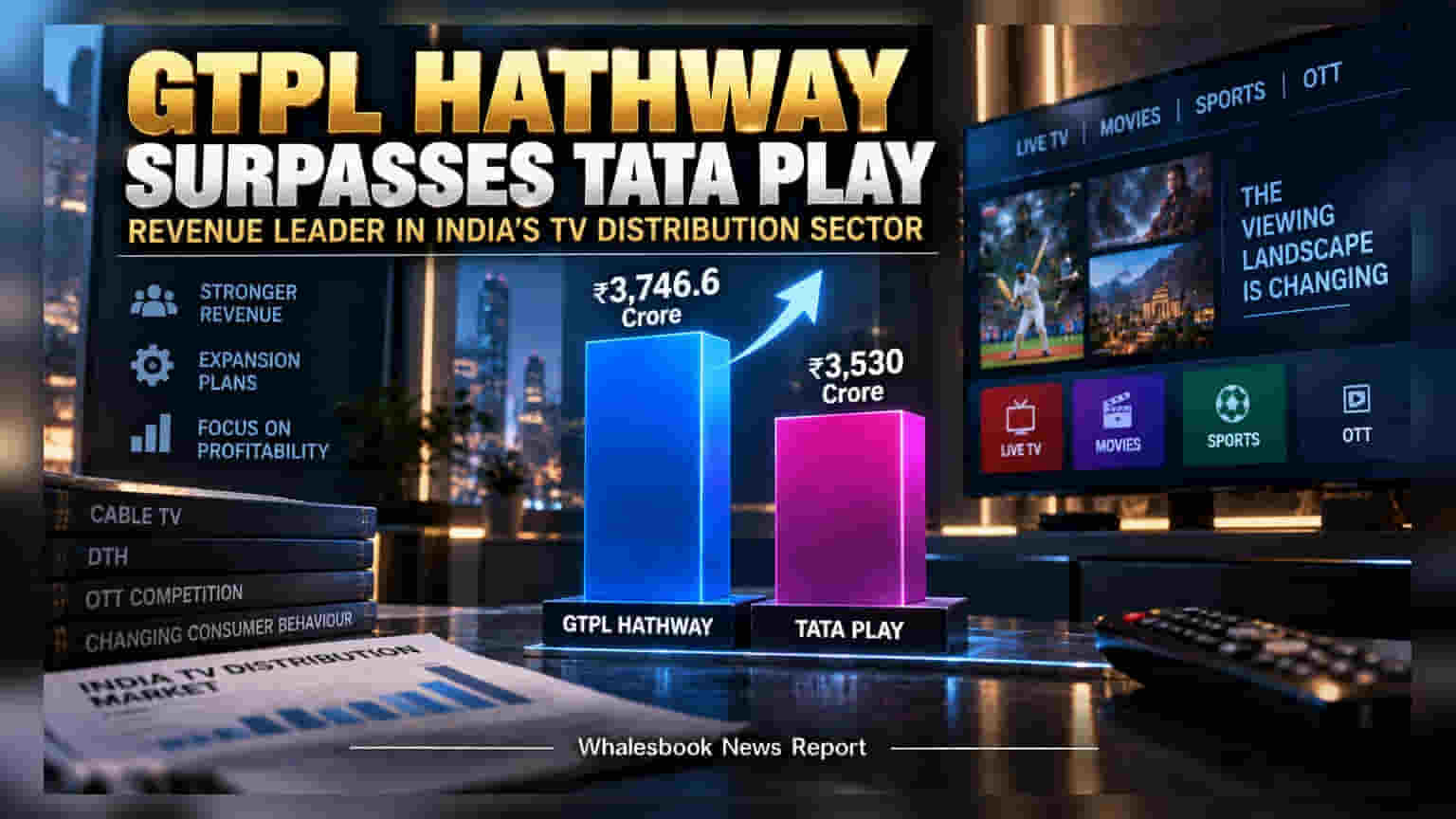
GTPL Hathway has become India's largest TV distributor by revenue for FY26, reporting ₹3,746.6 crore compared to Tata Play’s ₹3,530 crore. While this marks a leadership change, both companies are facing a difficult environment as subscribers move to streaming services. Investors should track whether GTPL’s new ₹1,000 crore expansion plan can improve profit margins in this shrinking market.
GTPL Hathway has officially emerged as the revenue leader in India's television distribution sector for the fiscal year 2026. The company reported total revenue of ₹3,746.6 crore, surpassing Tata Play, which recorded ₹3,530 crore during the same period. This shift is notable because GTPL operates with a smaller subscriber base than Tata Play's extensive Direct-to-Home (DTH) network, highlighting differences in business scale and operational reach across regions.
Sector Challenges and Subscriber Exodus
While the change in revenue leadership is a significant company milestone, it does not necessarily indicate a growth phase for the traditional television industry. Both cable and DTH providers are grappling with a persistent migration of consumers toward internet-based streaming services and Over-the-Top (OTT) platforms. This shift has led to a structural decline in the pay-TV subscriber base, forcing companies to fight for a smaller pool of customers. For investors, this creates an environment where revenue growth may not always translate into higher profits, as companies struggle with customer retention and rising operational costs.
Financial Context and Expansion Strategy
For GTPL Hathway, the path forward involves balancing revenue leadership with the need to protect its bottom line. The company is currently focused on a ₹1,000 crore capital spending program spread over the next three years. This money is intended to improve its network infrastructure and technology. The primary goal of this investment is to restore EBITDA margins to the 23-25% range. Whether the company can successfully execute these plans while navigating a contracting market remains a key area for investors to monitor.
In contrast, Tata Play continues to face financial headwinds, reporting a net loss of ₹551 crore for FY26, which is wider than the ₹529 crore loss reported in the previous year. This performance reflects the broader pressure affecting the DTH sector, where companies find it increasingly difficult to turn a profit amid stiff competition from low-cost streaming alternatives and digital distribution models.
Governance and Operational Monitorables
As GTPL Hathway moves forward, shareholders may watch for updates on the transition in leadership. The company’s CFO, Saurav Banerjee, is set to retire on September 30, 2026. Additionally, investors will be observing how the company manages the integration of regional assets, such as the acquired cable TV operations from the ACT Group, to ensure these additions contribute to revenue without causing cost overruns. While the company's promoter entity has reported no encumbrance on shares for FY26, market participants will likely look for updates on margin trends, customer churn rates, and the impact of the ₹1,000 crore expansion on cash flow in the coming quarterly results.