 Whalesbook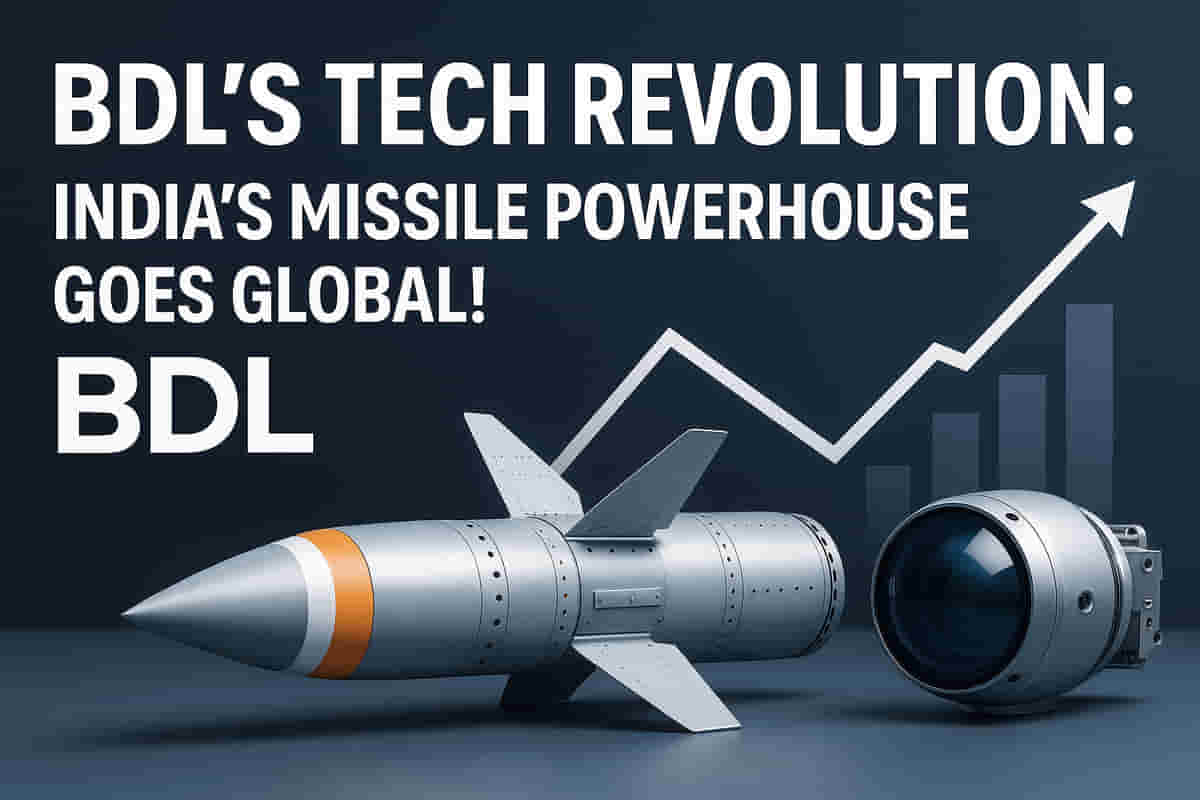
BDL's Strategic Metamorphosis: India's Missile Engineering Powerhouse Emerges
Bharat Dynamics Limited (BDL), a crucial player in India's defence sector, is redefining its role from a conventional missile assembler to a sophisticated hub for deep-tech engineering and scalable production. While fighter jets and warships often capture public attention, BDL is quietly engineering the complex subsystems – the brains and brawn – that transform raw armaments into precision instruments of modern warfare. This strategic evolution positions India as a significant global supplier of advanced defence technology.
The Core Issue: From Assembly to Ownership
For decades, BDL operated as a typical public sector undertaking (PSU), primarily tasked with assembling missiles based on designs from organisations like DRDO. Its revenue streams were steady, tied to established programmes like Akash and Konkurs, with limited focus on exports or modular design. However, the changing global defence landscape and India's drive for self-reliance necessitated a fundamental shift. BDL recognised that true strength lay not just in national assembly lines, but in developing domestic expertise for critical subsystems, including control systems, seeker logic, propulsion, and integration. This strategic pivot was about owning a larger portion of the value chain.
Financial Implications and Market Performance
BDL's reinvention is clearly reflected in its recent financial results. In the second quarter of fiscal year 2026 (Q2 FY26), revenue from operations surged by over 111% year-on-year to ₹1,147 crore. Net profit, excluding exceptional items, rose approximately 76% to ₹216 crore. These figures underscore an accelerated implementation and improved production capacity utilisation. The company's stock performance has been robust, with a compounded annual growth rate of 44% over the past three years and a return on equity of 15%. Notably, BDL maintains a debt-free status with a zero debt-to-equity ratio.
Despite its strong performance, BDL trades at a premium. Its P/E multiple stands around 79x, compared to the sector median of approximately 60x. Similarly, the enterprise value to earnings before interest, tax, depreciation, and amortisation (EVEBITDA) is 49.5x, higher than the sector's median of 32.8x. This valuation suggests strong investor confidence in its future prospects.
Future Outlook and Order Book Strength
BDL's order book is a significant asset, standing at around ₹23,029 crore as of August 31, 2025. The addition of a ₹2,461-crore Indian Army contract in early December further bolsters this backlog. This substantial and growing order book provides long-term performance visibility, a crucial advantage in the often uneven defence manufacturing sector.
The Real Deep-Tech Game: Modular Engineering
The heart of BDL's advanced capability lies in its subtle, deep-tech engineering. The company excels in building the operational logic that directs a missile's mission, including propulsion units optimised for performance, and guidance control segments capable of real-time adjustments. Its adoption of a modular design philosophy, akin to building with Lego blocks, allows subsystems to be shared, recalibrated, updated, or expanded across different missile families and platforms (air, sea, land). This approach reduces engineering risk, speeds up production, and enhances predictability.
The Armenia Effect: Exports Soar
BDL's export performance has seen a dramatic transformation. In FY25, export turnover reached ₹1,270 crore, an astounding 689% increase from ₹161 crore in FY24. This surge was largely driven by a breakthrough order from Armenia for the Akash Weapon System. This achievement signifies India's emergence as a credible global supplier of complex air defence technology, demonstrating that there is a real international demand for cost-effective, indigenous Indian missile hardware. BDL's flexible, subsystem-focused export model offers a significant differentiator.
The Bigger Picture: India's Defence Ambitions
BDL's evolution mirrors India's broader defence ambitions. Key shifts include the indigenisation of critical weapon systems, reducing import dependence and enhancing sovereign capability. The adoption of modular engineering fosters faster upgrades and cross-platform reuse. Export-led credibility is turning defence trade into a political and financial asset. Against a backdrop of expected 16-18% defence sector revenue growth in FY26, BDL is not merely manufacturing products; it is building capability and shaping India's future defence industrial landscape.
Impact
- Impact Rating: 9/10
- Possible effects: This news positively impacts the Indian defence sector by showcasing technological advancement and export potential. It boosts investor confidence in BDL and similar PSUs, potentially leading to increased market valuations. It also strengthens India's 'Make in India' initiative and 'Atmanirbhar Bharat' (self-reliant India) campaign in defence manufacturing, enhancing its global standing as a defence exporter and reducing reliance on foreign suppliers.
Difficult Terms Explained
- PSU (Public Sector Undertaking): A company owned and controlled by the government.
- DRDO (Defence Research and Development Organisation): India's primary government agency for defence research and development.
- Subsystems: Smaller, distinct components or units that make up a larger system, such as a missile.
- Modularity: A design principle where a system is composed of independent, interchangeable parts or modules.
- YoY (Year-on-Year): A comparison of a period's performance to the same period in the previous year.
- P/E Multiple (Price-to-Earnings Ratio): A valuation ratio that compares a company's stock price to its earnings per share, indicating how much investors are willing to pay per dollar of earnings.
- EVEBITDA (Enterprise Value to Earnings Before Interest, Taxes, Depreciation, and Amortisation): A valuation metric that compares a company's total value to its operating profit before accounting for interest, taxes, depreciation, and amortisation.
- CAGR (Compound Annual Growth Rate): The average annual growth rate of an investment over a specified period longer than one year.
- ROE (Return on Equity): A measure of financial performance calculated by dividing net income by shareholders' equity.
- SAMs (Surface-to-Air Missiles): Missiles designed to be launched from the ground or sea to intercept airborne targets.