 Whalesbook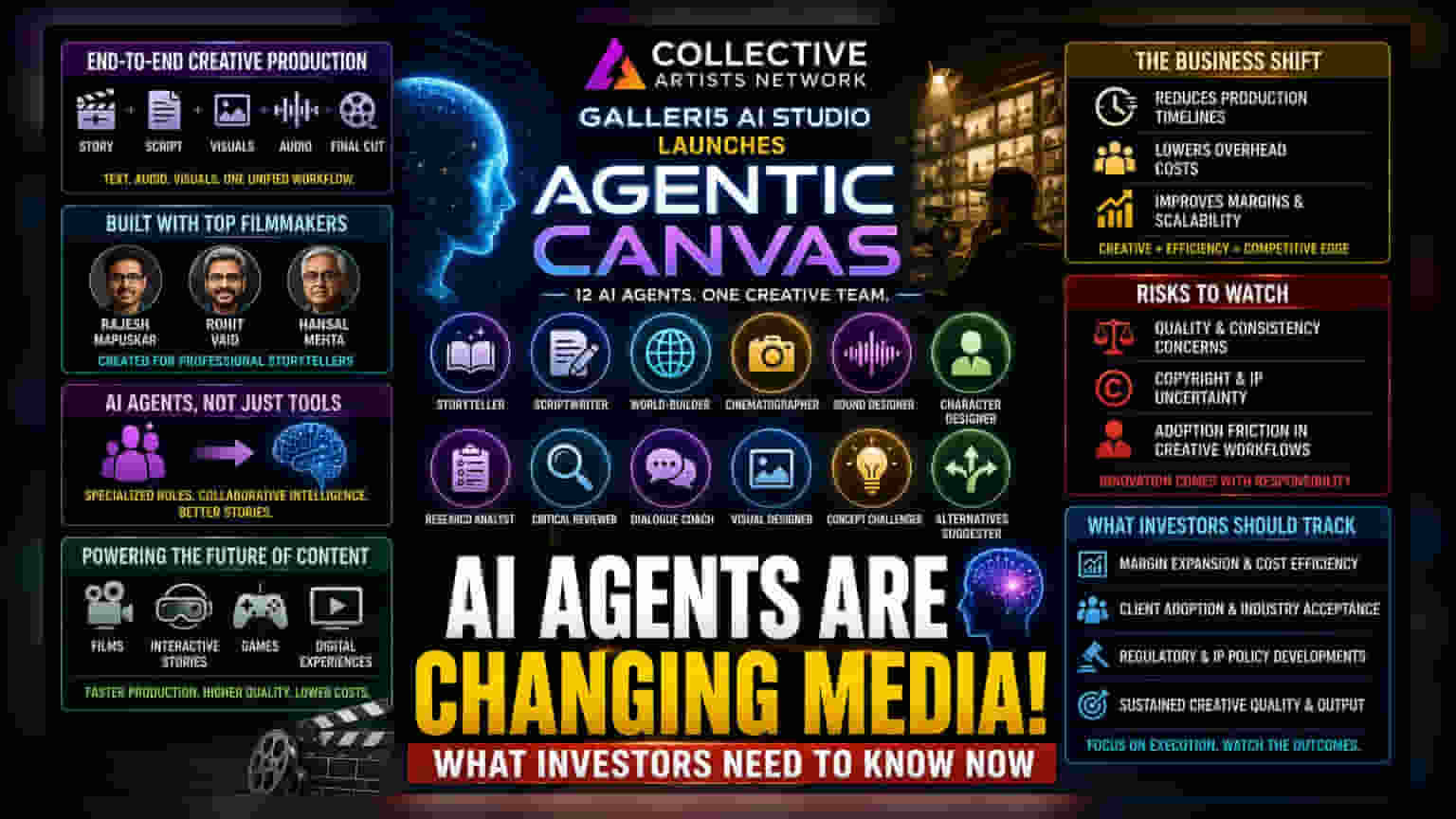
Collective Artists Network has introduced 'Agentic Canvas', an AI-driven platform within its Galleri5 studio. Featuring 12 specialized AI agents, the tool handles tasks ranging from scriptwriting to production planning. This development highlights the media and entertainment sector's move toward using AI to reduce production time and costs. Investors are increasingly watching how such technology-led shifts impact the traditional agency business model and competitive landscape in Indian media.
What Happened
Collective Artists Network has launched a new platform called Agentic Canvas through its Galleri5 AI Studio. This system acts as an integrated creative team, using 12 distinct AI agents designed to handle specific parts of the content production process. Unlike standard AI tools that simply generate text or images, this platform focuses on end-to-end production workflows, including storytelling, scriptwriting, world-building, and cinematography planning. The company has developed this tool in collaboration with notable filmmakers, including Rajesh Mapuskar, Rohit Vaid, and Hansal Mehta, to ensure the technology meets professional creative standards.
Changing How Content Is Made
The primary shift with Agentic Canvas is its move toward AI agents that perform specific roles rather than just creating content on command. For instance, the system includes agents dedicated to critical review, challenging concepts, and suggesting alternatives, which mimics the structure of a human creative team. The platform allows for the development of complex media—such as cinematic universes and interactive storytelling—by combining text, audio, and visual outputs into a unified workflow. The company stated that the goal is to allow creators to focus on decision-making while the AI handles the execution and technical planning.
The Business Shift in Media
For the media and entertainment industry, the integration of such AI platforms represents a shift in how value is created. Traditional production models often rely on large teams and long lead times. By using 'agentic' workflows—where AI handles routine or structured creative tasks—agencies aim to significantly reduce production timelines and overhead costs. This allows companies to take on a larger volume of work or produce higher-quality content with fewer manual resources. As media agencies in India continue to adopt such technologies, investors are watching whether this leads to better profit margins for firms that can successfully scale these automated creative solutions.
Potential Risks and Challenges
While AI integration offers efficiency, it carries risks that investors often monitor in the technology and media sectors. One primary concern is the quality and consistency of AI-generated work. Ensuring that AI outputs meet high creative standards without requiring excessive human rework is a significant hurdle. Furthermore, the media industry faces ongoing uncertainty regarding copyright and intellectual property rights for AI-created content. If a platform relies heavily on models trained on third-party data, it may encounter legal or regulatory challenges. Additionally, there is the risk of adoption; creative professionals may face friction when moving from traditional methods to AI-assisted workflows, which could impact the expected speed and cost benefits.
What Investors Should Track
As the media and advertising sector increasingly adopts AI, the key monitorable is the tangible impact on business results. Investors should track whether such platforms lead to sustainable margin expansion by reducing dependency on large production teams. It will also be important to observe client adoption rates—do major brands and filmmakers view these AI-generated workflows as a replacement or just a supporting tool? Finally, any shifts in regulatory policies concerning AI usage in entertainment, as well as the company's ability to maintain high creative quality, will be crucial to determining the long-term success of these AI-native production strategies.