

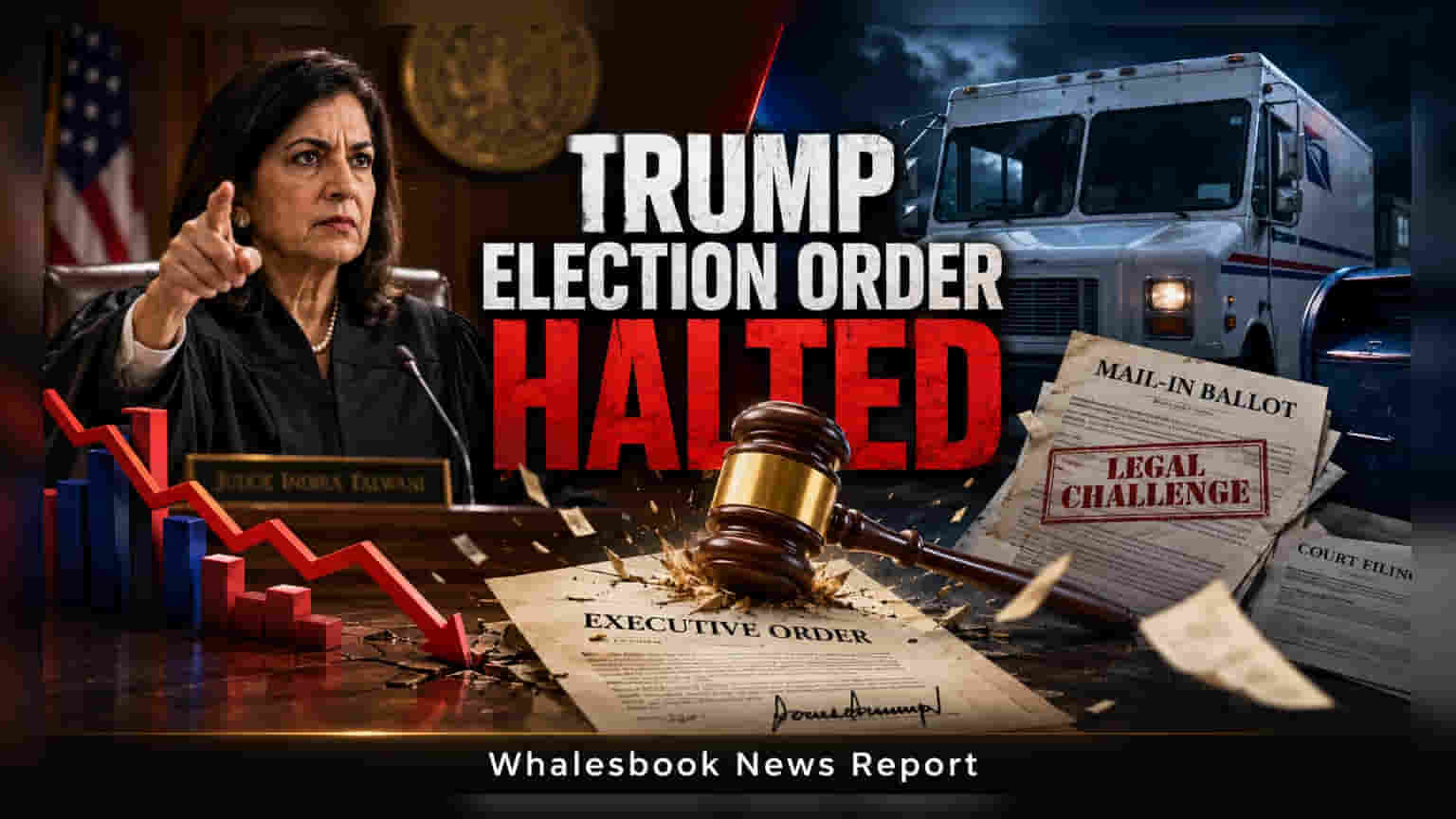
A U.S. federal judge has issued a nationwide injunction halting key parts of President Donald Trump’s executive order concerning federal voter lists and U.S. Postal Service (USPS) election protocols. The court ruled that the executive branch lacks the constitutional authority to regulate election procedures, which belong to states and Congress. This decision creates further administrative uncertainty ahead of the November 2026 midterm elections.
U.S. District Judge Indira Talwani has issued a nationwide preliminary injunction blocking key provisions of President Donald Trump's March 2026 executive order. The order sought to establish a federal voter list and dictate the U.S. Postal Service’s role in delivering mail-in ballots. The court’s decision explicitly prevents the administration from implementing these directives for the upcoming election cycle.
Court Rules Executive Branch Lacks Election Authority
In the ruling, Judge Talwani determined that the executive branch does not have the constitutional authority to regulate election rules. The court sided with various plaintiffs, including the League of Women Voters, who argued that such powers are reserved for states and the U.S. Congress. The judge noted that the administration failed to adequately defend the executive order's constitutionality during proceedings. This ruling effectively expands a prior June 2026 injunction that had already limited the order’s implementation in 23 states and the District of Columbia.
Operational Uncertainty for U.S. Postal Service
The executive order had aimed to restrict mail-in ballot deliveries exclusively to individuals appearing on a new federal voter list. This requirement had raised significant concerns among election officials and postal unions regarding potential operational chaos and the increased administrative burden on the U.S. Postal Service. By blocking these provisions, the court has halted potential changes to the existing mail-in voting procedures. However, the Trump administration has already filed an emergency request with the U.S. Supreme Court to lift the previous lower court injunctions, leaving the final legal standing of the order in flux.
For those monitoring the U.S. political and market environment, this legal battle represents ongoing uncertainty regarding the mechanics of the November 2026 midterm elections. The administrative challenges faced by the postal service and the potential for last-minute changes to voting protocols are important factors for the broader U.S. institutional landscape. The next critical development for investors and market observers will be any emergency ruling or further guidance from the U.S. Supreme Court, which could either uphold the current injunction or allow the executive order to proceed.