

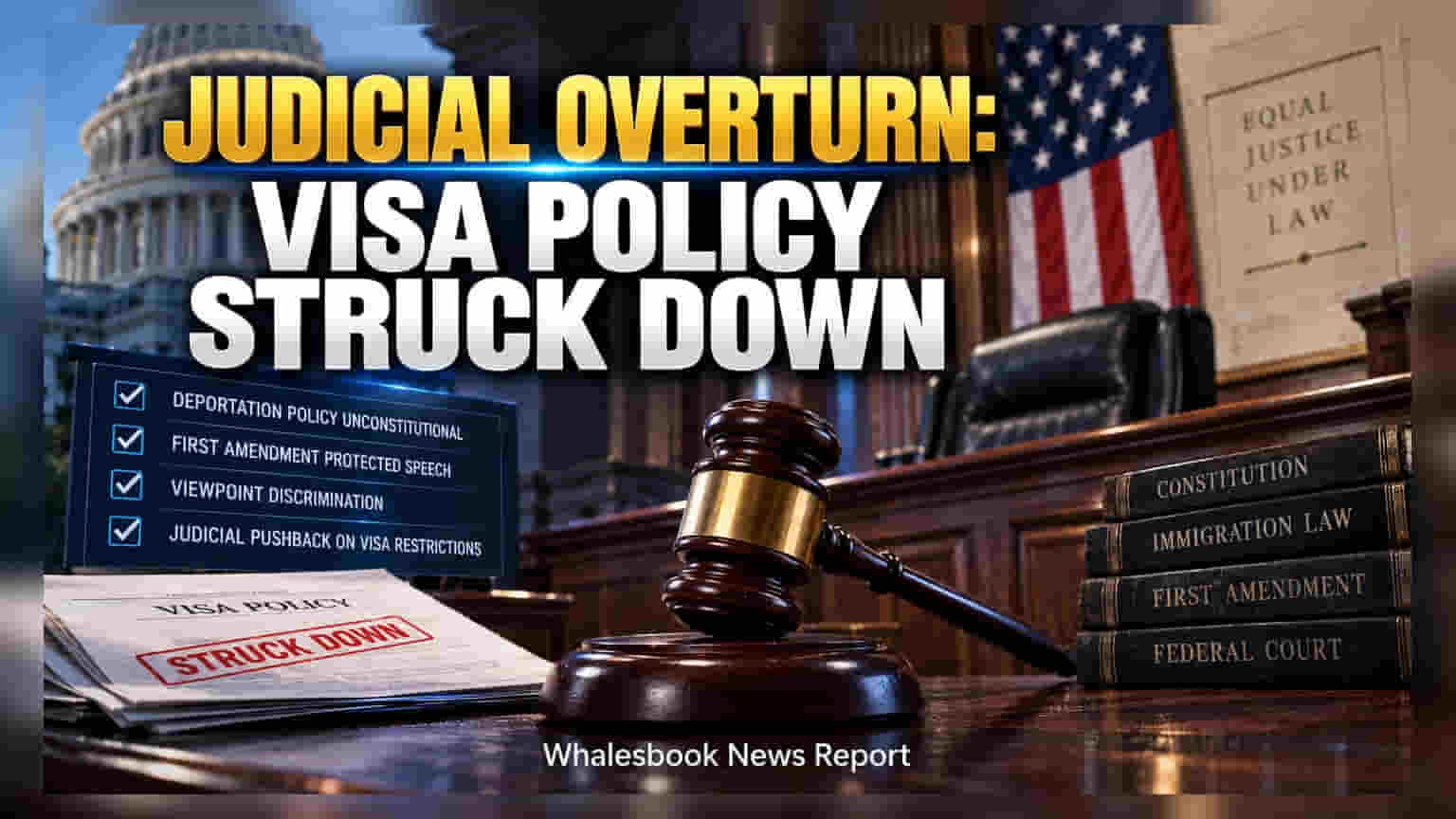
A U.S. federal judge has ruled that government policies used to revoke student visas over pro-Palestinian advocacy are unconstitutional. The decision, arising from a lawsuit by The Stanford Daily, challenges the use of immigration law to penalize political speech. While this provides a legal shield for students, the regulatory landscape remains subject to potential appeals and further legal scrutiny.
On Friday, August 28, 2026, U.S. District Judge Noel Wise issued a ruling declaring that government policies targeting non-citizens for deportation based on pro-Palestinian advocacy are unconstitutional. The court found that the government's deployment of provisions within the Immigration and Nationality Act to penalize individuals for political expression constitutes viewpoint discrimination and violates First Amendment protections.
Legal Challenges to Executive Discretion
The ruling marks a significant legal checkpoint regarding the executive branch's authority over immigration. The case originated from a lawsuit filed in August 2025 by The Stanford Daily, which contended that the administration's actions were weaponizing immigration law to suppress journalistic coverage and campus activism. Judge Wise concluded that when the government uses foreign policy interests as a justification to target specific viewpoints, it bypasses the constitutional protections afforded to free speech.
This decision is part of a broader series of legal challenges against these policies. Other federal judges, including Judge William Young in Massachusetts, have issued similar rulings since late 2025, consistently characterizing the administration’s focus on ideological deportation as an infringement on constitutional rights. These rulings collectively signal a strong judicial pushback against the use of visa revocation as a tool for managing campus discourse.
Implications for the Education Sector
For investors and market observers, this event is primarily a regulatory and policy update rather than a direct stock market event. The ruling does not impact any specific exchange-listed security directly. However, the regulatory environment surrounding international students is a crucial factor for the global higher education sector, which remains a significant market for institutions and service providers that support student mobility.
Historically, shifts in U.S. visa policies have created volatility for educational institutions and the broader ed-tech and international service ecosystems that depend on a stable flow of international students. While this ruling provides a degree of legal certainty for students currently navigating deportation proceedings, the legal environment remains fluid. Given that such high-level constitutional rulings are frequently subject to appeals, the risk of a reversal or a prolonged legal battle between the executive branch and the judiciary remains a persistent factor for stakeholders in the U.S. education sector.
Investors and observers should track future legal developments, specifically whether the Department of Justice moves to appeal the ruling. The finality of this legal position will be determined by whether it survives further judicial review, which will continue to be a primary monitorable for organizations that rely on consistent immigration and visa policy frameworks.