 Whalesbook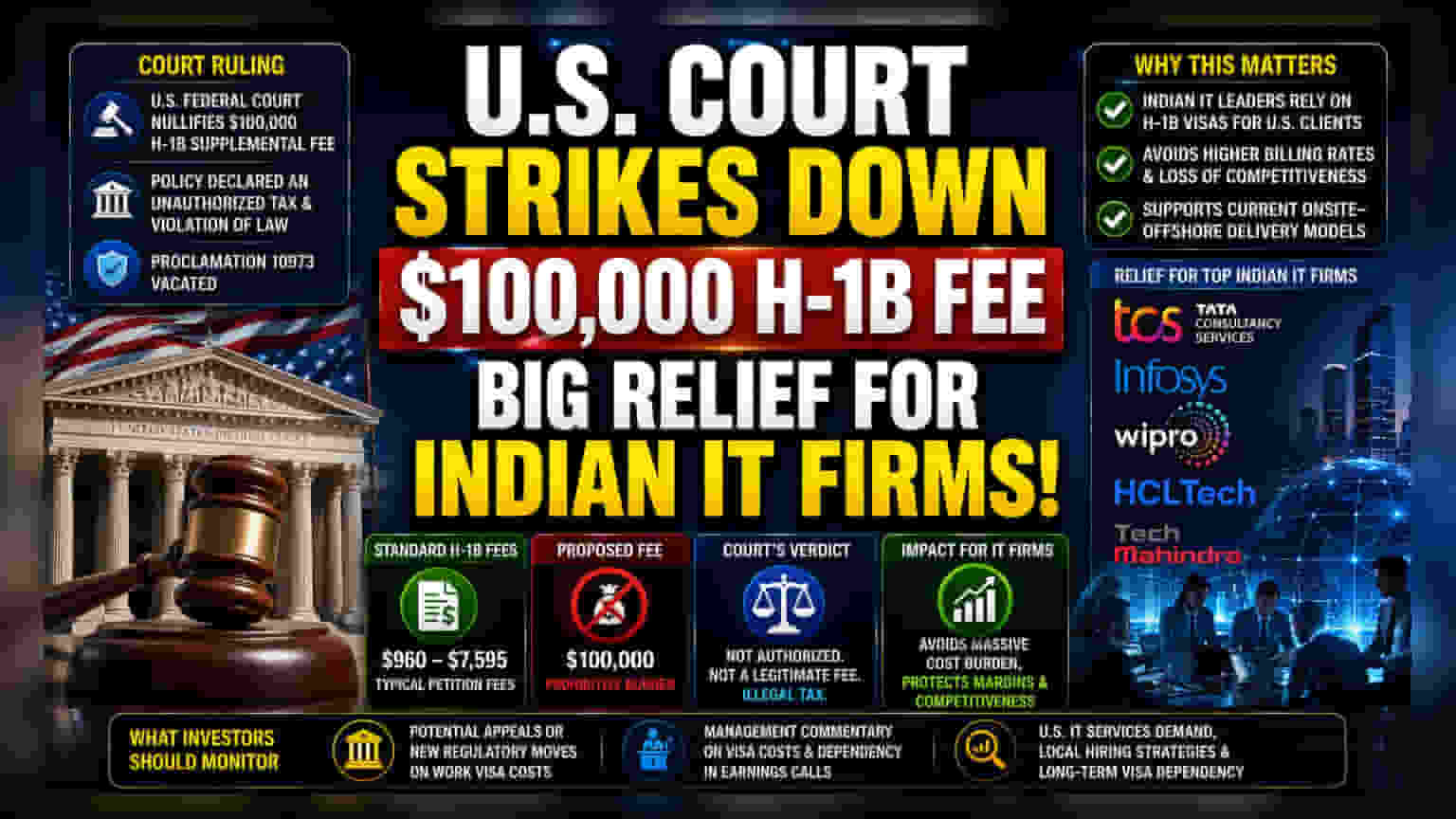


What Happened
A U.S. federal court has nullified a policy introduced by the Trump administration that required employers to pay a $100,000 supplemental fee for new H-1B visa petitions. The ruling, issued by Judge Leo T. Sorokin of the U.S. District Court for the District of Massachusetts, declared the fee an unauthorized tax and a violation of the Administrative Procedure Act.
The policy, known as Proclamation 10973, had aimed to restrict the entry of non-citizens. However, the court found that the government lacked the authority to impose such a heavy financial burden, noting that Congress had not explicitly granted the President the power to levy taxes through immigration regulations. The court vacated the policy, effectively removing this additional cost for companies.
Why This Matters for Investors
For Indian investors, the primary concern revolves around the IT services sector. Major Indian technology firms—including giants like Tata Consultancy Services, Infosys, Wipro, HCL Technologies, and Tech Mahindra—rely significantly on the H-1B visa program to place skilled engineers and professionals at client sites in the United States.
The proposed $100,000 fee was not just a minor increase; it represented a massive hike from the standard petition fees, which typically range between $960 and $7,595. Had this fee remained in place, it would have created a severe financial hurdle for Indian IT companies. It would have either forced them to significantly increase billing rates to cover the costs—potentially making them less competitive—or forced a drastic shift in their hiring and delivery models, both of which would have pressured profit margins.
The Financial Impact Explained
The fundamental difference between the standard visa fees and the proposed $100,000 levy was the difference between a administrative processing cost and a prohibitive business barrier. By ruling that the payment was an illegal tax rather than a legitimate restriction, the court protected companies from a cost structure that did not reflect the actual service of processing a visa application. For shareholders, this outcome mitigates the risk of a sudden, forced increase in operating expenses related to overseas personnel.
What This Means for the IT Sector
The Indian IT industry has been navigating a complex environment characterized by varying demand in export markets, currency fluctuations, and talent competition. The ability to deploy skilled professionals to client locations is a core part of the service model. A fee of this magnitude would have likely caused companies to rethink their onsite-offshore delivery ratios, potentially leading to operational inefficiencies. With this barrier removed, companies can maintain their current operational strategies without the immediate threat of such a massive cost escalation.
What Investors Should Monitor
While this ruling provides immediate relief, the regulatory landscape regarding immigration and visa policies remains sensitive to political shifts. Investors should continue to monitor three key areas. First, watch for any potential government appeal or new regulatory attempts to introduce different, albeit smaller, cost increases for work visas. Second, observe management commentary in upcoming quarterly earnings calls regarding visa-related costs and dependency on the H-1B program. Finally, keep an eye on broader sector trends, such as shifting demand for IT services in the U.S. and how companies are evolving their local hiring strategies in foreign markets to reduce dependence on visas over the long term.