

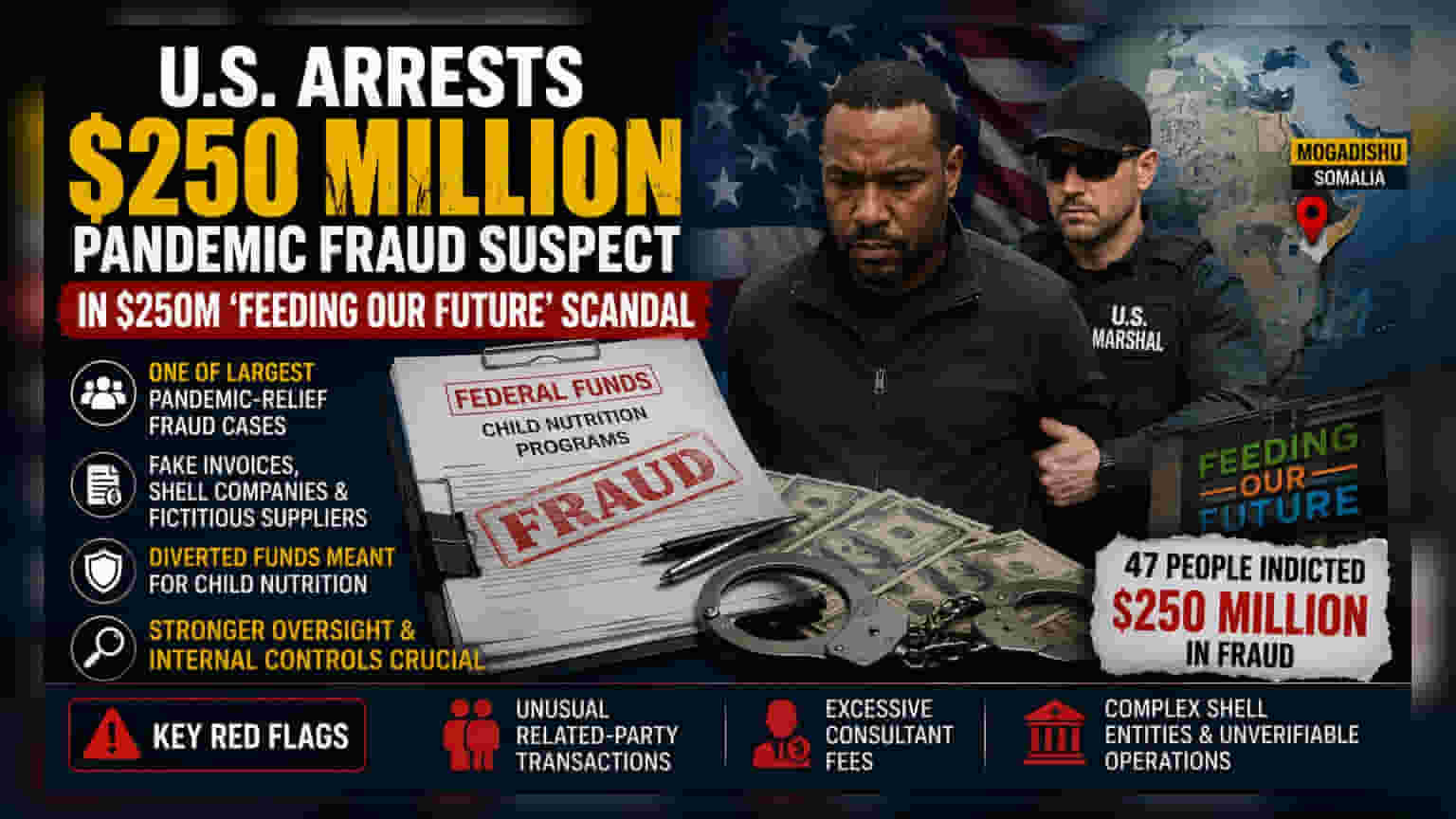
US authorities have arrested Abdikerm Abdelahi Eidleh in Mogadishu, Somalia, for his alleged role in a $250 million COVID-19 pandemic relief fraud. Eidleh was allegedly the second-in-command of the 'Feeding Our Future' nonprofit scheme, which misappropriated federal funds meant for children. This arrest marks a significant expansion in the international investigation into the massive financial crime.
What Happened
United States authorities have apprehended Abdikerm Abdelahi Eidleh, a 42-year-old suspect accused of playing a leading role in a large-scale fraud scheme. The arrest took place in Mogadishu, Somalia, following an international effort to track down key figures involved in the 'Feeding Our Future' scandal. Prosecutors claim Eidleh was the second-in-command to the primary architect of the scheme, Aimee Bock, whose nonprofit organization was accused of siphoning millions of dollars in federal funds intended for child nutrition programs during the COVID-19 pandemic.
The Scale Of The Fraud
The case, which surfaced in 2022, involved the indictment of 47 individuals for their alleged participation in a scheme totaling approximately $250 million. It stands as one of the largest pandemic-relief fraud cases ever prosecuted in the United States. Federal investigators allege that the organization diverted public money by falsifying records and claiming to serve thousands of meals to underprivileged children that were never actually provided.
Why This Matters For Governance
While this case involves a nonprofit organization, it highlights structural risks that are relevant to any financial evaluation. The methods described by prosecutors—such as the use of shell companies, fictitious supplier firms, and the routing of funds through disguised consulting fees—are classic red flags in financial mismanagement.
For investors, understanding how these mechanisms work is essential. Fraud often relies on the manipulation of invoices and the creation of fake entities to hide the true destination of cash. When auditing financial statements, oversight bodies and investors look for complexity in transactions that serve no clear business purpose, as these are often used to siphon value from an entity.
Understanding Fraud Risk Factors
This case underscores the importance of internal controls and regulatory oversight. When evaluating a business, investors typically assess whether the company has robust audit processes and transparent procurement policies.
Key areas that often attract scrutiny include:
Unusual Related-Party Transactions: When companies route payments through entities controlled by insiders or third parties that lack clear operational substance.
Excessive Consultant Fees: A sudden rise in consulting or service charges that do not correlate with verifiable business output can be a sign of money being diverted.
Operational Complexity: Shell entities used to bill for services that cannot be physically verified, such as food delivery or logistics in remote areas, create a layer of distance that makes fraud easier to conceal.
What Investors Should Track
In the broader context of financial integrity, investors generally monitor how companies handle their cash and public disclosures. The 'Feeding Our Future' case serves as a reminder that even large programs with significant federal backing can be exploited if the oversight and internal checks are weak. For those monitoring listed companies, watching for governance failures, auditor concerns, and changes in accounting practices remains a standard way to assess long-term stability.