

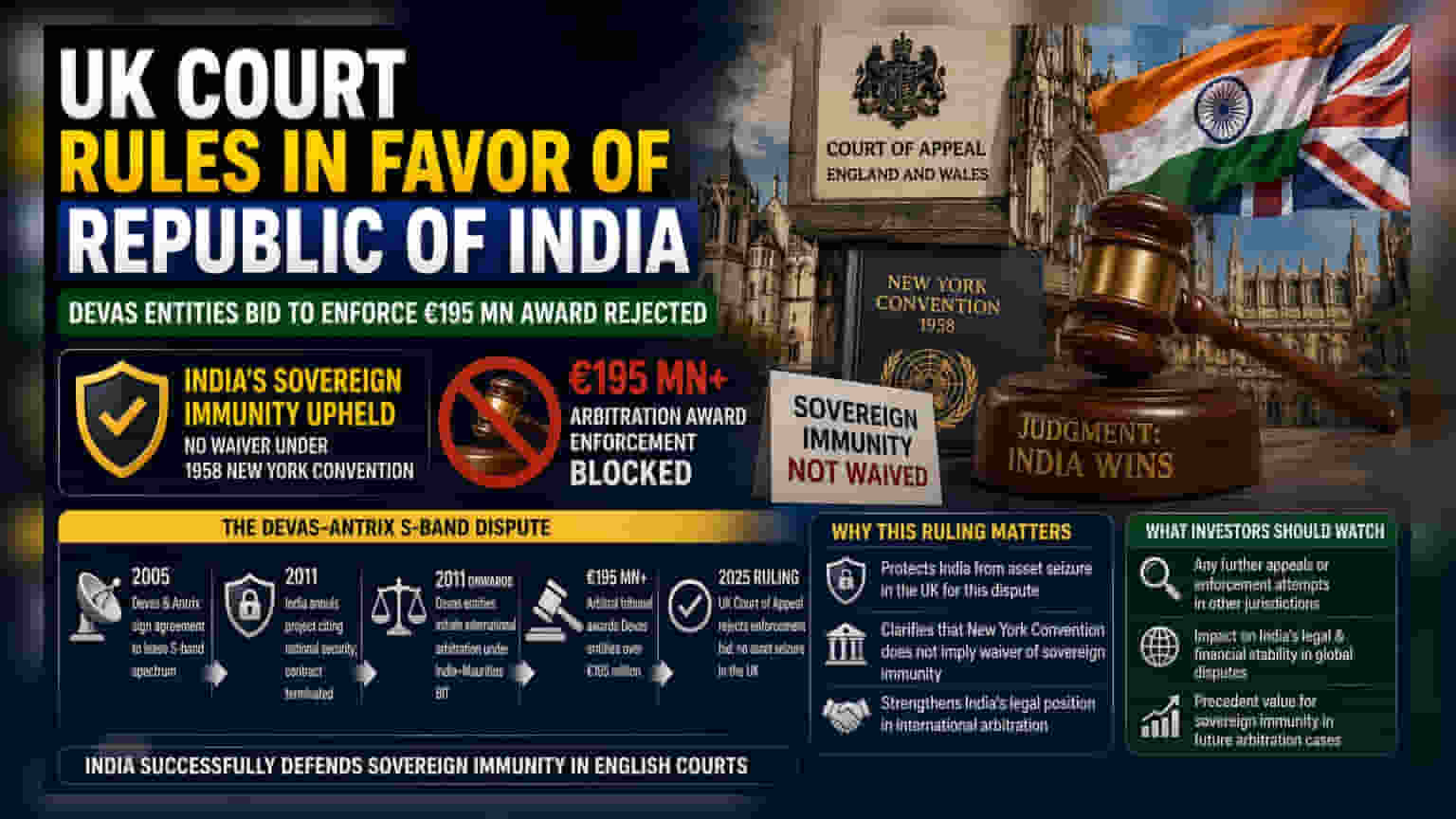
The UK Court of Appeal has dismissed an attempt by Devas investors to enforce a €195 million arbitration award against India. The ruling reaffirms India’s sovereign immunity, preventing the seizure of Indian assets in the UK related to this claim. This decision provides significant legal clarity on how foreign arbitration awards are handled under the New York Convention.
What Happened
The Court of Appeal in England and Wales has ruled in favor of the Republic of India, rejecting a bid by Devas-related entities to enforce an arbitration award exceeding €195 million. A three-judge bench concluded that India’s ratification of the 1958 New York Convention does not mean the country has waived its sovereign immunity in English courts. This ruling effectively blocks attempts to seize Indian assets in the UK to recover the disputed amount.
The Legal Dispute Explained
The core of the legal battle was whether India, by signing the New York Convention, implicitly agreed to let English courts enforce arbitration awards against it. Investors argued that this convention acts as a waiver of sovereign immunity. However, the Court of Appeal disagreed. Lord Justice Phillips clarified that the convention requires enforcement to follow the local rules of procedure in the country where the enforcement is sought. The court determined that sovereign immunity is a procedural rule and that states do not waive it without a specific, separate agreement to arbitrate.
The judges distinguished this from the ICSID Convention, where ratification has previously been interpreted as a waiver of immunity. They emphasized that the New York Convention is designed to support arbitration, but only after a court’s jurisdiction is properly established.
Historical Context: The S-Band Case
This legal dispute traces back to a 2005 contract between Devas Multimedia and Antrix Corporation, the commercial arm of the Indian Space Research Organisation (ISRO). The agreement involved the lease of S-band spectrum for satellite services. In 2011, the Indian government annulled the project, citing national security concerns. This led to the contract’s termination and triggered a long series of international arbitration proceedings initiated by Devas-related entities under the India-Mauritius bilateral investment treaty.
Why This Ruling Matters
For investors and the broader market, this decision removes a significant layer of legal and financial risk regarding potential asset seizure in the UK related to the Devas claim. Sovereign immunity is a vital protection for nations, and this ruling provides a strong precedent against the automatic enforcement of international arbitration awards when sovereign status is involved. It reduces the likelihood of the Indian government facing unpredictable asset seizures in the UK for this specific dispute.
What Investors Should Track
While this specific attempt to enforce the award in the UK has been dismissed, legal battles involving the Devas-Antrix dispute have spanned multiple jurisdictions over several years. Investors may continue to monitor any further appeals or attempts by the involved entities to enforce claims in other countries. The primary focus for the market is the stability this brings to India’s legal standing in international disputes, as it prevents the immediate threat of asset attachment in the UK for this case.