

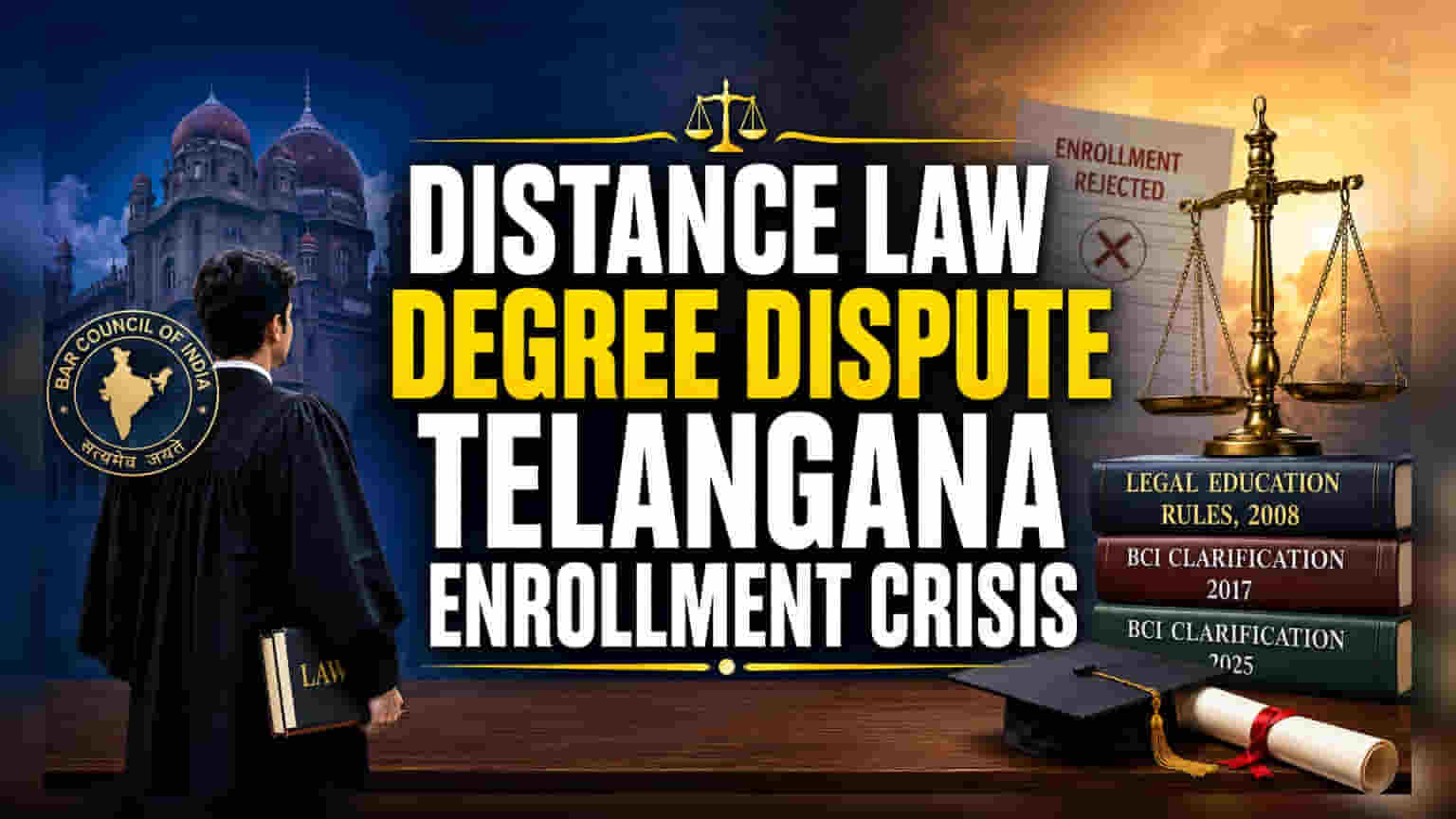
The Telangana Bar Council is blocking enrollment for nearly 80 law graduates who completed their studies through distance or open learning. This decision contradicts the Bar Council of India’s rules, forcing affected graduates to seek court intervention. The dispute highlights growing uncertainty regarding the validity of non-traditional educational qualifications for legal practice.
What Happened
The Telangana Bar Council (BCT) has been withholding the enrollment of approximately 80 law graduates who obtained their law degrees or qualifying education through distance or open university programs. While the Bar Council of India (BCI) has consistently maintained that qualifications from recognized open universities and distance education boards are valid, the BCT continues to deny enrollment based on its interpretation of a 2021 Telangana High Court ruling. This has resulted in a recurring pattern where students are forced to approach the judiciary to secure their right to practice law.
The Clash Between Rules and Orders
The conflict arises from differing interpretations of eligibility requirements. Under the BCI’s Rules of Legal Education, 2008, and subsequent clarifications in 2017 and 2025, degrees from recognized institutions—including open universities like IGNOU—are explicitly considered valid for both enrollment and law school admission. However, the BCT points to the December 2021 judgment in M Naveen Kumar v. State of Telangana as the basis for refusing applications. This creates a regulatory gap where central guidelines are being applied differently at the state level, causing operational friction for graduates.
Impact on Students and Careers
For many students, this situation creates significant professional uncertainty. Because the BCT's stance is often communicated informally or only at the time of enrollment, many graduates spend years pursuing a law degree, only to find their eligibility questioned afterward. This lack of transparency leads to frustration and financial loss, as students are left with few options other than seeking judicial intervention. Some graduates have successfully secured enrollment through individual court petitions, such as the case of Shashanka Reddy in December 2025, but this path remains costly and time-consuming for the majority.
The Legal Debate Over Distance Education
The central issue is whether the M Naveen Kumar judgment, which primarily targeted 'single-sitting' degrees that lacked formal academic structure, should apply to recognized distance education programs like those from the National Institute of Open Schooling (NIOS). Other High Courts, including those in Madras and Karnataka, have previously ruled that NIOS-qualified students are eligible for integrated law courses. The BCI is currently exploring ways to address these discrepancies, with specific cases, such as that of M Navneeth Chowdary, currently under review by a Division Bench of the Telangana High Court.
What Professionals Should Track Next
The primary monitorable is the ongoing litigation in the Telangana High Court. Any ruling by the Division Bench will likely set a clearer precedent, potentially forcing the BCT to align its enrollment policy with the BCI’s national standards. Additionally, students and legal professionals should watch for any formal policy revisions or circulars from the BCT that may clarify how it intends to treat distance education qualifications in future application cycles.