

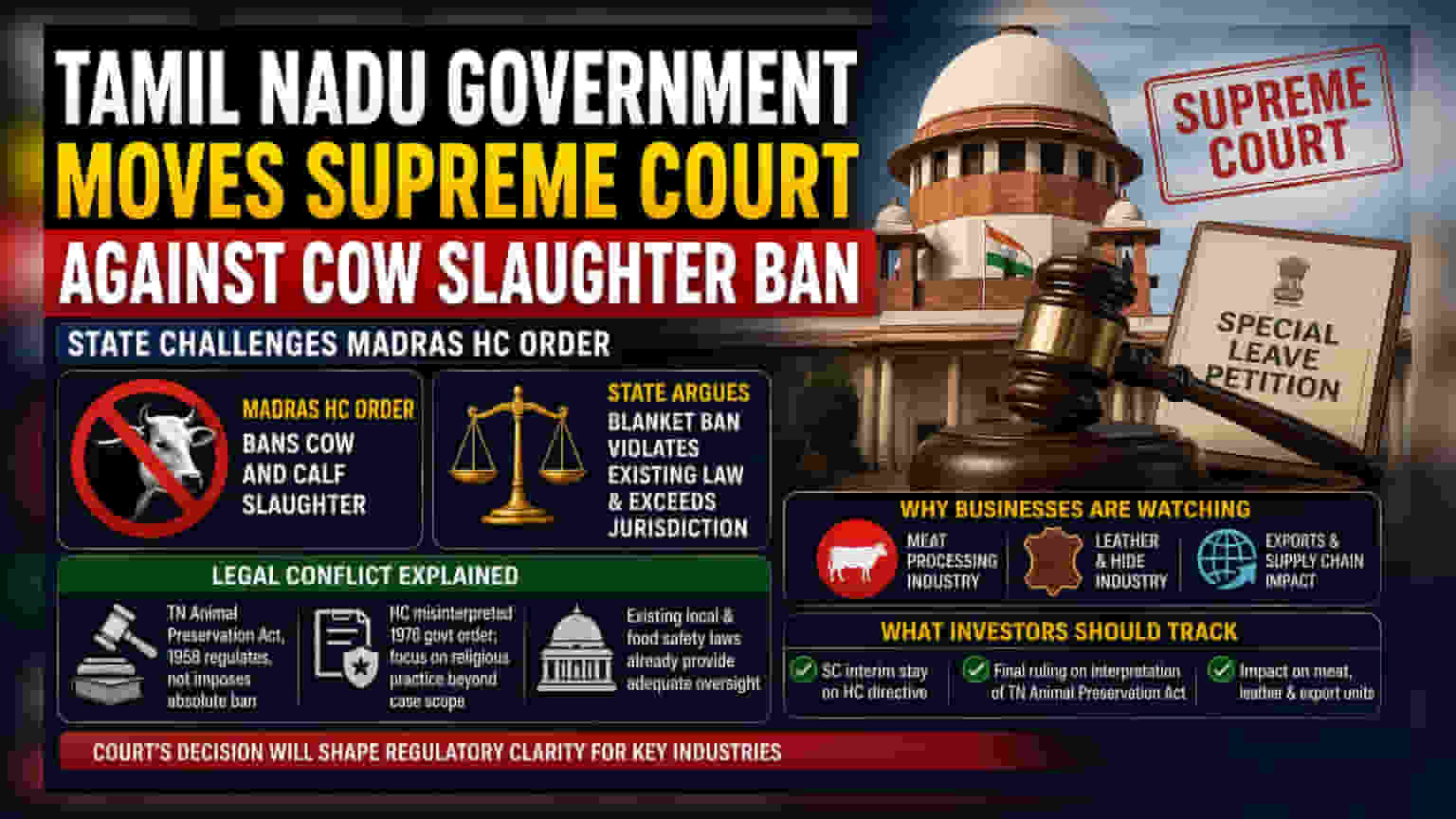
The Tamil Nadu government has appealed to the Supreme Court against a Madras High Court order that restricted cow and calf slaughter. This legal challenge highlights regulatory uncertainty for sectors reliant on animal by-products, such as leather and meat processing. Investors may watch the case for potential impacts on supply chain operations and business compliance within the state.
What Happened
The Tamil Nadu government has filed a special leave petition in the Supreme Court, challenging a May 27, 2026, Madras High Court order that effectively banned cow and calf slaughter in the state. The state government argues that the High Court’s directive creates a blanket prohibition that contradicts the existing legal framework. The original petition before the High Court was aimed at preventing cow slaughter in public spaces during the festival of Bakrid in Coimbatore. However, the state contends that the resulting court order imposed broader restrictions that were not part of the initial plea, effectively exceeding the court's jurisdiction.
Why The Business Sector Is Watching
The meat processing, leather, and hide industries are sensitive to changes in slaughter regulations. Businesses operating in these sectors rely on consistent supply chains and clear regulatory norms to manage production. A shift toward stricter or ambiguous bans can create uncertainty for companies involved in the collection, processing, and export of animal by-products. When legal frameworks are subject to conflicting interpretations between state governments and the judiciary, it can impact the operational planning and compliance costs for units that depend on regulated slaughterhouses for raw materials.
The Legal Conflict Explained
The Tamil Nadu government’s petition rests on the argument that the current statutory framework, including the Tamil Nadu Animal Preservation Act of 1958, is designed to regulate animal slaughter rather than enforce an absolute ban. The state argues that existing urban local body regulations and food safety laws provide adequate oversight for the sector. The government maintains that the High Court incorrectly interpreted a 1976 government order—which was aimed at preserving milk production and supporting the rural economy—as a complete legal prohibition on slaughter. Furthermore, the state has objected to the High Court’s focus on whether cow sacrifice is an essential religious practice, arguing this issue was outside the scope of the case.
What Investors Should Track
Investors may monitor the Supreme Court proceedings for clarity on how slaughter regulations will be applied in the state. The key monitorable is whether the Supreme Court grants an interim stay on the High Court's directive or provides a definitive ruling that settles the interpretation of the Tamil Nadu Animal Preservation Act. A resolution is important for businesses to ensure their operations remain within the scope of legal compliance and to mitigate potential supply chain disruptions. The impact on leather and meat export units will depend on how the state enforces slaughter norms moving forward, making the court's final stance on the regulatory framework a critical update.