

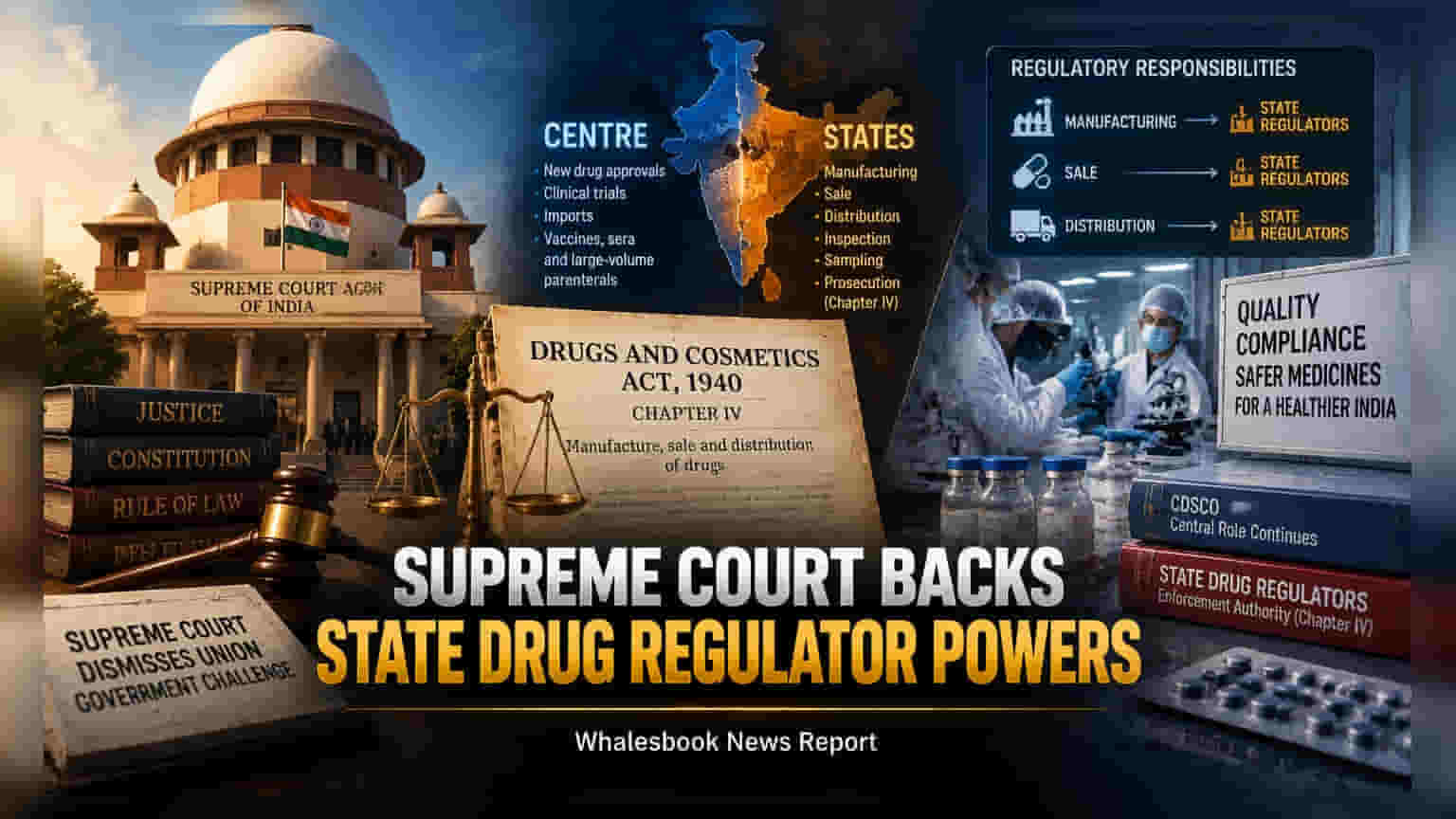
The Supreme Court dismissed the Centre’s challenge to a Himachal Pradesh High Court ruling, confirming that independent drug enforcement powers under Chapter IV of the Drugs and Cosmetics Act belong to state regulators. While central authorities retain oversight for drug imports and clinical trials, the decision limits the independent powers of CDSCO inspectors in state-level enforcement.
The Supreme Court has dismissed the Union government's challenge to a Himachal Pradesh High Court order, a decision that clarifies the jurisdictional boundaries between central and state drug regulators. The legal dispute centered on whether inspectors from the Central Drugs Standard Control Organisation (CDSCO) possess the independent authority to inspect, collect samples, and prosecute pharmaceutical manufacturers under Chapter IV of the Drugs and Cosmetics Act, 1940.
With this dismissal, the High Court’s ruling stands, establishing that enforcement activities related to the manufacture, sale, and distribution of drugs fall under the specific jurisdiction of state-appointed drug regulators. This interpretation limits the ability of central inspectors to independently exercise these powers in state-governed areas, enforcing a clearer divide in the regulatory duties of central and state authorities.
Scope of Regulatory Authority
The judgment does not strip the CDSCO of its overall regulatory mandate. Central authorities continue to hold jurisdiction over critical pharmaceutical functions, including the approval of new drugs, management of clinical trials, oversight of drug imports, and the regulation of vaccines, sera, and large-volume parenterals. The ruling is specific to enforcement actions under Chapter IV, meaning that while central inspectors are limited in how they independently sample or prosecute standard manufacturing compliance, their broader supervisory role over imports and high-level approvals remains unchanged.
Context of the Dispute
This legal challenge originated from a case involving Salus Pharmaceuticals, where a CDSCO inspector had collected drug samples from a hospital in Jalandhar. The manufacturer contested the inspector’s authority to initiate prosecution, arguing that such enforcement functions were reserved for state-level officials. The resulting High Court decision, now effectively upheld by the Supreme Court, has provided a judicial interpretation that reinforces state authority in routine manufacturing and distribution enforcement.
Impact on Pharmaceutical Compliance
For the pharmaceutical industry, the primary implication is procedural. Manufacturers operate in a regulatory landscape where they are subject to both central and state oversight. The Supreme Court's stance forces a sharper distinction in how inspections and legal proceedings are initiated. Companies may need to ensure that their compliance teams clearly understand which regulatory body—central or state—has the statutory authority to act on specific compliance matters.
This ruling may lead to changes in how enforcement actions are structured across the country, as state and central regulators align their procedures with the upheld judicial interpretation. For the industry, the main monitorable will be how administrative protocols evolve to accommodate this jurisdictional division, potentially reducing procedural friction in future regulatory actions.