

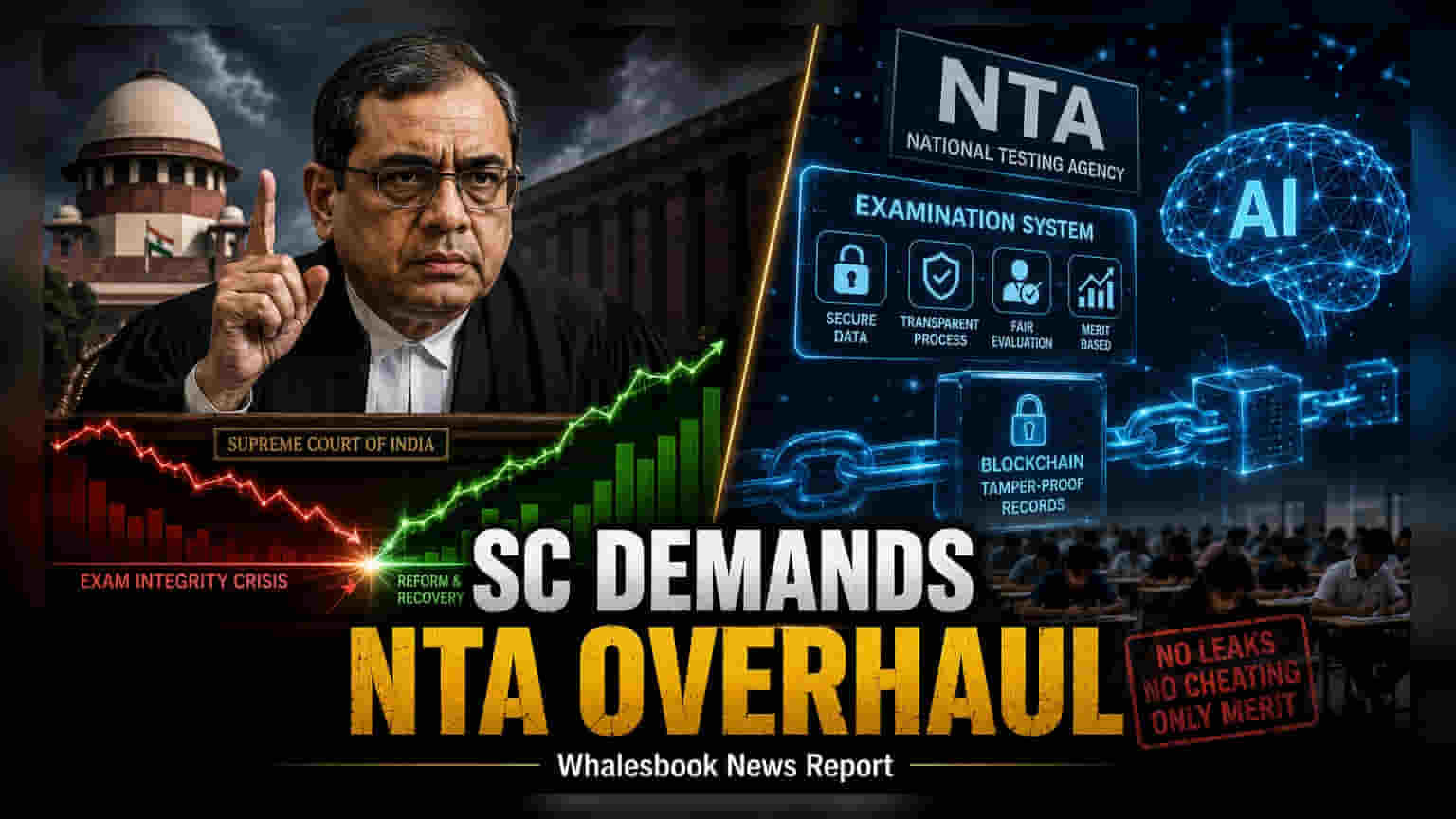
The Supreme Court has directed the Centre to submit a detailed action plan within three weeks to institutionalize reforms at the National Testing Agency (NTA). The court emphasized the need to implement recommendations from the Radhakrishnan and Nilekani committees to secure the integrity of entrance exams like NEET-UG. This move aims to replace temporary fixes with a robust, long-term system to restore public trust in national examinations.
The Supreme Court of India has ordered the central government to present a concrete roadmap within three weeks to overhaul the National Testing Agency (NTA). A bench led by Justices PS Narasimha and Alok Aradhe stressed that the testing body needs structural changes to function as a reliable institution, moving away from reactive, ad-hoc safety measures. This directive follows persistent concerns regarding the integrity and security of major entrance examinations, most notably the NEET-UG.
The court’s focus is on implementing systemic changes proposed by two key groups: the seven-member Radhakrishnan Committee and the high-powered task force led by Infosys co-founder Nandan Nilekani. These groups were tasked with suggesting ways to improve data security, refine the examination process, and restructure the NTA. The bench pointed out that while the government often lists individual security measures, the agency lacks a deep, permanent structure and institutional memory—qualities that established bodies like the Union Public Service Commission (UPSC) have built over decades.
During the hearing, the Solicitor General represented the government and argued that current protocols are already comprehensive. These include multiple checks during the printing and distribution of question papers, constant CCTV surveillance, police escorts, and storage in secure bank vaults. However, the court maintained that these safeguards, while useful, do not address the deeper need for an institutional overhaul. The bench emphasized that technology, such as advanced data security, needs to be deeply integrated into the NTA’s core operations rather than applied as a layer on top of a weak structure.
For the broader education ecosystem, this development is crucial. The credibility of national entrance exams is the backbone of India's higher education sector, affecting the operations of coaching centers, edtech platforms, and academic institutions. Constant controversies regarding exam integrity create policy uncertainty, which can disrupt the planning and stability of education-related businesses and student timelines. By pushing for a robust, technology-driven, and autonomous NTA, the judiciary is signaling that it expects permanent, systemic solutions to ensure exam security.
The primary monitorable for stakeholders will be the government’s affidavit, which is due in three weeks. This document is expected to detail how the recommendations from the Radhakrishnan and Nilekani panels will be put into practice. The court has made it clear that it will closely monitor the substance and timeline of these reforms, leaving little room for surface-level changes.