

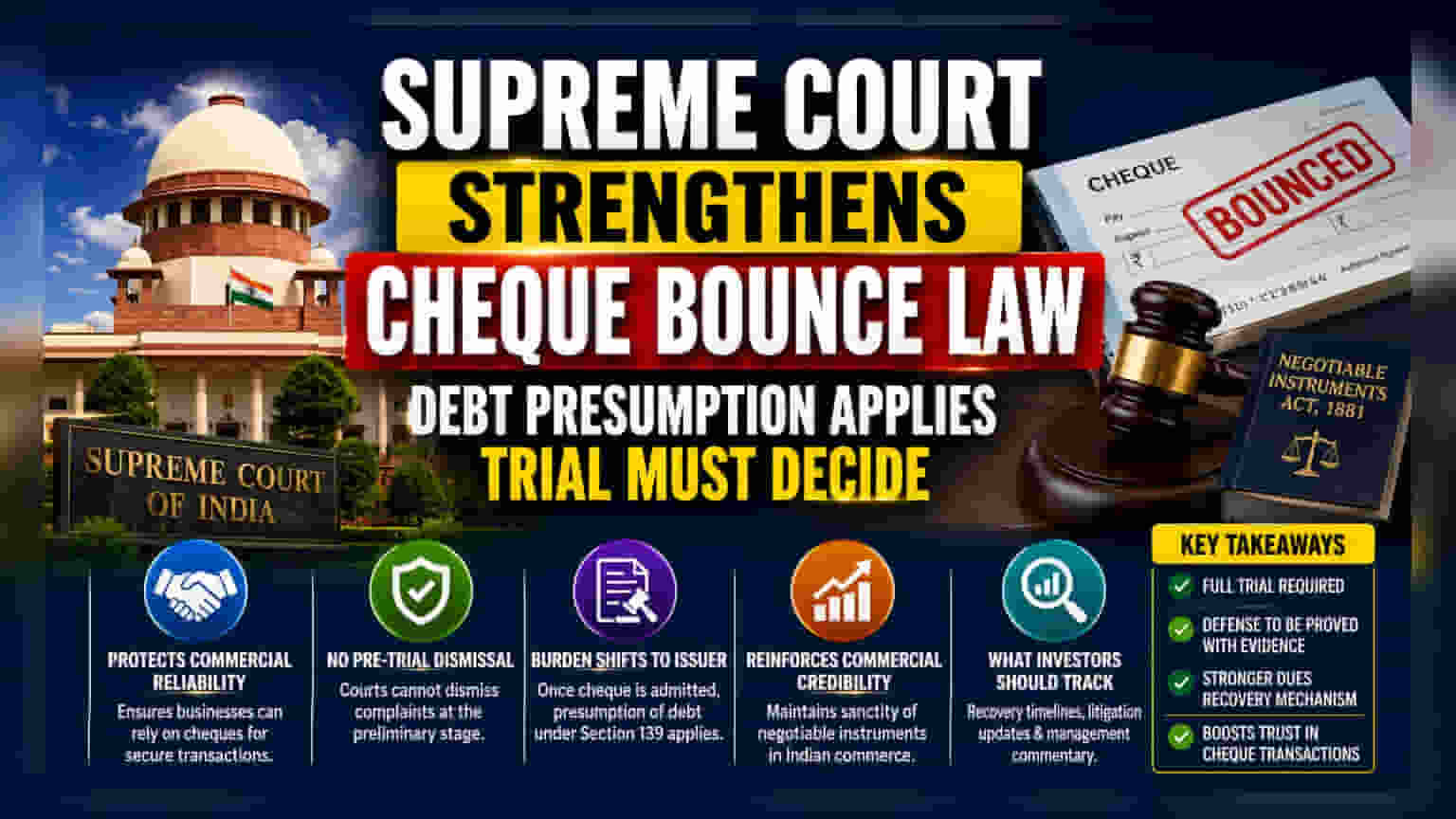
The Supreme Court has ruled that cheque bounce cases under the Negotiable Instruments Act cannot be dismissed at a preliminary stage. Once a cheque's issuance is admitted, the legal presumption of debt applies, and defenses must be tested during a full trial. This decision enhances commercial credibility for companies relying on cheque-based settlements and receivables.
What Happened
The Supreme Court has clarified the legal process for cheque bounce cases under Section 138 of the Negotiable Instruments Act, 1881. In a recent judgment, the apex court ruled that courts cannot dismiss these complaints at the preliminary stage based on arguments presented by the accused. Once the issuance and signature of a cheque are admitted, the legal presumption of a debt—governed by Section 139 of the Act—automatically applies. This means the burden of proof shifts to the issuer, and any defense or rebuttal must be thoroughly tested during the trial phase, not before it begins.
Why This Matters For Business
For companies, this ruling is a significant reinforcement of commercial reliability. Businesses frequently use cheques to settle accounts, pay for supplies, or manage inter-corporate debt. When a cheque is dishonored, companies often face lengthy legal battles to recover their money. By preventing lower courts from prematurely closing these cases, the Supreme Court has made the legal process for recovering dues more predictable and robust. This move helps protect creditors by ensuring that legitimate complaints are heard in a full trial rather than being dismissed early due to pre-trial defenses.
The Legal Context Explained
The dispute that led to this ruling involved a Rs. 50 crore cheque that had been dishonored. Lower courts had previously set aside the complaint, arguing that there was no legally enforceable debt. The Supreme Court overturned this, stating that such an approach was legally unsustainable. The court emphasized that the legislative intent of Section 138 is to provide a clear, reliable mechanism for commerce. By limiting the scope for pre-trial dismissal, the ruling ensures that the statutory presumption of debt carries actual weight in court proceedings.
Impact On Commercial Credibility
This judgment serves to maintain the sanctity of negotiable instruments. In the Indian corporate landscape, where receivables management is a key aspect of operational health, the ability to rely on cheques as a secure payment method is essential. If cheque-based claims were easily dismissed before a trial, it could undermine the trust companies place in these instruments. By mandating that defenses be proven through evidence and cross-examination during a trial, the court has prioritized the enforceability of these financial instruments.
What Investors Should Track
While this is a legal development, it has implications for how companies manage their receivables and legal disputes. Investors should continue to monitor management commentary in quarterly reports regarding significant litigation or recovery proceedings. Specifically, if a company has substantial outstanding receivables linked to cheque-based disputes, this ruling may provide a more structured path for potential recovery. Investors may also watch whether this legal clarity leads to faster resolution timelines in commercial disputes involving listed entities.