

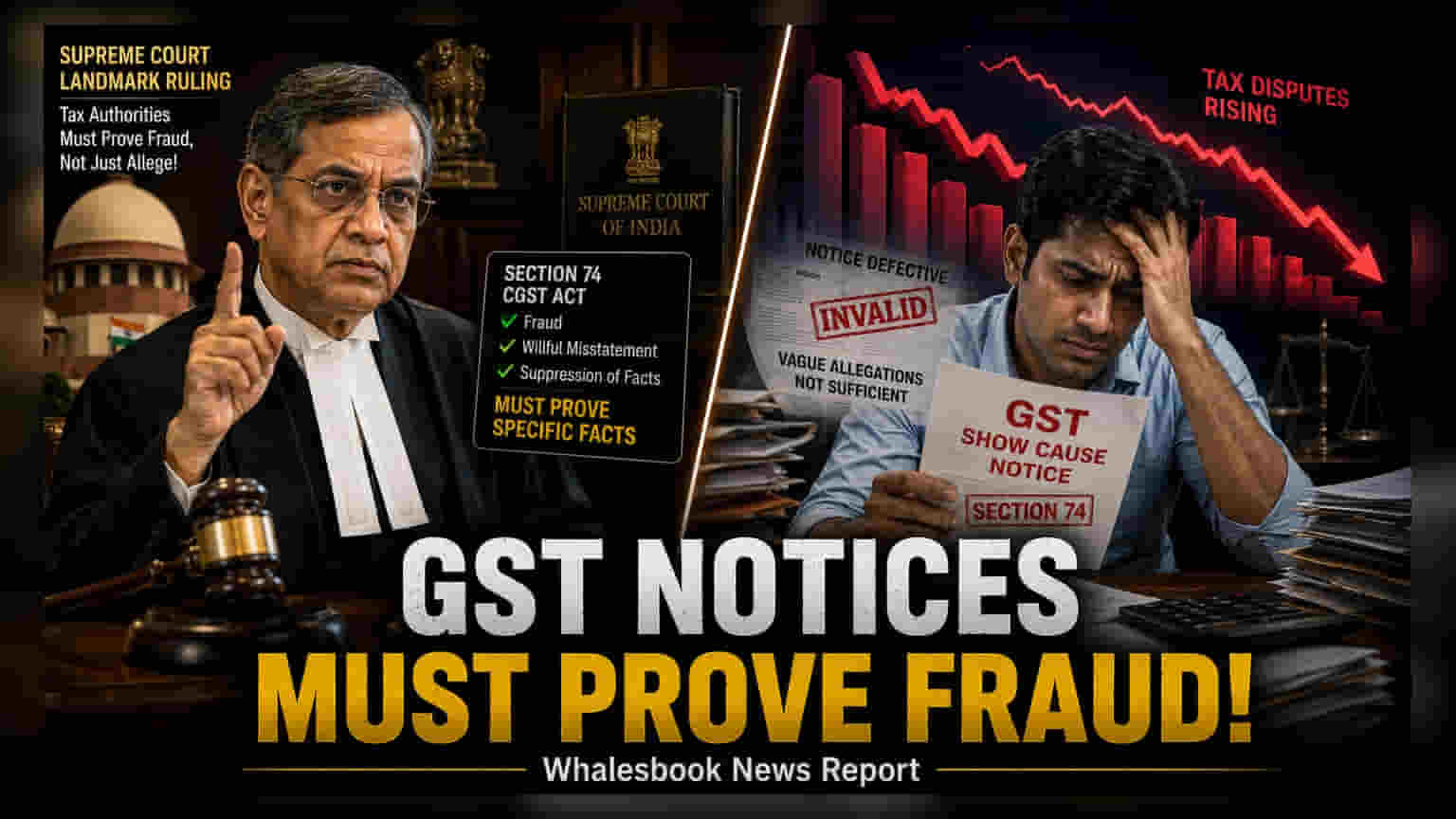
The Supreme Court has ruled that GST notices issued under Section 74 must provide specific factual details regarding allegations of fraud or suppression. Generic notices are no longer sufficient to trigger extended tax recovery timelines. This judgment provides significant relief for companies facing unclear tax litigation and raises the standard for transparency required from tax authorities.
In a significant development for Indian corporate taxpayers, the Supreme Court of India has delivered a landmark ruling regarding the validity of show cause notices issued under Section 74 of the Central Goods and Services Tax (CGST) Act. On August 19, 2026, the apex court clarified that tax authorities cannot invoke the extended limitation periods available under Section 74 by merely using vague, mechanical language alleging fraud, willful misstatement, or suppression of facts.
The ruling came in the case of M/s G.R. Infra Projects Limited vs. State of Madhya Pradesh & Ors. The Supreme Court emphasized that the tax department must explicitly detail the specific factual basis for such serious allegations within the notice itself. A 'bland' or generic recital of statutory language is legally insufficient to justify the harsher tax assessment procedures allowed under this section.
Impact on Tax Litigation
Section 74 of the CGST Act is critical because it allows authorities a longer window to recover taxes compared to standard assessment sections. This section is reserved for cases involving fraud, willful misstatement, or suppression, which carry significant penalties and reputational risk. Historically, companies have often faced notices that used boilerplate language without providing clear evidence or reasons for the suspicion of fraudulent activity.
The Supreme Court’s decision provides immediate legal strength to businesses currently fighting tax disputes. Crucially, the court also ruled that tax authorities cannot 'cure' or rectify defective notices later in court proceedings or through counter-affidavits. If a notice is fundamentally flawed because it lacks specificity, it cannot be validated after the fact.
What This Means for Businesses
For investors and corporate management, this ruling helps reduce uncertainty regarding potential tax liabilities. Companies that have received tax notices based on vague grounds now have a much stronger legal position to challenge these proceedings. This may lead to the closure of various pending tax disputes where the department failed to substantiate its claims of suppression or fraud.
While this judgment offers relief, it also marks a shift in how tax departments must operate. Tax authorities will likely need to conduct more thorough internal reviews and gather concrete evidence before issuing notices under Section 74. For companies, the immediate step is to review pending tax notices with legal counsel to determine if they meet this new standard of specificity. Moving forward, the effectiveness of tax enforcement will increasingly depend on the clarity and factual foundation provided at the very beginning of the assessment process.