 Whalesbook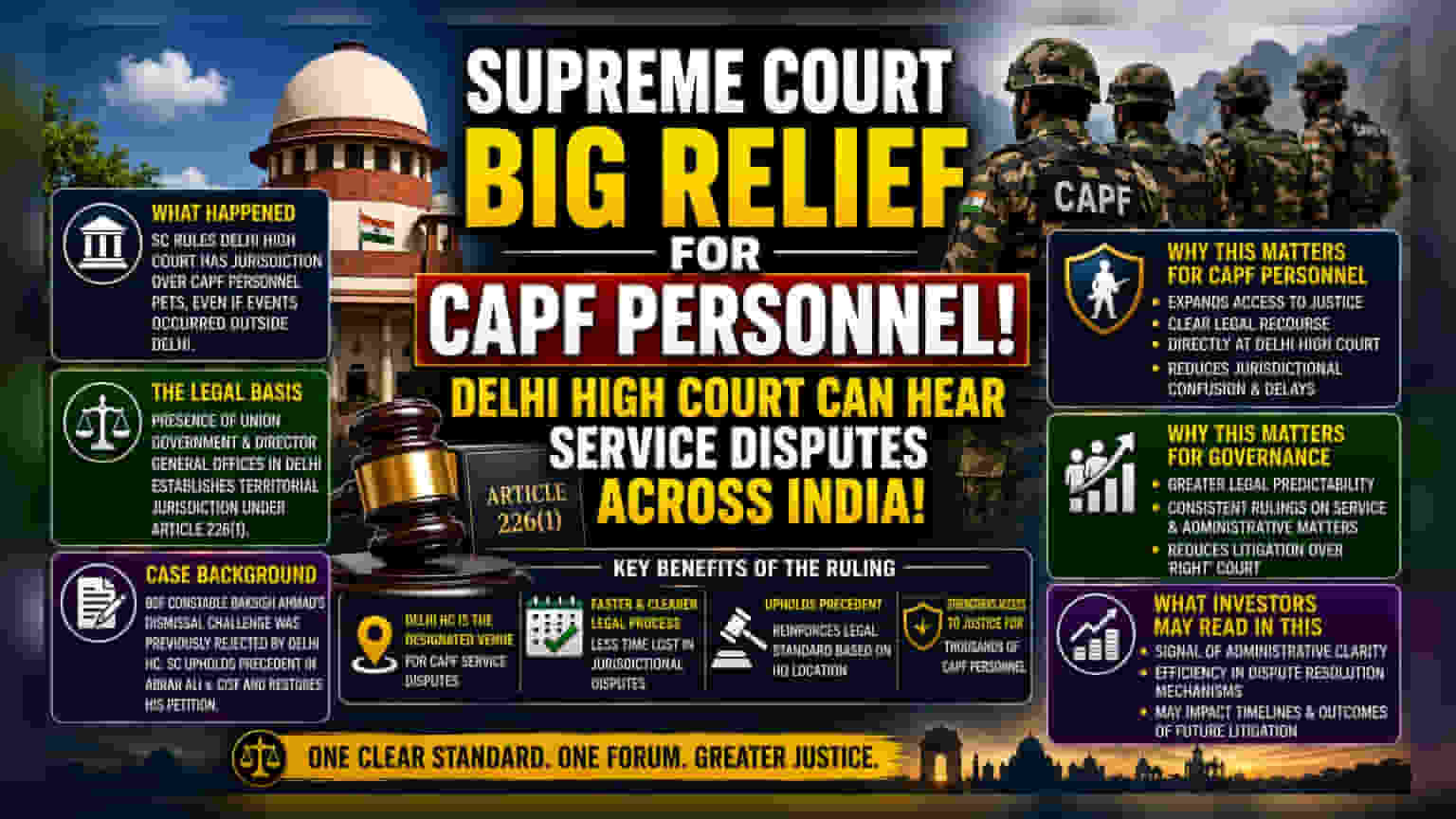


The Supreme Court has confirmed that the Delhi High Court holds jurisdiction over service-related disputes for Central Armed Police Forces (CAPF) personnel, regardless of where an incident occurred. The ruling relies on the fact that central command headquarters are located in New Delhi, allowing the High Court to handle these matters under the Constitution. This decision aims to clarify legal access and streamline administrative litigation for government personnel.
What Happened
The Supreme Court has issued a ruling that expands the legal pathways for Central Armed Police Forces (CAPF) personnel to address service-related disputes. The court decided that the Delhi High Court has the clear authority to hear petitions filed by CAPF members, even if the events that led to the dispute took place outside of the national capital region.
This decision overturns previous instances where the Delhi High Court had declined to hear such cases, often citing that the events occurred in other states. The apex court bench, comprising Justices Dipankar Datta and Satish Chandra Sharma, clarified that the presence of the Union government and the commanding offices—specifically the Director General of the concerned forces—within Delhi is sufficient to establish territorial jurisdiction under Article 226(1) of the Constitution.
The Legal Basis
The ruling focuses on the practical application of jurisdictional rules. The court emphasized that when the primary administrative authority, such as the Director General of a force like the Border Security Force (BSF), is based in Delhi, the High Court in the capital has the power to exercise jurisdiction. This legal position is intended to move away from the doctrine of 'forum non conveniens,' which suggests that a case should be heard in the most convenient venue. By establishing that the location of the central command is the deciding factor, the Supreme Court aims to prevent confusion over where a personnel member should file a legal challenge.
Case Background
The ruling came following an appeal by Baksish Ahmad, a constable from the Border Security Force. The constable had been dismissed from service after an internal inquiry, and his subsequent statutory appeals were rejected. When he approached the Delhi High Court to challenge the dismissal, the court refused to hear the petition, pointing out that the events had transpired in West Bengal and Jammu and Kashmir. The Supreme Court, upon reviewing the appeal, referenced its previous precedent in Abrar Ali v. CISF, which established that the High Court of a territory where the force's headquarters is situated has the necessary authority to handle such disputes. Consequently, the court restored the petition, allowing the Delhi High Court to proceed with a hearing on the merits of the case.
Why This Matters For Governance
For those observing government and administrative efficiency, this ruling provides greater legal predictability. By confirming that the Delhi High Court is a designated venue for these central government personnel, the court reduces the potential for long, drawn-out disputes over which court is the 'right' one to hear a case. This centralization of legal recourse can lead to more consistent rulings on administrative and service matters, as the Delhi High Court will now handle a broader set of these issues based on the centralized location of the government authorities involved.
What Investors May Read In This
While this is a legal ruling, it highlights the importance of administrative clarity within government-affiliated organizations. Investors often track how the legal system resolves disputes related to large public sector and government bodies, as efficient resolution mechanisms reduce administrative friction. This ruling establishes a firm standard for how jurisdiction is determined for centrally administered forces, which may influence the timelines and outcomes of future service-related litigation involving such entities.