

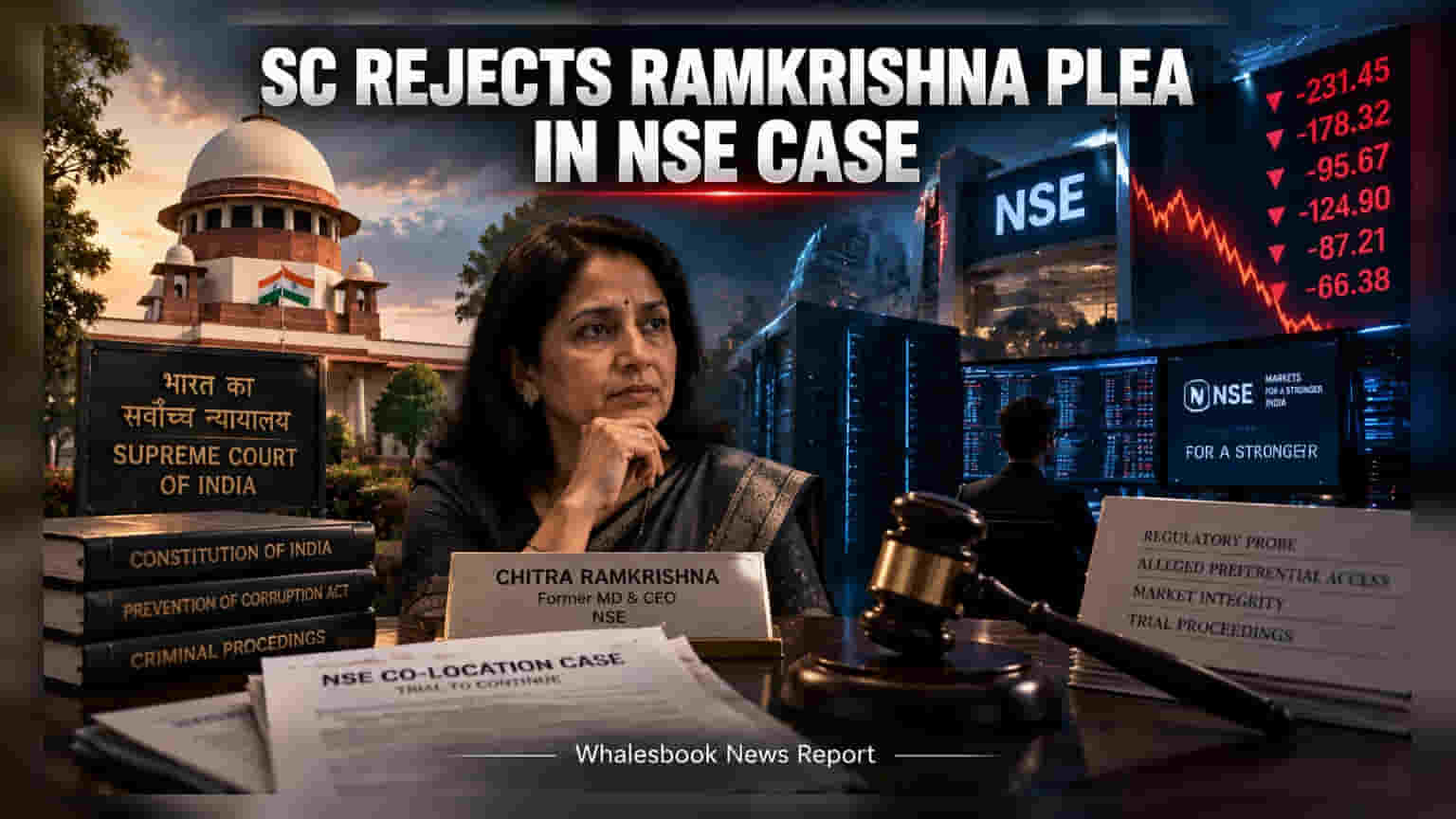
The Supreme Court has dismissed a plea by former NSE Managing Director Chitra Ramkrishna challenging her prosecution in the co-location case. As the legal proceedings against the former executive continue, the exchange is preparing to launch its Initial Public Offering (IPO) on September 17, 2026.
The Supreme Court of India on September 15, 2026, refused to interfere with the proceedings against former National Stock Exchange (NSE) Managing Director and CEO Chitra Ramkrishna in the long-running co-location case. A bench comprising Justices J.B. Pardiwala and K. Vinod Chandran dismissed her challenge to a Delhi High Court order that had declined to quash her prosecution.
Legal Dispute Over 'Public Servant' Status
Chitra Ramkrishna had approached the Supreme Court arguing that the NSE is a private entity and that she, as its former chief, could not be classified as a 'public servant' under the Prevention of Corruption Act. She sought to challenge the cognizance of offences taken by the trial court. The Supreme Court bench held that this specific contention regarding her status as a public servant can be raised before the trial court itself, which will examine the issue on its merits. By declining to intervene, the court has allowed the criminal trial proceedings to continue.
The co-location case, which has been under investigation by the Central Bureau of Investigation (CBI), involves allegations of preferential server access granted to certain brokers between 2010 and 2014, leading to claims of improper market advantages. The trial will now proceed to determine the merits of these allegations.
NSE IPO and Regulatory Context
This legal development occurs just two days before the National Stock Exchange is set to launch its Initial Public Offering on September 17, 2026. The exchange has set a price band between ₹1,700 and ₹1,785 per share for the upcoming issue. For potential investors, it is important to distinguish between the legacy legal cases involving former executives and the current operational status of the exchange.
The NSE has recently moved to address its regulatory history. Earlier in September 2026, the Supreme Court disposed of SEBI's appeals against the NSE regarding the co-location and dark fibre cases, following a settlement of approximately ₹1,491.21 crore paid by the exchange to the regulator. This settlement was a significant step in resolving the exchange's past regulatory disputes and clearing its path for public listing.
While the NSE as an institution has settled its financial obligations with SEBI, the ongoing criminal trial against its former managing director serves as a legacy governance matter. Investors participating in the IPO may want to monitor how the exchange manages such historical governance issues post-listing. The key monitorable for the market will be the progress of the trial court proceedings and any further impact on the governance structure of the exchange.