

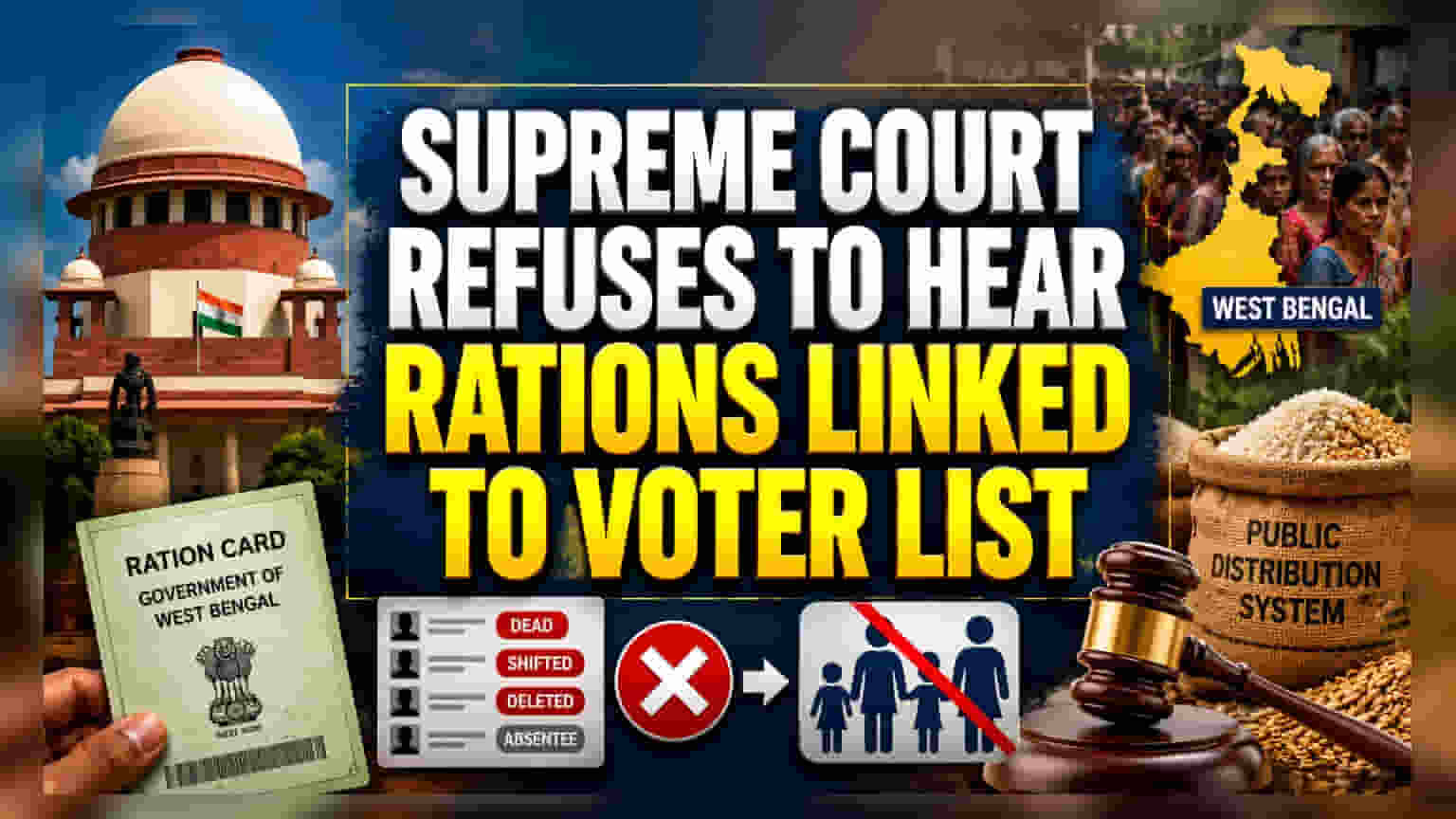
The Supreme Court has directed a petition challenging the linkage of West Bengal’s ration cards to electoral roll data to the Calcutta High Court. Petitioners claim this move could lead to the deactivation of 35 to 60 lakh cards. The court determined that the case, involving specific state directives, is best heard at the high court level.
What Happened
The Supreme Court has declined to hear a petition challenging the West Bengal government's decision to link ration card eligibility to electoral roll status. A vacation bench comprising Justices BV Nagarathna and Joymalya Bagchi directed the petitioners to present their case before the Calcutta High Court. The petition was filed by the Paschim Banga Khet Majoor Samity, an organization representing agricultural workers, to challenge directives issued by the state's Food and Supplies Department and the Department of Women and Child Development and Social Welfare.
The Core Dispute
The controversy centers on the state's use of data from the Special Intensive Revision (SIR) of electoral rolls to determine eligibility for the Public Distribution System (PDS) and the Annapurna Yojana. The government directives use electoral classifications such as "dead," "shifted," "deleted," or "absentee" to filter beneficiaries. The petitioners argue that using this electoral data to deny access to food security benefits is legally flawed and does not accurately reflect a person's actual residency or economic need.
Potential Scale of Impact
Legal representatives for the petitioner highlighted a significant administrative concern, estimating that a mechanical application of these criteria could result in the deactivation of between 35 lakh and 60 lakh ration cards. The petitioners contend that this mass exclusion could violate fundamental rights under Articles 14 and 21 of the Constitution. They further argued that data originally collected for the purpose of maintaining electoral rolls should not be repurposed to decide eligibility for welfare programs.
Why the Court Redirected the Case
During the hearing, Justice Nagarathna questioned why the petitioners had approached the Supreme Court directly under Article 32 of the Constitution. The bench observed that the issues raised, which involve specific state-level administrative orders and the potential discontinuation of welfare services, represent a distinct cause of action. The court concluded that the Calcutta High Court is the more appropriate forum to examine the merits of these state directives and the associated data management concerns.
What to Monitor Next
The next step in this legal matter will be the filing or hearing of the case before the Calcutta High Court. For observers, the key monitorable will be the High Court's assessment of whether the state’s data usage violates individual rights or if the administrative process is justifiable under existing state welfare policies. Any decision by the High Court could set a precedent for how electoral and welfare databases are integrated by state governments across the country.