

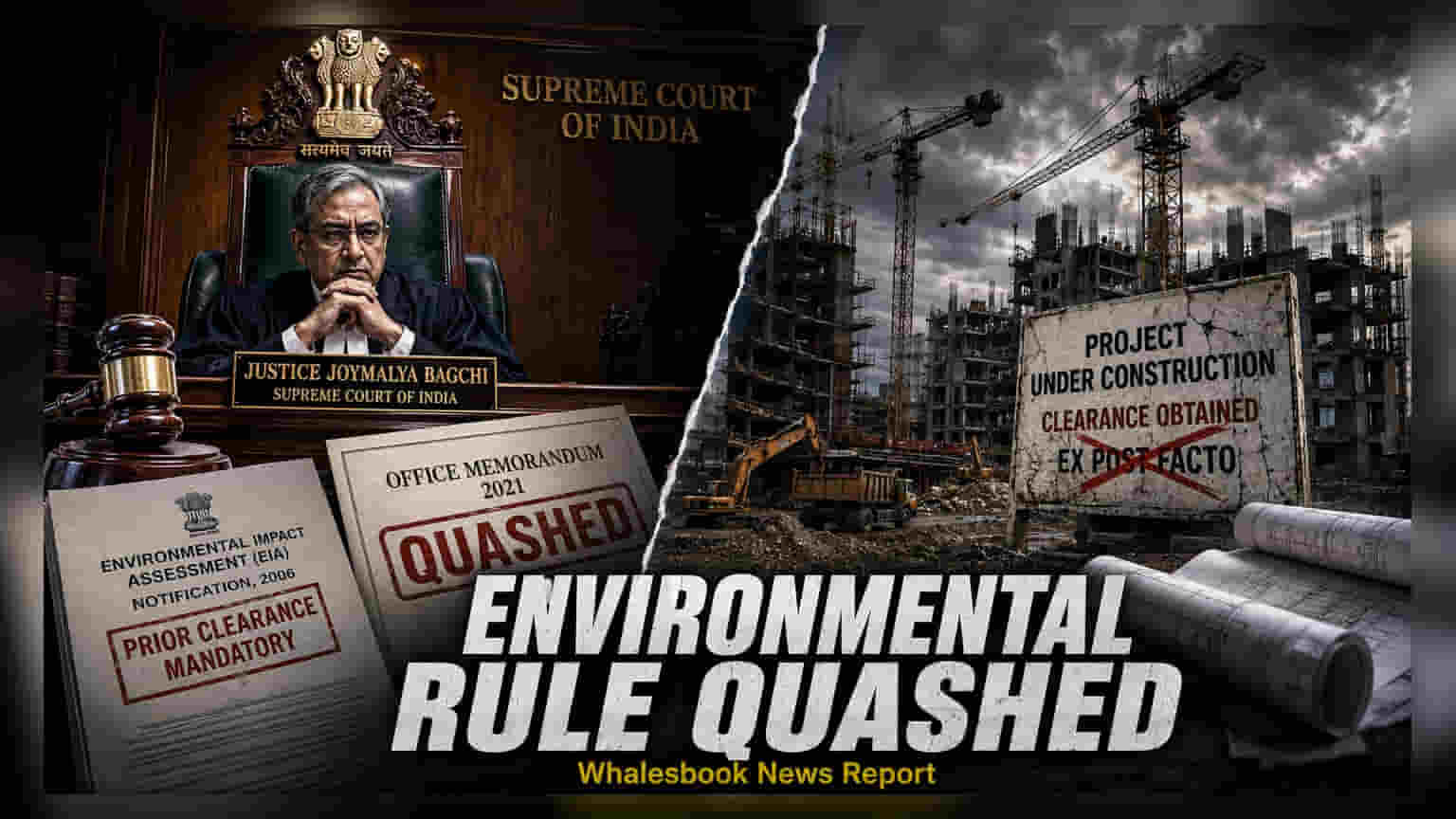
The Supreme Court has struck down a 2021 administrative order that allowed perpetual post-facto environmental clearances for projects. While existing approvals remain valid, the ruling forces companies to secure prior environmental clearance, increasing regulatory scrutiny for infrastructure, real estate, and mining sectors. Investors may now expect stricter compliance standards for project developments.
The Supreme Court of India has delivered a landmark ruling that significantly alters the regulatory landscape for infrastructure, mining, and real estate sectors. In a judgment dated July 29, 2026, a three-judge bench led by Chief Justice Surya Kant quashed a 2021 Office Memorandum (OM) that had allowed companies to obtain environmental clearances after commencing construction, a practice known as 'ex post facto' approval.
The court emphasized that the 2006 Environmental Impact Assessment (EIA) Notification mandates prior environmental clearance for projects. The 2021 order, which attempted to create a permanent regularization regime through administrative circulars, was found to be legally inconsistent with these statutory requirements. By striking down this memorandum, the judiciary has signaled a shift away from the 'build first, regularize later' approach that has historically facilitated the rapid execution of large-scale projects.
Impact on Project Compliance and Due Diligence
For investors and developers, this ruling introduces a period of heightened regulatory uncertainty. Companies that relied on the now-quashed 2021 OM to regularize their projects may face increased scrutiny. While the court clarified that the ruling has prospective effect and does not automatically cancel existing clearances, these approvals are no longer shielded by the invalidated administrative order. This leaves them vulnerable to individual legal challenges from environmental groups or local stakeholders, which could lead to project delays or the need for expensive, time-consuming fresh clearances.
Lenders and institutional investors may now require more rigorous due diligence before financing new projects. The ability of a project to secure statutory clearance before breaking ground is now a critical risk factor. Any reliance on executive circulars for compliance is likely to be viewed as a significant governance and operational risk. This shift forces companies to prioritize environmental planning early in the project lifecycle, potentially increasing the initial time and capital investment required for new developments.
Scope for Limited Amnesty Schemes
It is important to note that the court has not entirely banned the concept of amnesty for environmental violations. The judgment clarifies that the government retains the power to formulate limited, time-bound amnesty schemes, but only for cases of 'supervening public interest.' Crucially, these schemes must be established through formal statutory notifications under the Environment (Protection) Act, 1986, rather than through executive or administrative orders. This ensures that any future relaxation of rules is subject to greater transparency and legislative oversight.
The court also upheld the validity of a 2017 notification, viewing it as a narrowly tailored and time-bound piece of delegated legislation that managed past violations without creating a permanent loophole. This distinction suggests that while the government can still provide relief in exceptional, well-defined cases, the era of using broad administrative memos to bypass environmental laws is over.
The key monitorable for investors and stakeholders in the coming months will be the government's approach to drafting any new, compliant amnesty schemes and how lower courts handle existing legal challenges to projects that utilized the now-quashed 2021 memorandum. Companies with significant project pipelines or ongoing developments in sensitive environmental zones will need to closely assess their clearance status to avoid potential litigation or regulatory interventions.