

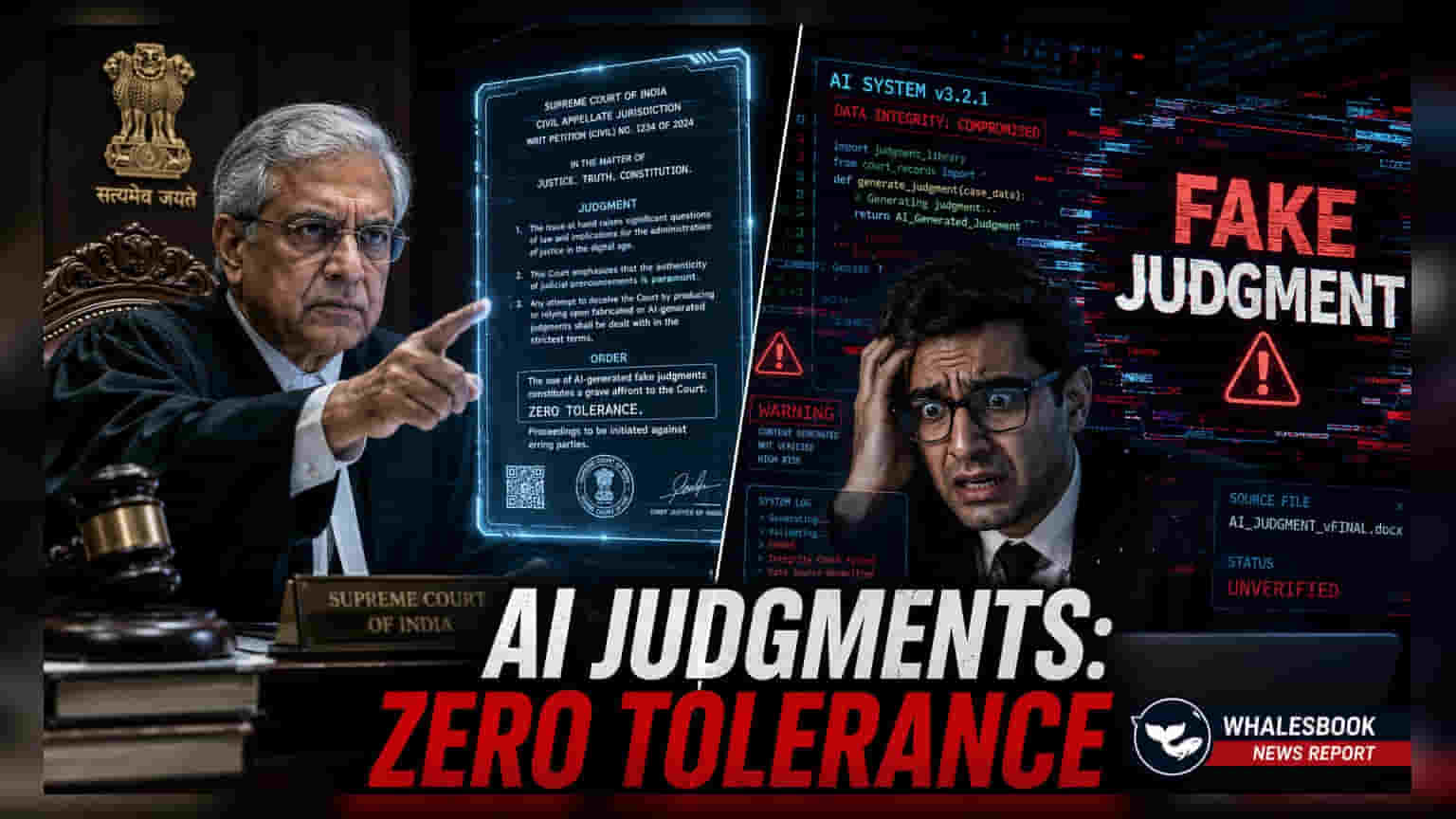
The Supreme Court has set aside an NCLT order in the Essel Infraprojects insolvency case, citing the use of fabricated AI-generated legal precedents. The bench declared a zero-tolerance policy, warning that rulings based on hallucinated material are legally invalid. The Bar Council of India has been directed to establish oversight guidelines for the use of artificial intelligence in legal filings.
What Happened
The Supreme Court of India has issued a stern directive against the use of artificial intelligence (AI) to generate fake legal precedents in court filings. In a landmark ruling regarding the Essel Infraprojects insolvency case, a bench comprising Justices PS Narasimha and Alok Aradhe set aside orders from both the National Company Law Tribunal (NCLT) and the National Company Law Appellate Tribunal (NCLAT). The Court discovered that these tribunals had mistakenly relied on non-existent, AI-generated judgments, which were falsely attributed to the Supreme Court. The top court has now ordered the NCLT to hear the case fresh, with a directive to reach a decision within two weeks.
Why This Matters For The Legal System
The reliance on fabricated AI content poses a significant risk to the integrity of the judicial process. Artificial intelligence tools, while useful for research, can sometimes "hallucinate," creating plausible-sounding but entirely fake court rulings. The Supreme Court emphasized that if a judicial decision is based on such unreal material, the entire judgment becomes legally compromised. The Court described the unchecked use of AI-generated misinformation as a major threat, drawing a serious parallel to the catastrophic industrial leaks of the past, underscoring that the legal system could suffer irreparable harm if such practices are not stopped.
Accountability For Lawyers And Judges
The Supreme Court clarified that the responsibility for verifying legal citations lies with both the legal practitioners and the judiciary. Citing unverified or AI-fabricated judgments was labeled as "misconduct" for advocates. Similarly, the bench noted that judges accepting such material as valid evidence constitutes a serious lapse in the judicial process. To prevent future occurrences, the Court has tasked the Bar Council of India with forming a committee. This body will be responsible for creating clear principles and disciplinary rules for lawyers who submit AI-generated materials to courts.
Impact On The Essel Infraprojects Case
In the specific matter involving Essel Infraprojects, an affidavit filed by J&K Bank confirmed that its legal counsel did not introduce the fake citations. This revealed that the fabricated precedents were sourced independently by the tribunal itself, escaping notice at both the NCLT and NCLAT stages. Because the original proceedings were built upon these invalid references, the Supreme Court nullified the previous orders. The case has now been sent back to the NCLT for a fresh, accurate evaluation.
What To Watch Next
The key monitorable for the industry is how legal practitioners and tribunals adapt their verification processes. Investors and stakeholders in insolvency cases should track the new guidelines expected from the Bar Council of India, as these will set the standard for acceptable AI usage in legal arguments. Furthermore, the fresh hearing for the Essel Infraprojects insolvency application will be a critical development for the creditors involved, as the previous order is no longer in effect.