 Whalesbook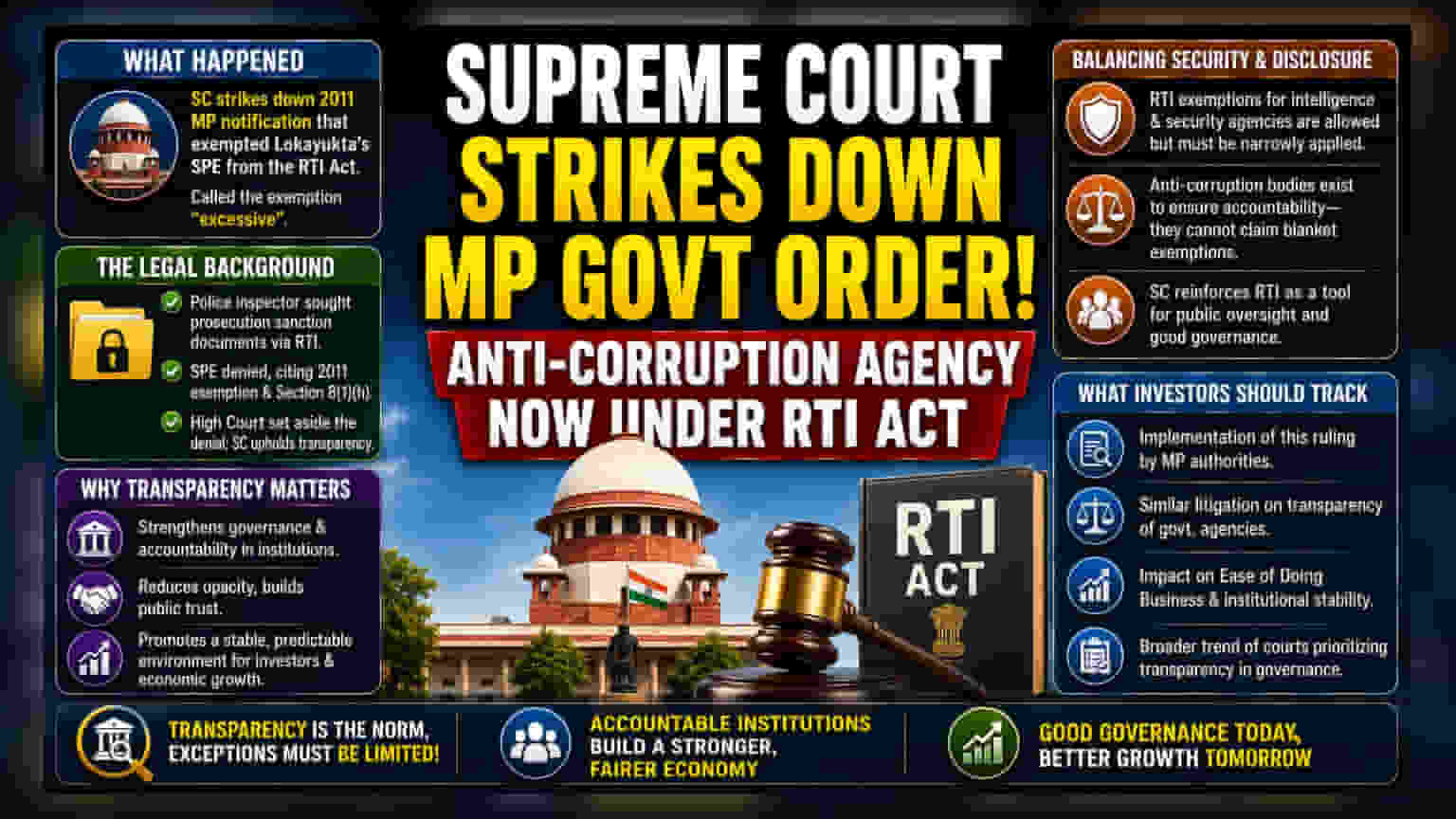


The Supreme Court has cancelled a 2011 Madhya Pradesh government order that kept the state’s anti-corruption police unit outside the Right to Information (RTI) Act. The court ruled that shielding an investigative agency from transparency laws is excessive. This decision boosts institutional accountability, an essential element for long-term governance and public trust in state institutions.
What Happened
The Supreme Court of India has struck down a 2011 notification by the Madhya Pradesh government that had exempted the state’s Lokayukta Special Police Establishment (SPE) from the Right to Information (RTI) Act. The ruling, delivered by a bench comprising Justices S.V.N. Bhatti and Atul S. Chandurkar, declared the broad exemption as "excessive." The SPE, which functions as the state’s anti-corruption agency, had previously argued that it should be protected from RTI disclosure requirements, similar to intelligence and security agencies under Section 24(4) of the RTI Act.
The Legal Background
The case emerged after a police inspector, facing charges under the Prevention of Corruption Act, sought specific documents related to his prosecution sanction through an RTI request. The SPE had denied the request, relying on the 2011 state notification to claim that it was outside the scope of the RTI Act. While the agency initially used Section 8(1)(h) of the RTI Act—which allows for the withholding of information that might impede an investigation—the primary conflict remained the broader exemption notification. The Madhya Pradesh High Court had earlier set aside the denial of information, and the Supreme Court has now upheld this, emphasizing that transparency should be the norm, even for investigative bodies, unless specific, limited exceptions apply.
Why Transparency Matters for Governance
For those tracking the broader business and economic environment, this ruling underscores the increasing emphasis on governance and accountability in public institutions. While this specific event concerns a state-level anti-corruption agency, the principle of transparency is a cornerstone of a healthy economic environment. Stronger RTI compliance generally promotes institutional integrity, reduces the scope for administrative opacity, and fosters public trust. For investors, clear and accessible information is a fundamental expectation of regulatory and government bodies, as it creates a predictable and fair framework for operations.
The Balance Between Security and Disclosure
The Supreme Court's decision highlights the legal principle that transparency exemptions for government bodies must be used sparingly. The RTI Act allows for exemptions for intelligence and security agencies to protect national interest and sensitive operations. However, the court has clarified that these exemptions cannot be applied broadly to anti-corruption units that are primarily tasked with ensuring accountability. By narrowing the scope of these exemptions, the court has reinforced the role of the RTI Act as a tool for public oversight, ensuring that agencies responsible for checking corruption remain subject to the same standards of openness they are meant to uphold.
What Investors Should Track
Investors and market participants often monitor developments in governance, legal, and regulatory transparency, as these factors contribute to the overall "Ease of Doing Business" and institutional stability. While this specific ruling does not directly impact private sector companies, it is part of a larger trend where courts are increasingly prioritizing transparency in administrative actions. Future updates regarding the implementation of this ruling by state authorities or any similar litigation concerning the transparency of government agencies will be important for assessing the evolution of the regulatory environment in the region.