

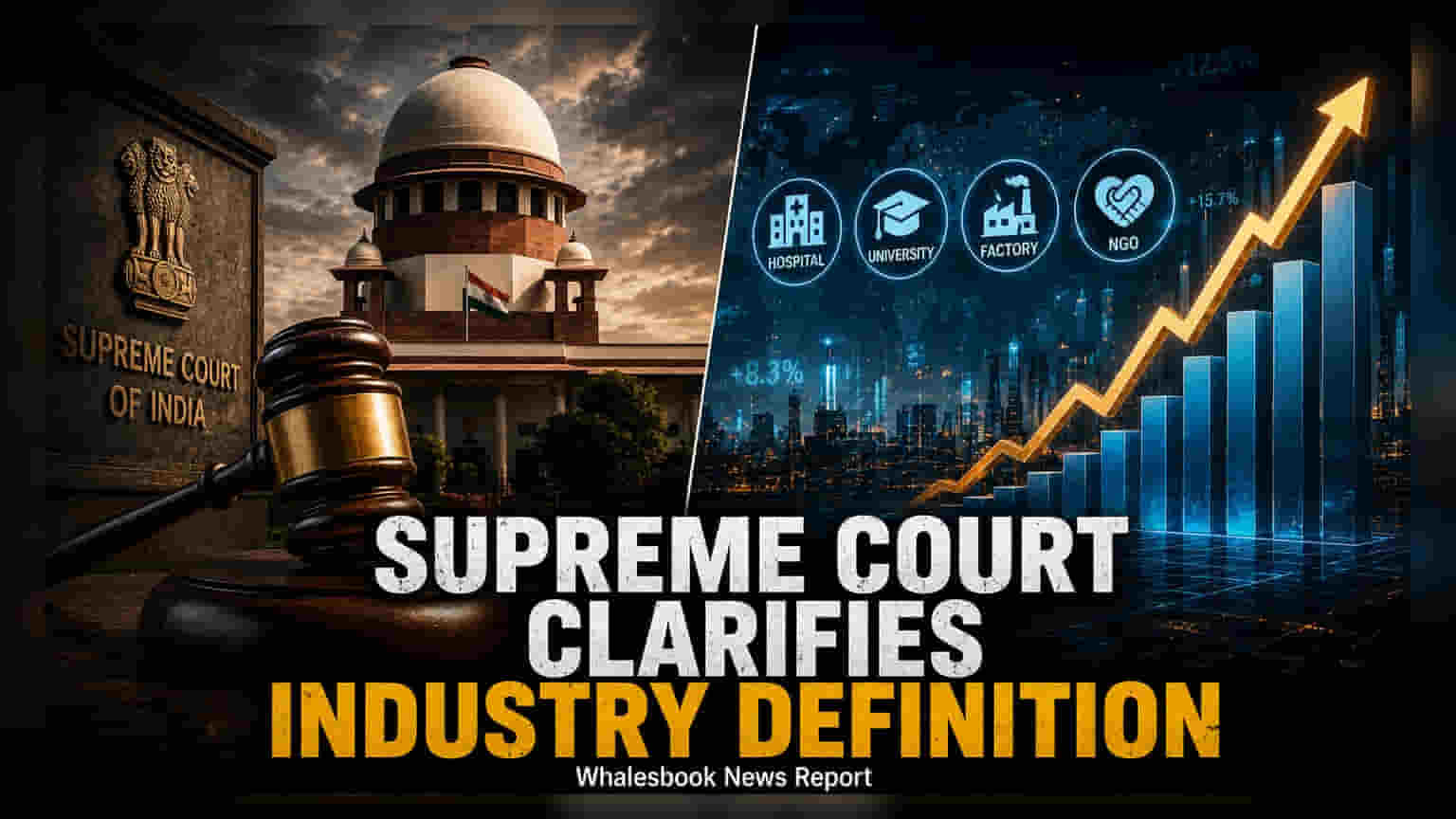
The Supreme Court ruled on August 20, 2026, that the broad 1978 'triple test' for defining an 'industry' applies only to cases under the old 1947 Industrial Disputes Act. This decision does not extend to the new Industrial Relations Code (IRC), 2020. For businesses, this marks a shift in labor compliance, as courts will now create fresh interpretations for newer labor laws, potentially changing how hospitals, schools, and service entities manage labor disputes.
On August 20, 2026, a nine-judge Constitution Bench of the Supreme Court of India issued a verdict in the case of State of Uttar Pradesh v. Jai Bir Singh, clarifying the definition of an 'industry' under labor law. The Court ruled that the expansive criteria established in the 1978 'Bangalore Water Supply and Sewerage Board' judgment—known as the 'triple test'—will continue to govern all disputes currently pending under the now-repealed Industrial Disputes Act, 1947.
This decision provides stability for ongoing litigation, ensuring that cases already in the legal system are not disrupted. However, the Court made a crucial distinction: this 1978 interpretation will not apply to the Industrial Relations Code (IRC), 2020, which has been in effect since November 2025. This means that for any new disputes arising under the current 2020 Code, the definition of an 'industry' remains an open question, allowing courts to interpret the law based on the new legislative text rather than decades-old precedents.
Impact on Service Sector Entities
The most significant implication of this ruling relates to how non-traditional 'industries' are classified. Under the 1978 precedent, institutions like hospitals, educational organizations, charitable trusts, and non-profits were often categorized as industries, making them subject to rigorous labor laws, unionization, and dispute resolution mechanisms. By explicitly limiting the application of this old test, the Court has opened the door for these entities to argue for a different classification under the Industrial Relations Code, 2020.
For investors and business owners, this creates a period of transition. Hospitals, schools, and other service-oriented institutions may face re-evaluations of their compliance requirements. As labor courts and tribunals begin to interpret the IRC, 2020, the extent to which these entities are required to follow specific labor dispute protocols will depend on new judicial outcomes rather than the blanket protections previously offered by the 1978 ruling.
Future Legal Standards
A four-judge opinion, led by Chief Justice Surya Kant, introduced a nuanced perspective for future cases. While not a binding precedent for the old Act, the opinion suggested that future definitions of an 'industry' should consider whether an activity possesses a 'discernible commercial character' similar to trade or business. This indicates that judges may move away from the broad, all-encompassing definitions of the past, focusing instead on the economic nature of the work being performed.
The transition to the Industrial Relations Code, 2020, is intended to modernize labor laws and simplify compliance. However, until specific labor courts establish a clear track record of rulings under the new Code, businesses in the service sector may face temporary uncertainty regarding their labor obligations. Investors may monitor how these institutions adjust their human resource policies and labor agreements as the new legal framework takes hold.