

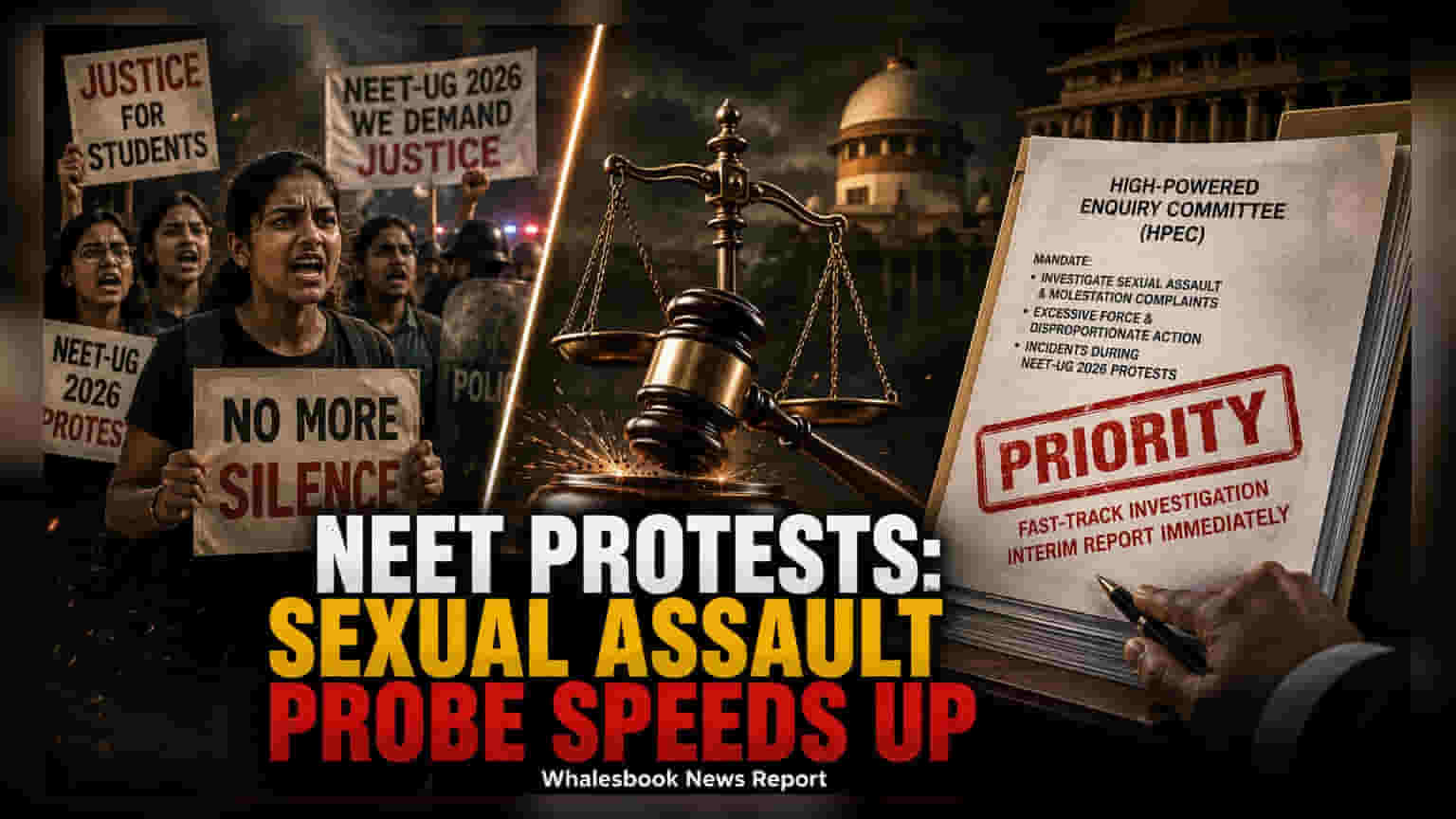
The Supreme Court has ordered its High-Powered Enquiry Committee to prioritize the investigation into sexual assault and molestation complaints reported by female demonstrators during the NEET-UG 2026 protests. The court has requested an immediate interim report from the panel. This directive emphasizes the judiciary's focus on ensuring accountability regarding allegations of police misconduct during the recent nationwide demonstrations.
The Supreme Court of India on Monday, August 24, 2026, issued a directive to the High-Powered Enquiry Committee (HPEC) to fast-track its investigation into sexual assault and molestation complaints made by female demonstrators. These allegations stem from the nationwide NEET-UG 2026 protests that took place between June 20 and July 25.
A bench led by Chief Justice Surya Kant, along with Justices Joymalya Bagchi and V. Mohana, emphasized that these specific complaints must be examined on a priority basis. The court has asked the committee to submit an interim report immediately to address these grievances.
HPEC to Examine Claims
The High-Powered Enquiry Committee was formally established by the Supreme Court on August 20, 2026. It is headed by former Supreme Court judge Justice R. Subhash Reddy. The committee includes several other experienced members, such as former Punjab and Haryana High Court Chief Justice Ravi Shankar Jha, former Delhi High Court judge Justice Shalinder Kaur, former CBI Director Rishi Kumar Shukla, and retired Meghalaya DGP L.R. Bishnoi.
The committee was initially tasked with investigating broader allegations of excessive force, the use of disproportionate measures like pellet guns, and incidents of violence reported during the demonstrations. By bringing sexual assault claims to the forefront, the court is ensuring that these sensitive matters receive dedicated and urgent attention.
Background and Context
The protests were organized to demand accountability regarding alleged irregularities in competitive examinations, specifically the NEET-UG 2026. The demonstrations led to clashes at various locations, including Jantar Mantar. The recent court order followed a plea filed by senior advocate Shobha Gupta, who urged the court to take direct note of the specific allegations of assault against women. The petitioner requested the establishment of a clear mechanism, such as a designated officer or email channel, to allow victims to file complaints safely and effectively.
From a governance and public order perspective, this development is notable as it underscores the judiciary's role in addressing allegations of police misconduct during civil unrest. The progress of this enquiry, particularly the expected interim report, will be the key update to watch, as it will likely influence further legal proceedings and the assessment of state conduct during the protest period.