

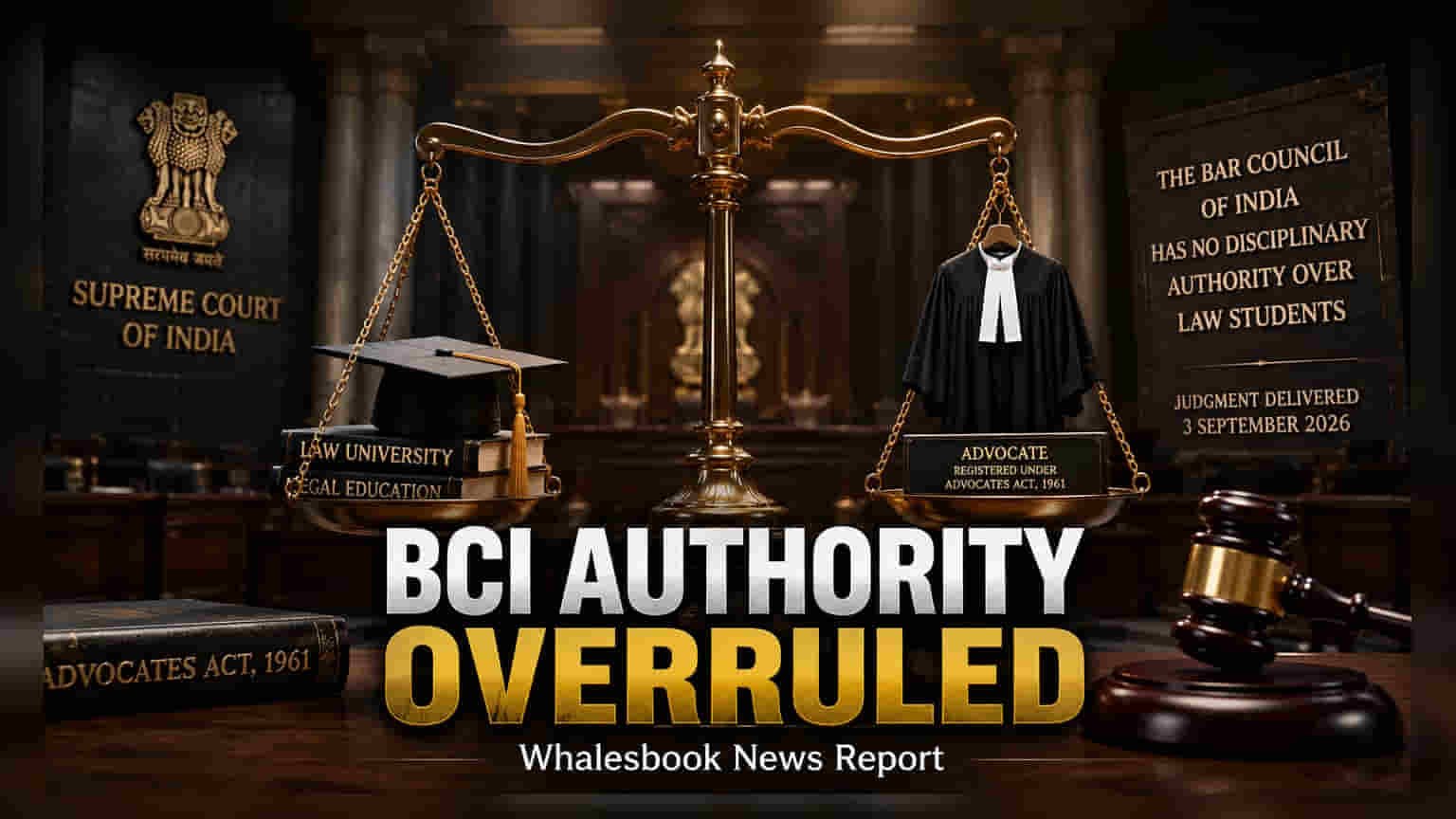
The Supreme Court of India ruled on September 3, 2026, that the Bar Council of India lacks statutory authority to discipline law students. The bench clarified that the Council’s jurisdiction begins only after a graduate registers as an advocate. This decision confirms that internal student discipline remains the exclusive domain of educational institutions, resolving a dispute linked to the 2026 NALSAR University of Law controversy.
The Supreme Court of India delivered a significant verdict on Thursday, September 3, 2026, declaring that the Bar Council of India (BCI) does not possess the statutory power to take disciplinary action against law students. A bench led by Chief Justice of India Surya Kant, alongside Justices Joymalya Bagchi and V Mohana, ruled that the Council's disciplinary jurisdiction under the Advocates Act, 1961, applies exclusively to individuals who have formally registered as advocates.
The court’s decision settles a legal conflict that emerged following a controversy at NALSAR University of Law earlier in 2026. During that incident, the Bar Council had attempted to block the enrollment of graduating students following campus protests. The Supreme Court formally set aside those communications, noting that the BCI's intervention in campus affairs was unwarranted. Chief Justice Surya Kant characterized the campus tension as a private matter between students and the university administration, outside the BCI's scope of control.
By this ruling, the judiciary has reinforced that law schools and universities hold the primary authority to manage internal discipline according to their own bylaws. The court emphasized that the BCI's role is not to police the behavior of individuals currently enrolled in academic programs. This decision serves to protect the autonomy of educational institutions, ensuring that they retain control over administrative and student-related matters without interference from the regulatory body meant for practicing lawyers.
The ruling also signals a move toward stricter oversight of the Bar Council’s governance. The court indicated that major policy decisions by the body should involve consultation with the Attorney General for India and the Solicitor General. For stakeholders in the legal education sector, this judgment provides essential clarity on the limits of regulatory power and preserves the separation between academic management and professional legal oversight.