 Whalesbook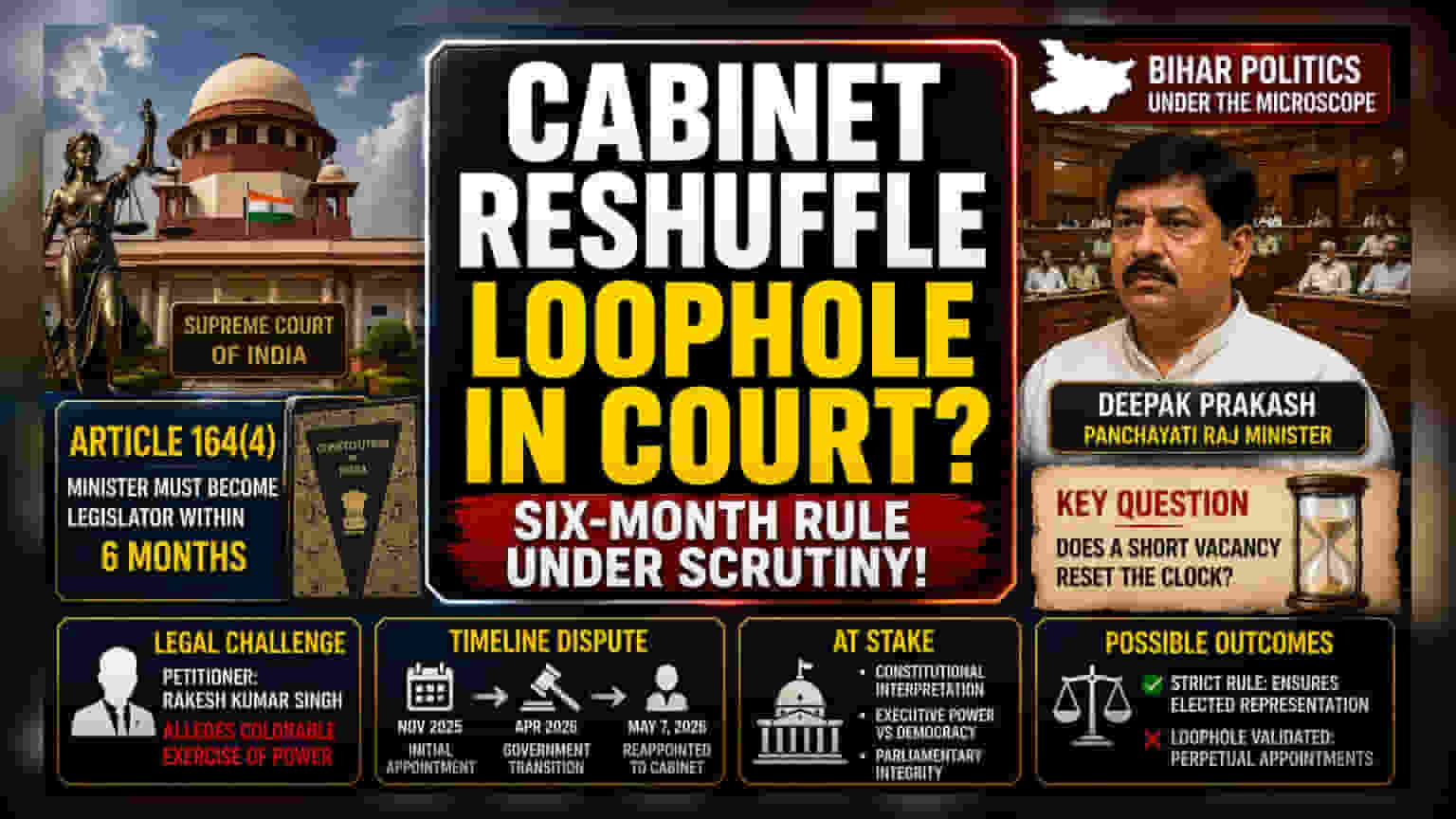


The Constitutional Deadlock
The current challenge before the Supreme Court targets the strategic use of cabinet reshuffles to circumvent Article 164(4) of the Indian Constitution. This provision dictates that a minister who is not a member of the state legislature must secure such membership within a six-month window. The dispute arises from the specific timeline surrounding Deepak Prakash, who serves as the Panchayati Raj Minister. After an initial appointment in November 2025, a government transition in April 2026 created a short vacancy in his portfolio. His subsequent return to the cabinet on May 7, 2026, has ignited a controversy over whether this brief gap resets the clock for non-elected officials to attain legislative status.
The Jurisprudential Conflict
The petitioner, Rakesh Kumar Singh, characterizes this administrative maneuver as a colorable exercise of power. This legal doctrine prevents authorities from doing indirectly what they are expressly prohibited from doing directly. Legal analysts suggest this case serves as a crucial stress test for parliamentary norms, as it forces the judiciary to clarify whether executive discretion allows for the indefinite retention of non-elected ministers via periodic reappointments. While the executive branch often claims broad latitude in cabinet formation, this challenge highlights the potential for administrative gaps to be weaponized to evade democratic mandates.
The Risk of Precedent
Beyond the political implications for the Rashtriya Lok Morcha and the current Choudhary administration, the outcome of this case carries significant implications for state-level governance. If the court validates the government’s interpretation, it may inadvertently create a pathway for perpetual appointments of unelected loyalists, effectively hollowng out the legislative requirement. Conversely, a ruling against the state would mandate stricter adherence to electoral timelines, forcing political parties to prioritize legislative seats for their appointees rather than relying on technical loopholes. The legal fraternity is watching closely to see if the bench will impose a strict, literal interpretation of the six-month rule or allow for pragmatic exceptions during periods of political instability.
Future Outlook
The judiciary faces the difficult task of balancing executive autonomy with the rigid constraints of the Constitution. Given the potential to disrupt established administrative practices in Bihar, the court's upcoming deliberations will likely focus on whether the intent of Article 164(4) was to prevent the accumulation of power by unelected individuals. Observers expect the court to demand a clear accounting of the cabinet’s decision-making process during the April transition to determine if the break in service was a genuine political necessity or a pre-meditated attempt to bypass constitutional safeguards.