

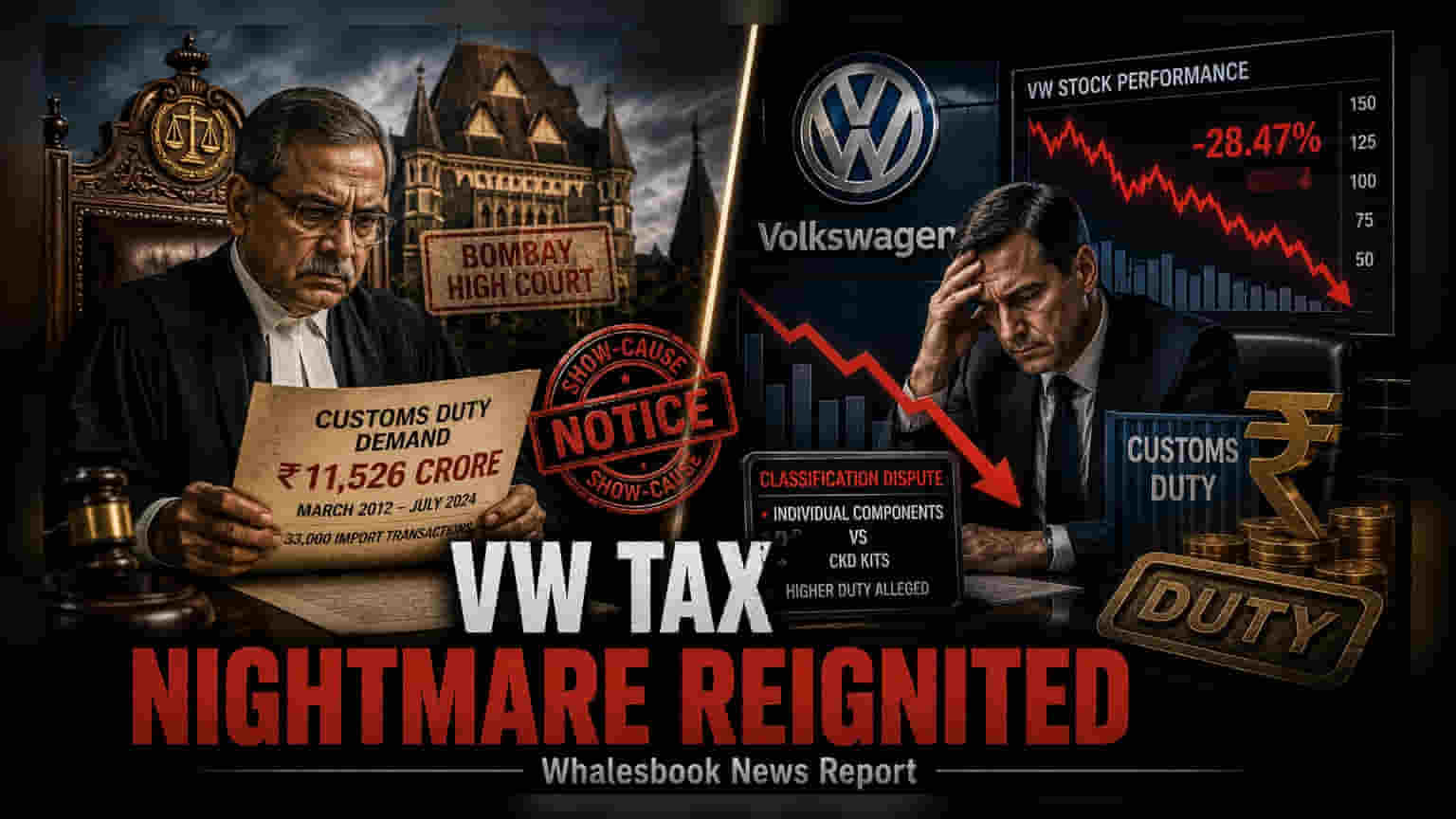
The Bombay High Court has released the Rs 11,526 crore customs duty case against Skoda Auto Volkswagen India, requiring the automaker to re-argue its position before a new bench. This development prolongs a massive legal dispute over import classification that has spanned over a decade, creating fresh uncertainty regarding the company's financial liability and operational focus in India.
The legal dispute between customs authorities and Skoda Auto Volkswagen India has taken a significant turn, as the Bombay High Court has released the matter without a final verdict. The case, which involves a massive customs duty demand of Rs 11,526 crore, must now be re-argued from the beginning before a new bench. This follows a period of 1.5 years during which the previous bench had reserved its judgment, only for the matter to be released due to procedural timelines.
The core of the conflict stems from a show-cause notice issued by customs authorities, which alleges that the company incorrectly classified imported vehicle components. The dispute covers a long period, specifically imports made between March 2012 and July 2024, involving approximately 33,000 transactions. Authorities contend that these imports were classified as individual components to take advantage of lower duty rates, whereas they should have been classified as Completely Knocked Down (CKD) kits, which attract higher taxes.
Skoda Auto Volkswagen India has consistently refuted these allegations. The company maintains that its classification practices were fully compliant with trade regulations and that its imports were indeed sourced as individual components, not as pre-assembled kits. This distinction is critical because the tax difference between individual parts and CKD kits is substantial, forming the basis of the Rs 11,526 crore demand.
For the company, this restart is a significant hurdle. Beyond the massive potential financial liability, the situation creates operational uncertainty. Long-standing legal battles over import classification can divert management focus and resources away from growth and expansion plans in the highly competitive Indian passenger vehicle market. Furthermore, this case is being watched by others in the automotive industry, as the final ruling could set a precedent for how multinational automakers handle the import and classification of vehicle parts in India.
The immediate next step for the company is to prepare and present its arguments anew before the newly assigned bench. Investors and industry observers will be watching the proceedings to see if the company can resolve the tax ambiguity that has persisted for over a decade. Until the legal matter is settled, the potential liability and the associated impact on the company's financial planning remain key monitorables.