 Whalesbook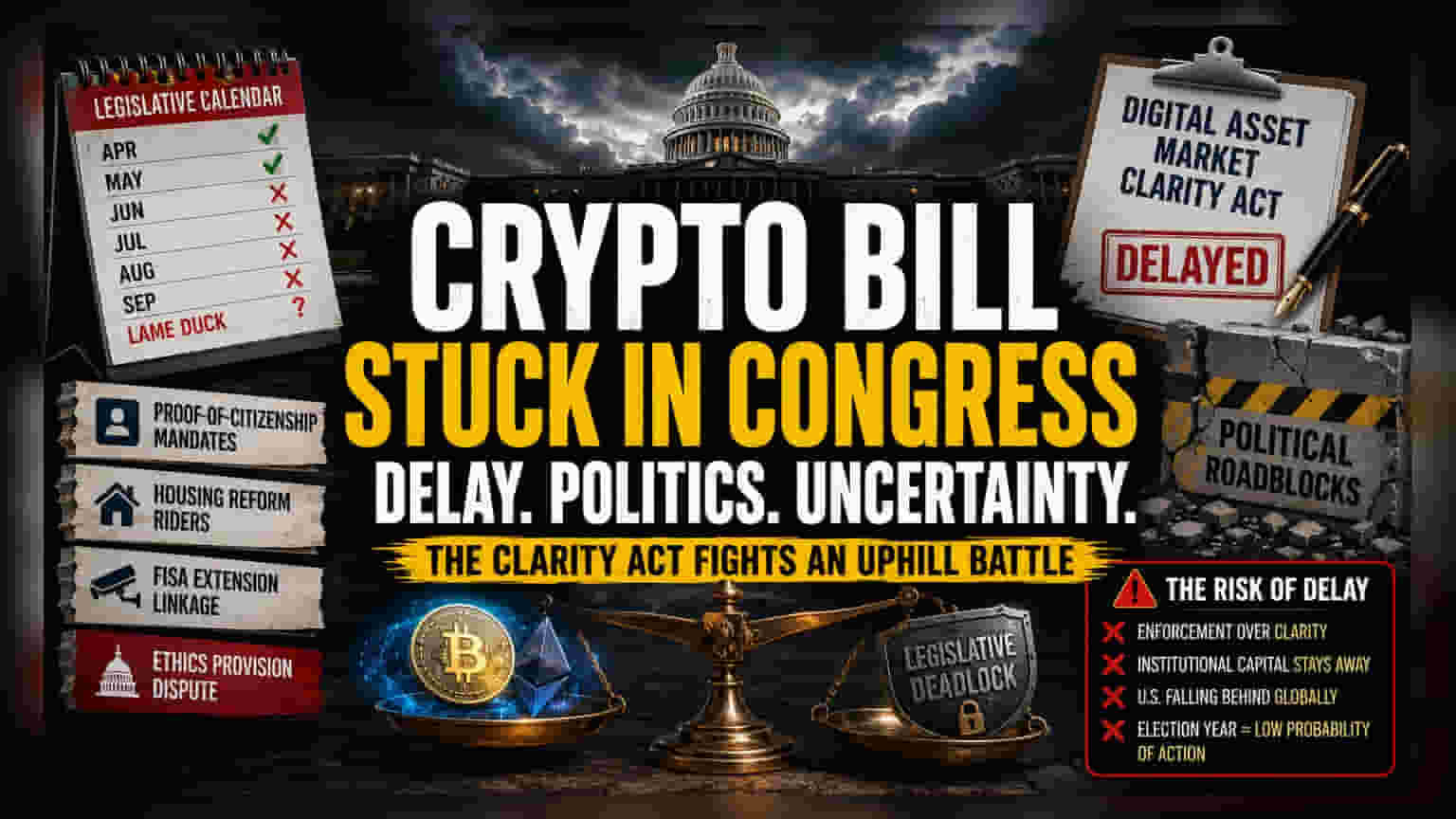


The Legislative Bottleneck
The legislative timeline for the Digital Asset Market Clarity Act has shifted from anticipation to survival. While market participants initially viewed the bill as a necessary framework to institutionalize digital assets, the reality of the current Senate calendar suggests a prioritization shift toward more traditional security and domestic funding concerns. The competition for time is not merely a matter of scheduling but a consequence of deep-seated disagreements over unrelated policy riders that have become inextricably linked to must-pass legislation.
The Impact of Strategic Linkage
The tactical decision by various factions to bundle unrelated requirements—such as proof-of-citizenship mandates or housing reform—onto major bills has created a volatility trap for the Clarity Act. By attaching these polarizing measures to vehicles like the Foreign Intelligence Surveillance Act extension, the legislative process risks becoming paralyzed. For the crypto sector, this means that even if a consensus on digital asset custody or stablecoin issuance is reached, the bill remains hostage to broader, non-crypto political posturing. The reliance on the 'lame duck' session as a final fallback is particularly risky, as such periods often prioritize baseline government funding over substantive regulatory reforms.
The Structural Conflict of Interest
Beyond external legislative hurdles, the internal friction regarding the proposed ethics provision remains a substantial barrier. By targeting the personal digital asset holdings of government officials, the bill has alienated a segment of the Democratic caucus that might otherwise support a clearer regulatory path. This specific disagreement serves as a barometer for the broader challenge: creating a framework that is acceptable to both the technology-focused lobby and the more traditionalist banking sector. The latter continues to exert significant pressure on specific yield-related clauses, viewing competitive stablecoin offerings as a disruption to traditional deposit-taking institutions.
The Bear Case: Why Delay Equals Institutional Neglect
From a risk-management perspective, the failure to pass this legislation carries significant weight. Prolonged uncertainty ensures that the current enforcement-heavy regulatory environment persists, leaving market participants exposed to arbitrary judicial interpretations rather than clear statutory law. Unlike jurisdictions that have moved toward formalized digital asset frameworks, the domestic market remains caught in a stalemate that forces institutional capital toward more stable, albeit less innovative, traditional financial products. As the election cycle moves into its final phase, the probability of meaningful legislative change diminishes, likely extending the current period of depressed institutional confidence and regulatory caution until at least the next year.