

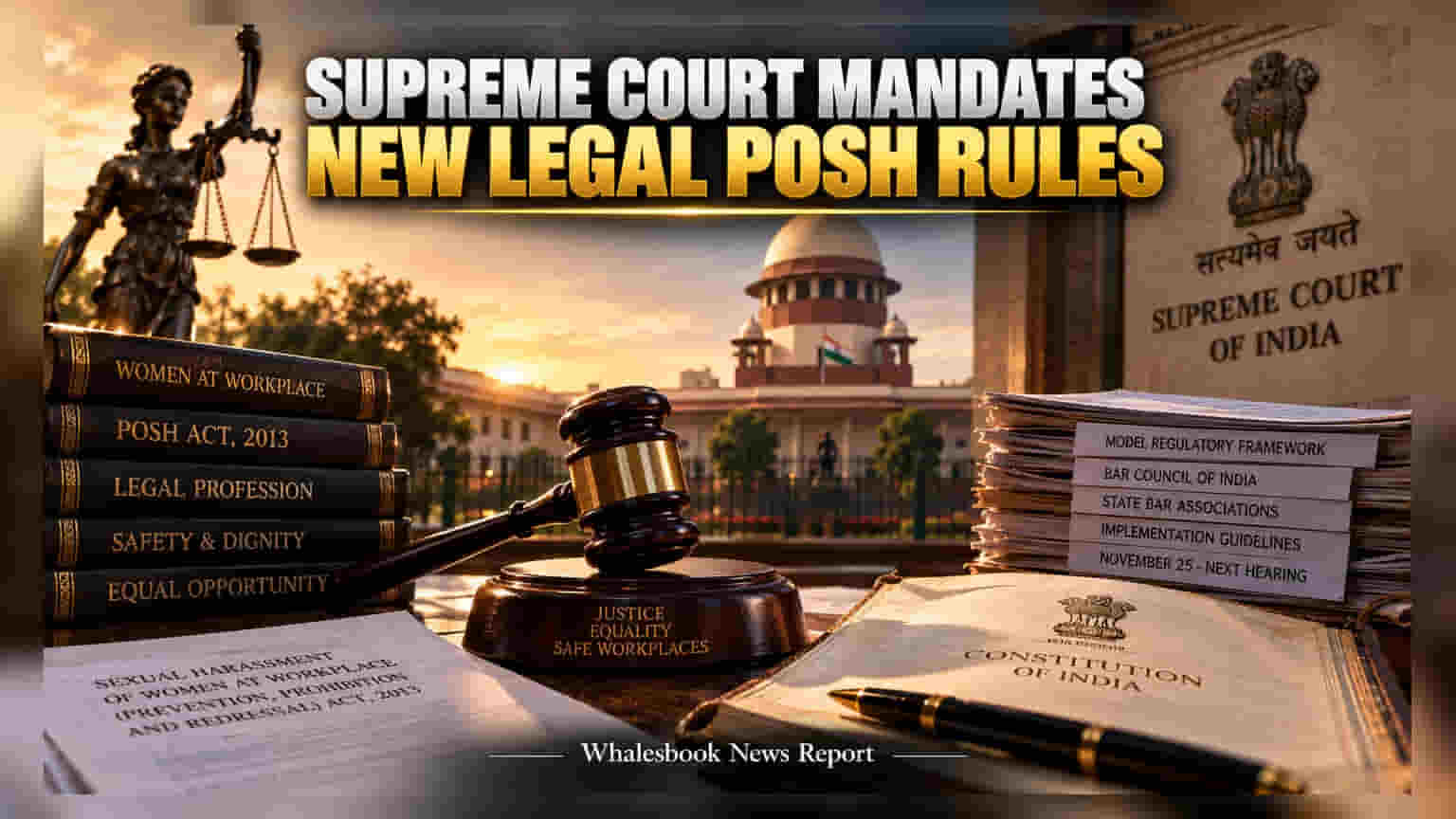
The Supreme Court has ruled that the 2013 POSH Act requires a specialized framework for women in the legal profession. Justices B.V. Nagarathna and Augustine George Masih directed a joint consultation between the Centre, the Bar Council of India, and state bodies to draft uniform regulations across all courts and tribunals. The matter will be reviewed again on November 25.
The Supreme Court of India has directed the formulation of a standardized regulatory framework for the legal profession under the Sexual Harassment of Women at Workplace (Prevention, Prohibition and Redressal) Act, 2013. A bench led by Justices B.V. Nagarathna and Augustine George Masih observed that the current application of the law, when treated rigidly, does not sufficiently address the unique working conditions and operational realities of the legal sector.
Currently, internal anti-harassment regulations—such as those operational within the Supreme Court itself—are often geographically limited to specific court precincts. This has led to a fragmented safety environment where protection mechanisms vary significantly across different high courts, district judiciaries, and quasi-judicial tribunals. The court noted that this inconsistency creates gaps in access to redressal for female advocates working across various legal institutions.
For the broader corporate and professional sector, this move highlights the growing emphasis on consistent governance and compliance standards. As Indian organizations increasingly integrate strict ESG (Environmental, Social, and Governance) principles into their operational models, judicial directives like this often serve as a benchmark for professional bodies and corporate entities to review and strengthen their own internal workplace safety policies.
The Supreme Court has instructed the Bar Council of India to coordinate with various state bar associations to gather implementation data and establish a model regulatory policy. This collaborative effort aims to replace the existing piecemeal approach with a cohesive national policy. The matter is scheduled for further review on November 25, when stakeholders are expected to present the framework for these uniform regulations.