

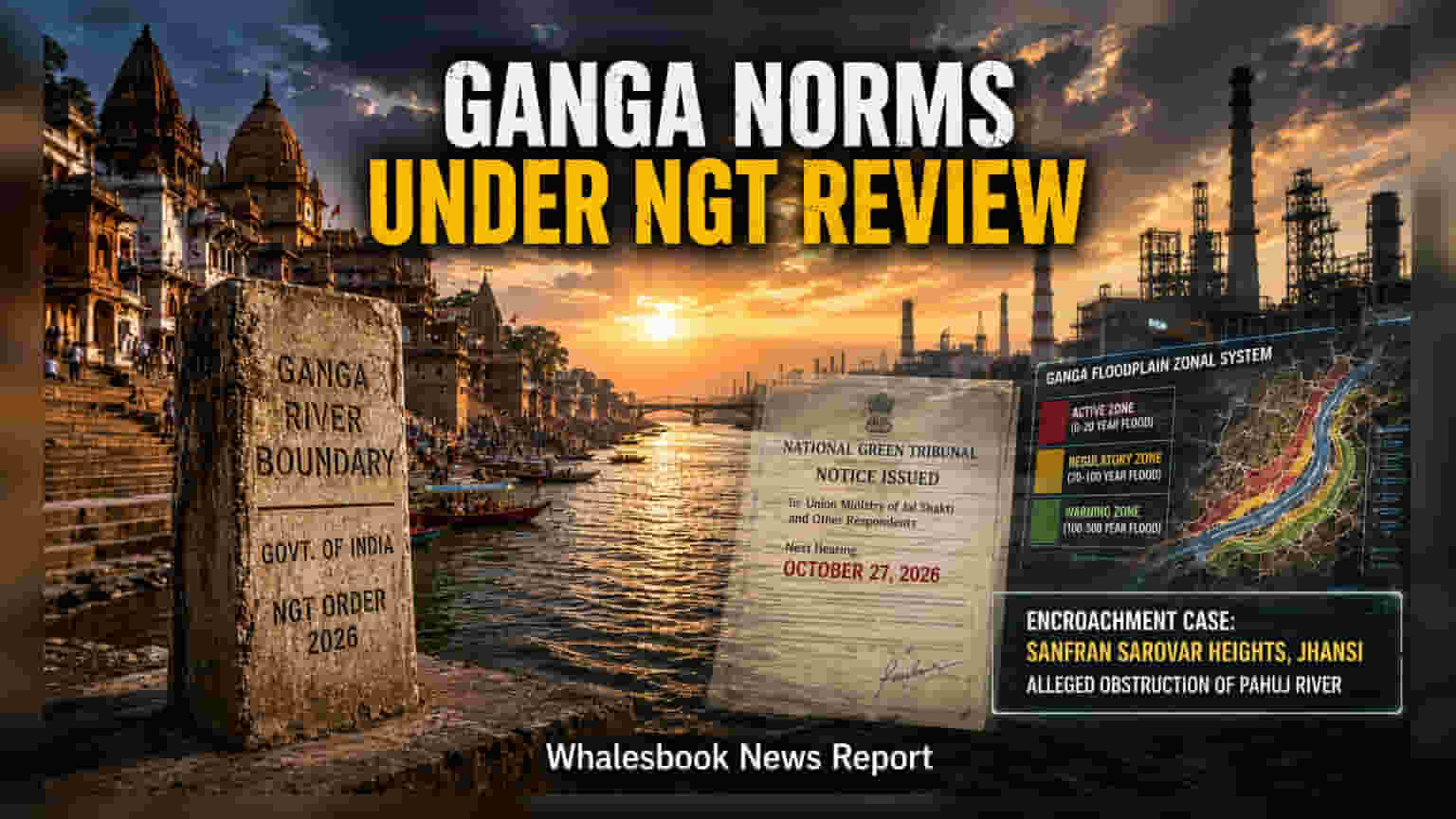
The National Green Tribunal is reviewing the Ministry of Jal Shakti’s August 7, 2026, amendment that changes construction norms near the Ganga. This legal challenge creates uncertainty for infrastructure and real estate projects planned along the river basin. Investors should watch the next hearing on October 27, 2026, for updates on whether these rules could be stayed or reversed.
The National Green Tribunal (NGT) has initiated a legal review of the Union Ministry of Jal Shakti’s August 7, 2026, amendment to the Ganga river construction norms. This amendment, which replaces the previous blanket 'construction-free' status for riverbanks with a new, flexible three-tier zonal system, is now under judicial scrutiny. The tribunal has issued notices to the Centre and relevant environmental agencies, with the next hearing set for October 27, 2026.
The regulatory shift has caused significant uncertainty for developers and infrastructure companies operating in the Ganga basin. The previous norms provided a clear, strict prohibition on construction near riverbanks. The new policy, which classifies floodplains into active, regulatory, and warning zones based on flood return periods, allows for more nuanced land use. However, critics and petitioners argue that this reclassification is regressive and undermines environmental protections set under the Environment (Protection) Act, 1986. For investors, this creates a 'wait and watch' scenario, as any court-ordered reversal or tightening of these norms could disrupt project timelines, force redesigns, or impact the legal viability of projects currently in the planning stage.
While the national policy is being debated, state-level actions continue to move forward. The Uttar Pradesh government has reported progress in its preservation efforts, confirming the completion of physical demarcation for a 700-kilometer stretch of the Ganga. By installing over 7,350 permanent pillars across 13 districts, the state aims to clearly define floodplain boundaries. This effort provides a baseline for local administration, though its effectiveness may still be subject to the outcome of the ongoing NGT proceedings regarding national policy.
Separately, the NGT is continuing its crackdown on specific cases of riverbed encroachment. In a notable instance in Jhansi, the tribunal is investigating allegations that the Sanfran Group’s 'Sanfran Sarovar Heights' project is encroaching upon the natural flow of the Pahuj river. The NGT has directed authorities to verify site coordinates to determine if construction debris is obstructing the riverbed. This case, distinct from the broader Ganga floodplain policy debate, highlights the tribunal's strict stance against illegal construction near water bodies.
The key monitorable for investors and stakeholders in the coming months will be the NGT’s hearing on October 27. The tribunal’s decision on whether to maintain, modify, or strike down the new zonal classification will determine the long-term regulatory environment for commercial and infrastructure projects along the Ganga. Until legal clarity is established, projects in these regions may face increased scrutiny from regulators and environmental activists.