

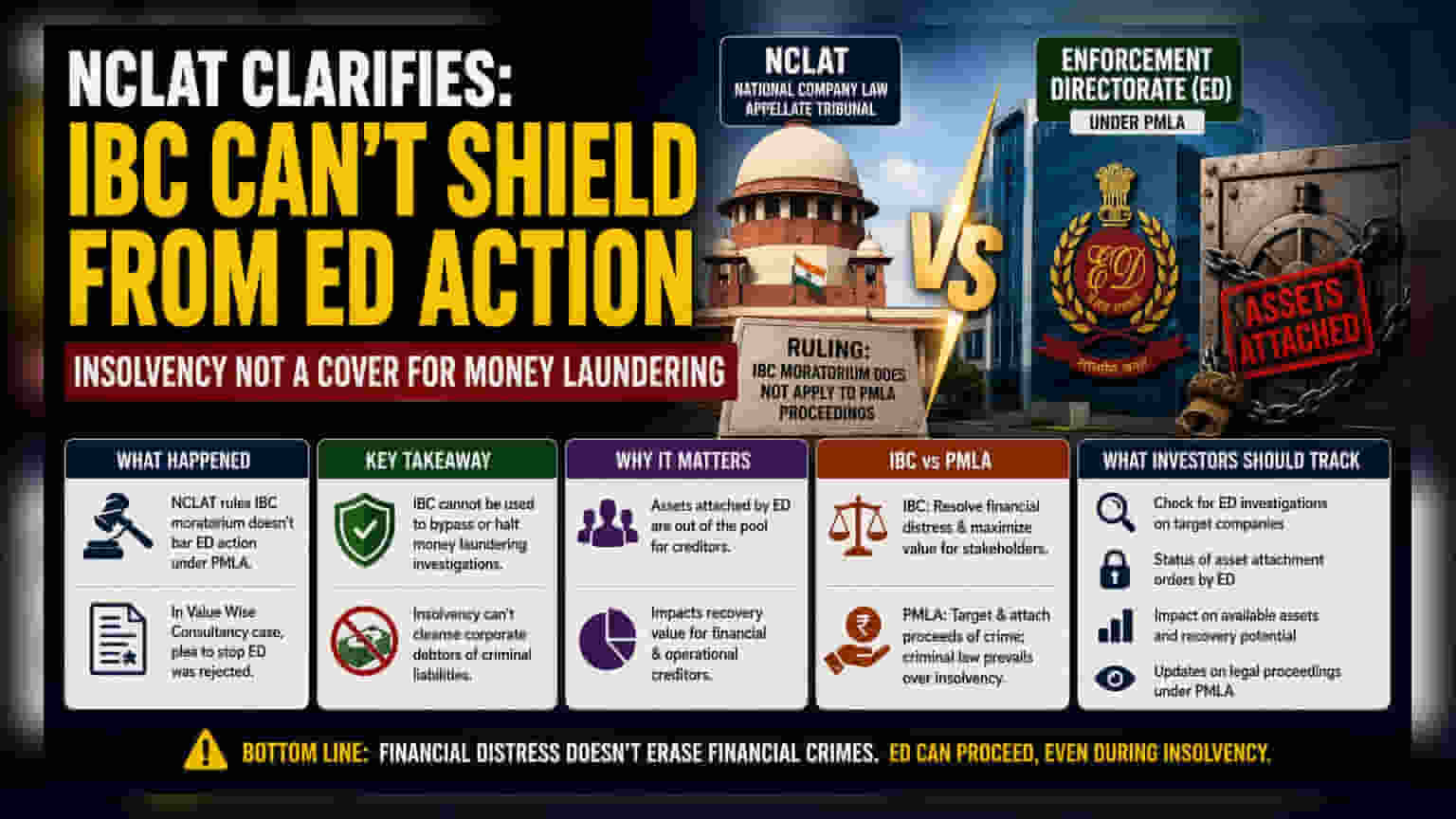
The National Company Law Appellate Tribunal (NCLAT) has ruled that the Insolvency and Bankruptcy Code (IBC) does not prevent actions under the Prevention of Money Laundering Act (PMLA). The tribunal clarified that assets linked to criminal proceedings cannot be protected by insolvency or liquidation processes, ensuring that law enforcement investigations remain separate from corporate bankruptcy.
What Happened
The National Company Law Appellate Tribunal (NCLAT) has clarified a key legal boundary regarding corporate insolvency. In a recent judgment involving Value Wise Consultancy, the tribunal ruled that the Insolvency and Bankruptcy Code (IBC) cannot be used as a shield to bypass investigations or actions initiated by the Enforcement Directorate (ED) under the Prevention of Money Laundering Act (PMLA).
The NCLAT stated that the IBC’s moratorium—a period where legal actions against a company are paused to allow for resolution or liquidation—does not apply to PMLA proceedings. The bench rejected the idea that insolvency processes could be used to 'cleanse' corporate debtors of criminal liabilities, noting that assets alleged to be proceeds of crime cannot be absorbed into the insolvency estate simply because a company is struggling financially.
Why This Matters For Investors
For investors and creditors, this ruling brings clarity to the risks involved in insolvency cases. Often, when a company enters insolvency, creditors hope to recover dues by liquidating the company’s assets. However, if the Enforcement Directorate attaches these assets due to allegations of money laundering or bank fraud, those assets are effectively removed from the pool available to creditors.
This ruling confirms that if a company is under investigation for financial crimes, the legal path for the Enforcement Directorate remains open. Creditors and potential resolution applicants should factor in that assets under the scanner of law enforcement agencies might not be recoverable, even during the corporate insolvency resolution process.
The IBC-PMLA Distinction
The NCLAT’s decision highlights the difference between the goals of the two laws. The IBC is designed to resolve financial distress and maximize the value of assets for stakeholders. However, the PMLA is a criminal law aimed at identifying and attaching wealth derived from illegal activities. The tribunal emphasized that the IBC cannot be used as a 'camouflage' for ill-gotten wealth.
The case arose after a liquidator requested that the NCLT stop the ED from taking action against the corporate debtor. The liquidator argued that the ED's withdrawal of funds from the company’s bank accounts hindered the liquidation process. The NCLAT disagreed, upholding the ED's power to proceed with investigations independently of the IBC.
What To Watch Next
Investors involved in distressed assets or companies currently under insolvency resolution should monitor whether their target entities have pending investigations by the Enforcement Directorate. The key monitorable for stakeholders is the status of asset attachment orders by law enforcement agencies. If significant assets are linked to money laundering allegations, they may not be available for resolution, which can impact the recovery value for financial and operational creditors.