

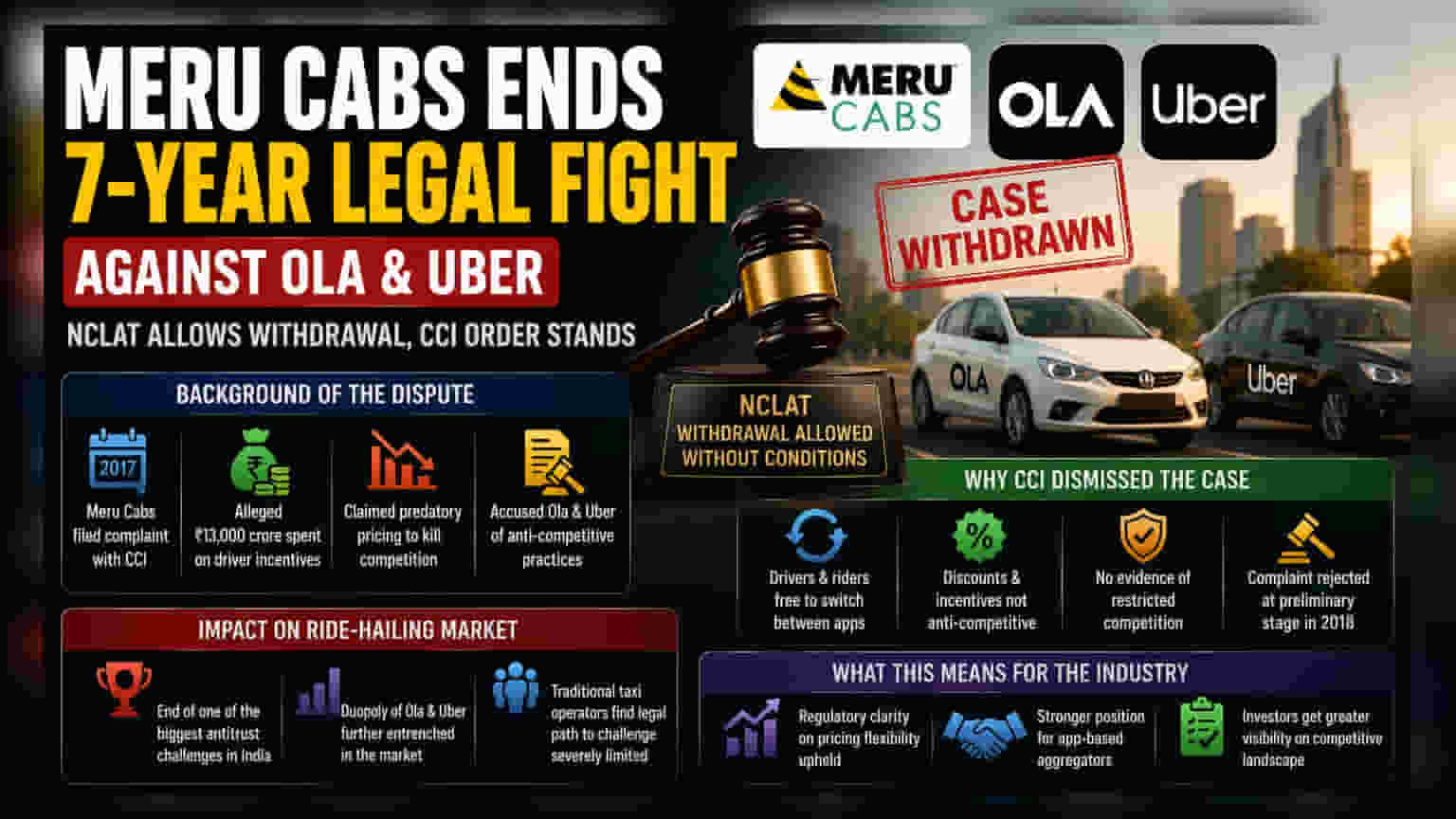
Meru Cabs has withdrawn its long-standing predatory pricing case against ride-hailing majors Ola and Uber at the NCLAT, citing financial constraints. This move closes the legal challenge, with the Competition Commission of India’s 2018 dismissal of the complaints remaining final. The withdrawal highlights the continued consolidation of the Indian ride-hailing market around major aggregators.
What Happened
Meru Cabs has officially ended its seven-year legal battle against ride-hailing companies Ola and Uber. The company informed the National Company Law Appellate Tribunal (NCLAT) that it could no longer sustain the legal fight due to a resource crunch and operational difficulties. The tribunal allowed the withdrawal without conditions, which means the previous decision made by the Competition Commission of India (CCI) to dismiss the complaints remains in place.
Background of the Dispute
The legal battle began in 2017 when Meru Cabs approached the CCI, accusing Ola and Uber of engaging in anti-competitive practices. Meru claimed that these ride-hailing companies were using their significant financial backing to offer unsustainable discounts and driver incentives. The argument was that this was a form of predatory pricing designed to drive out competition and monopolize the market. Meru had alleged that the companies spent roughly ₹13,000 crore on driver incentives in India to capture market share.
Why the CCI Dismissed the Case
In 2018, the CCI rejected Meru’s allegations at the preliminary stage. The commission stated that providing driver incentives and customer discounts did not automatically count as an anti-competitive agreement. A key factor in the regulator's decision was that both drivers and riders had the flexibility to switch between different apps and platforms. Since no single platform was forcing users to stay, the regulator found no evidence of restricted competition that would violate the Competition Act.
Impact on the Ride-Hailing Market
The withdrawal of this case marks a formal end to one of the most prominent antitrust challenges in the Indian gig economy sector. For years, traditional radio taxi operators argued that the aggregator model, supported by deep-pocketed venture capital, made it nearly impossible for traditional models to compete on price. The exit of this case serves as a reality check on the changing structure of the urban transport market, where app-based aggregators have established a clear lead.
What This Means for the Industry
For the broader market, this development signals the further entrenchment of the duopoly in the Indian ride-hailing space. The ability of new or traditional entrants to challenge these established giants through legal routes has been significantly limited by this outcome. Investors often track such regulatory developments to gauge the stability of the operating environment for tech-driven platforms. With the legal challenge removed, there is greater clarity regarding the competitive landscape, as the regulator’s stance on pricing flexibility remains largely unchallenged.