 Whalesbook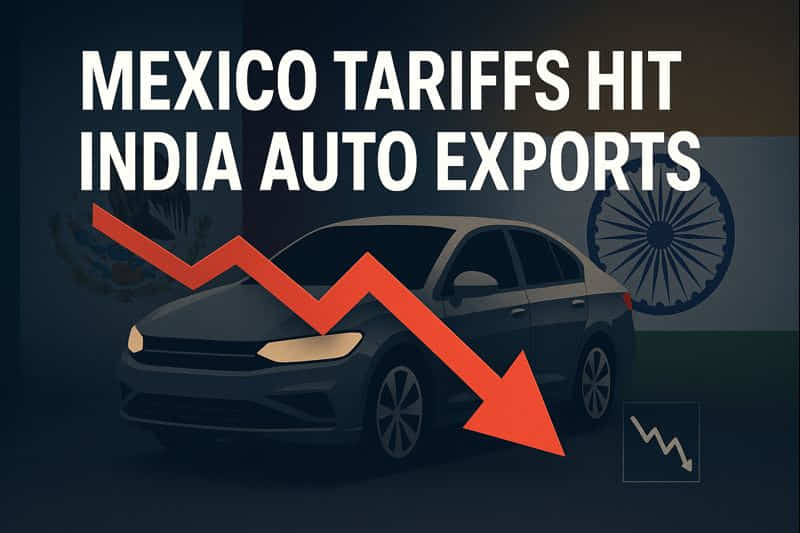
Mexico's Tariff Hike Hits Indian Auto Exports
Mexico has significantly escalated trade tensions by imposing tariffs of up to 50% on certain imported goods from India and other Asian nations. This sharp increase in duties is expected to affect approximately $1 billion worth of automotive shipments originating from India, a move that could force major Indian car exporters to fundamentally reevaluate their strategies for this crucial market.
The Core Issue
The imposition of these substantial tariffs by Mexico is widely seen as a strategic trade policy adjustment, potentially a direct response to tariffs implemented by the United States. By targeting specific categories of imports with duties as high as 50%, Mexico aims to rebalance trade relationships and potentially bolster its domestic automotive manufacturing sector. This action directly impacts countries like India, which have established significant export volumes to Mexico.
Financial Implications
For Indian automakers, the immediate consequence is a substantial increase in the cost of exporting vehicles to Mexico. With an estimated $1 billion in annual shipments now subject to significantly higher tariffs, companies face the challenging prospect of reduced profit margins, a potential decline in export volumes, or the difficult decision to absorb some of the increased costs. This introduces considerable financial uncertainty and requires a meticulous reevaluation of business models that have historically benefited from Mexico's previous trade accessibility.
Market Reaction
Investors and financial analysts are closely monitoring the unfolding situation, as these new tariffs represent a notable headwind for India's crucial automotive export sector. Companies whose revenue streams are heavily dependent on sales volumes in Mexico may experience downward pressure on their stock valuations. The market's reaction will likely hinge on the extent to which manufacturers can successfully mitigate these increased costs, either through strategic pricing adjustments or by effectively diversifying their export market portfolios.
Affected Companies
Several leading Indian car manufacturers are directly exposed to these new trade measures. Maruti Suzuki India, the nation's largest passenger car maker, is known to export vehicles to Mexico. Bajaj Auto, a significant player in both two-wheeler manufacturing and exports, also sends products to the Mexican market. Furthermore, Hyundai Motor India, a key subsidiary of Hyundai Motor Company, has reported substantial car shipments to Mexico, making it another prominent entity facing potential disruption.
Future Outlook
In response to these evolving trade dynamics, Indian automakers will likely need to implement strategic pivots. This could involve intensified efforts to explore alternative export markets, a careful adjustment of their product mix to align with new cost structures, or a greater focus on strengthening domestic market share. The critical factor for sustained success will be the ability to either pass on increased costs to consumers in Mexico or efficiently absorb them without compromising overall profitability. The long-term impact will fundamentally depend on the duration of these tariffs and the adaptive resilience demonstrated by the Indian auto industry.
Impact Rating
7
Difficult Terms Explained
- Tariffs: Taxes imposed by a government on imported goods, often designed to protect domestic industries or influence trade balances.
- Exporters: Individuals or companies engaged in selling goods or services to foreign countries.
- Subsidiary: A company that is owned or controlled by a larger parent company.
- EBITDA margin: A financial metric indicating a company's operational profitability before accounting for interest, taxes, depreciation, and amortization expenses.
- YoY (Year-over-Year): A method of comparing financial data from a specific period (like a quarter or year) with the equivalent period from the previous year to track performance trends.