

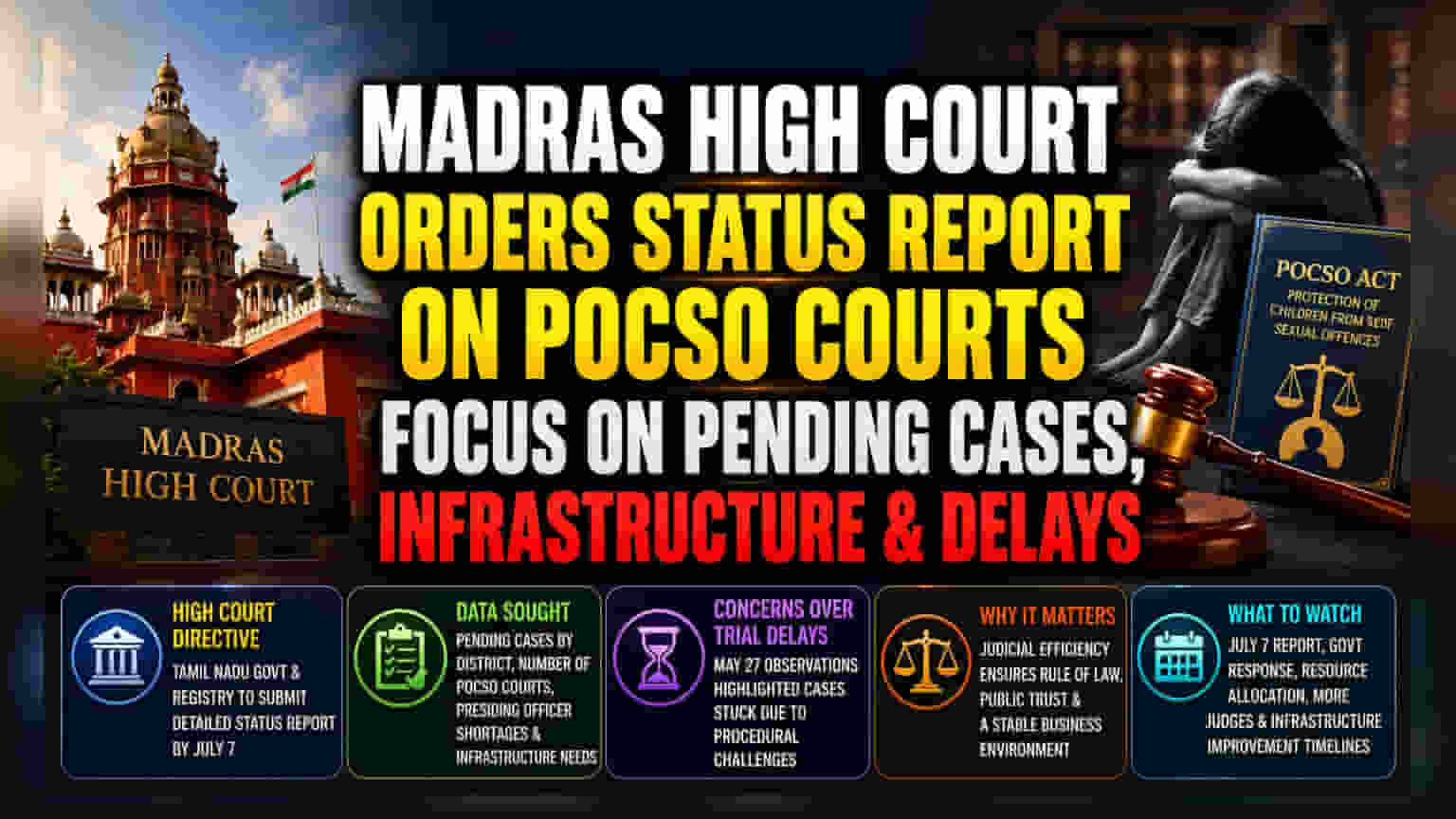
The Madras High Court has directed the Tamil Nadu government and its registry to submit comprehensive reports on POCSO court operations by July 7. This move aims to address judicial delays, infrastructure gaps, and officer vacancies in cases involving the Protection of Children from Sexual Offences Act. Efficient legal processes remain a vital component of institutional governance in the state.
What Happened
The Madras High Court has issued a directive to the Tamil Nadu government and the High Court Registry to provide a detailed status report on the functioning of courts handling cases under the Protection of Children from Sexual Offences (POCSO) Act. The order, issued on June 22 by a Division Bench comprising Chief Justice Sushrut Arvind Dharmadhikari and Justice G Arul Murugan, requires these reports to be submitted by July 7.
The court is seeking specific data to assess the current judicial landscape for these sensitive cases. The required information includes the total number of pending POCSO cases in each district, the number of currently operational POCSO courts, and an assessment of districts that face a shortage of presiding officers. Additionally, the court has requested details on the infrastructure upgrades needed to speed up trial proceedings across the state.
Concerns Over Trial Delays
This judicial intervention follows earlier observations made by a bench on May 27, which highlighted specific issues with trial efficiency. In that instance, the court noted a case registered in December 2025 that had not yet proceeded to trial. The case involved accused individuals who were previously police personnel and had been dismissed from service in October 2025. The bench expressed concern that a revision petition filed by the accused regarding a discharge plea was causing unexplained delays in the trial process.
The court emphasized that procedural challenges should not become a barrier to the timely resolution of sensitive cases. The current directive aims to identify structural and procedural bottlenecks that may be contributing to such delays across the state's POCSO court system.
Why Governance and Legal Efficiency Matter
For investors and observers of the state’s business environment, judicial efficiency is a key component of institutional governance. A functioning legal system that ensures the rule of law is fundamental to a stable operating environment. While this specific order focuses on POCSO courts, the court's effort to map infrastructure, vacancies, and case pendency reflects a broader focus on administrative accountability.
Efficient judicial processes are necessary to maintain public trust in institutions. When courts face infrastructure gaps or high vacancy rates, it can lead to backlogs that affect the overall delivery of justice, which is a baseline expectation for stable governance in any region.
What To Watch Next
The most important monitorable is the report submission due on July 7. This report is expected to provide a clearer picture of the scale of infrastructure and personnel shortages in Tamil Nadu’s POCSO courts. Investors and public stakeholders will likely watch for the state government’s response and any follow-up judicial actions regarding resource allocation, the appointment of additional presiding officers, and timelines for improving court infrastructure to address the identified case backlogs.