 Whalesbook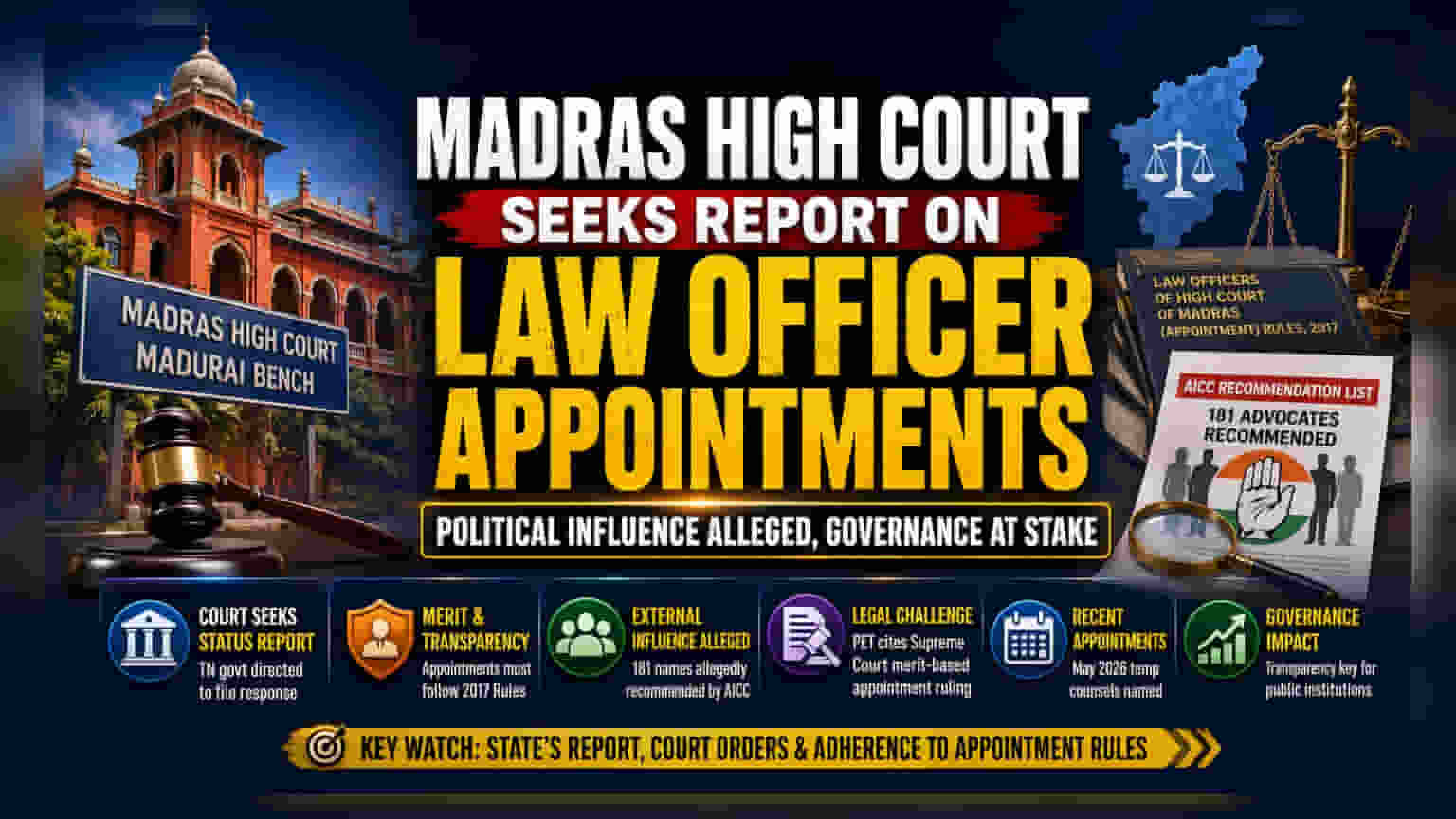


What Happened
The Madurai Bench of the Madras High Court has directed the Tamil Nadu government to submit a formal status report in response to a public interest litigation. The petition, filed by Advocate C Selvakumar, challenges the process used to appoint law officers, alleging that outside political influence—specifically from the All India Congress Committee (AICC)—is being used to select candidates for state counsel roles.
Why Governance Transparency Matters
For those monitoring the state’s administrative environment, the integrity of legal appointments is significant. Law officers represent the government in courts, and public institutions are expected to ensure these appointments are based on merit and follow established legal guidelines. The petitioner argues that relying on external recommendations bypasses the Law Officers of High Court of Madras and its Bench at Madurai (Appointment) Rules, 2017.
The Legal Challenge
The petitioner brought to the court's attention a document circulating on social media, which purportedly lists 181 advocates recommended by the AICC for various roles, including Additional Advocate General, Standing Counsel, and Government Advocate. The petition contends that considering such external lists violates principles of transparency, citing the Supreme Court’s direction in the Mamata Mohanty v. State of Orissa case regarding merit-based public appointments.
Context of Recent Appointments
The petition follows several temporary appointments made by the state in May 2026. These include the appointment of Senior Advocates PV Balasubramaniam and T Gowthaman as Additional Advocate Generals, and Senior Advocate R John Sathyan as a temporary counsel on the criminal side, along with 17 temporary counsels for the civil side appointed on May 26. The petitioner argues that proceeding with further recruitment while this legal challenge is pending could create third-party rights and complicate the judicial review process.
What Investors Should Track
The primary monitorable is the forthcoming status report from the state government. The court's reaction to this report and its subsequent orders will provide clarity on the state's adherence to the 2017 Appointment Rules. Observers will track whether the selection process is reaffirmed as transparent and merit-based, as this speaks to the consistency and governance standards within state-level administrative bodies.