

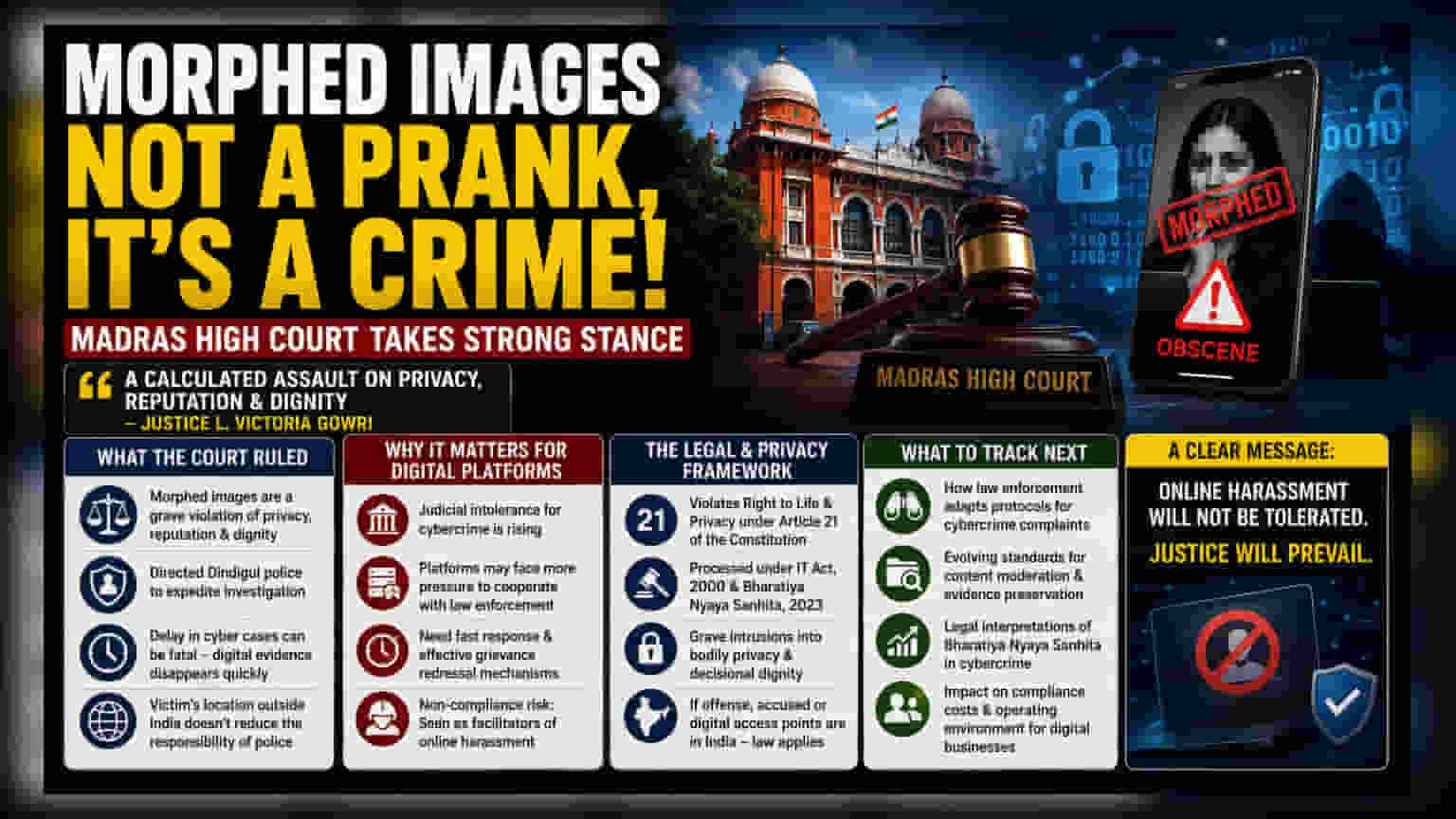
The Madras High Court has ruled that creating morphed images of women is a severe criminal act, not a harmless prank, directing police to act swiftly on such complaints. The court's directive emphasizes the urgent need for digital evidence preservation. This ruling highlights the strengthening legal environment around online safety, privacy, and the accountability expected from digital platforms operating in India.
What The Court Ruled
The Madurai Bench of the Madras High Court has delivered a strong message regarding the circulation of morphed images, classifying them as a "calculated assault" on privacy, reputation, and dignity rather than a digital prank. Justice L. Victoria Gowri directed the Dindigul police to expedite their investigation into a complaint involving the creation of obscene content and fake social media profiles. The ruling stemmed from a petition regarding a Singapore-based housekeeper who faced harassment, including allegations that an individual, identified in the petition as Manikandan, allegedly demanded money to remove the content after it was circulated online.
Why This Matters for Digital Platforms
For digital platforms and companies operating in the online space, this ruling underscores the rising regulatory and judicial intolerance for cybercrime. The court emphasized that in cyber offenses, delay can be fatal because digital footprints—such as URLs, IP logs, and account details—are fragile and can disappear quickly. The directive mandates that law enforcement must act promptly to preserve this evidence.
This development suggests that digital entities may face increased pressure to cooperate rapidly with law enforcement during investigations. As the legal framework tightens, businesses, especially those managing social media or user-generated content, are under greater scrutiny to implement effective grievance redressal mechanisms and comply with requests for data preservation to avoid being seen as facilitators of online harassment.
The Legal and Privacy Framework
Justice Gowri noted that such offenses violate the right to life and privacy protected under Article 21 of the Constitution. The court clarified that the victim's physical absence from India does not reduce the responsibility of local law enforcement when the offense, accused, or relevant digital access points are connected to Indian territory. The case is being processed under the Information Technology Act, 2000, and the Bharatiya Nyaya Sanhita, 2023. By framing these acts as grave intrusions into bodily privacy and decisional dignity, the court has signaled that such cases should not be dismissed as simple interpersonal disputes.
What To Track Next
Investors and stakeholders in the digital and tech sector should track how law enforcement agencies across India adjust their protocols for handling cybercrime complaints following this directive. The key monitorable for the industry is the evolving standard of compliance regarding content moderation and the speed of response required when authorities request digital evidence preservation. Additionally, ongoing legal interpretations of the Bharatiya Nyaya Sanhita in the context of cybercrime will continue to shape the operating environment for digital businesses in India.