

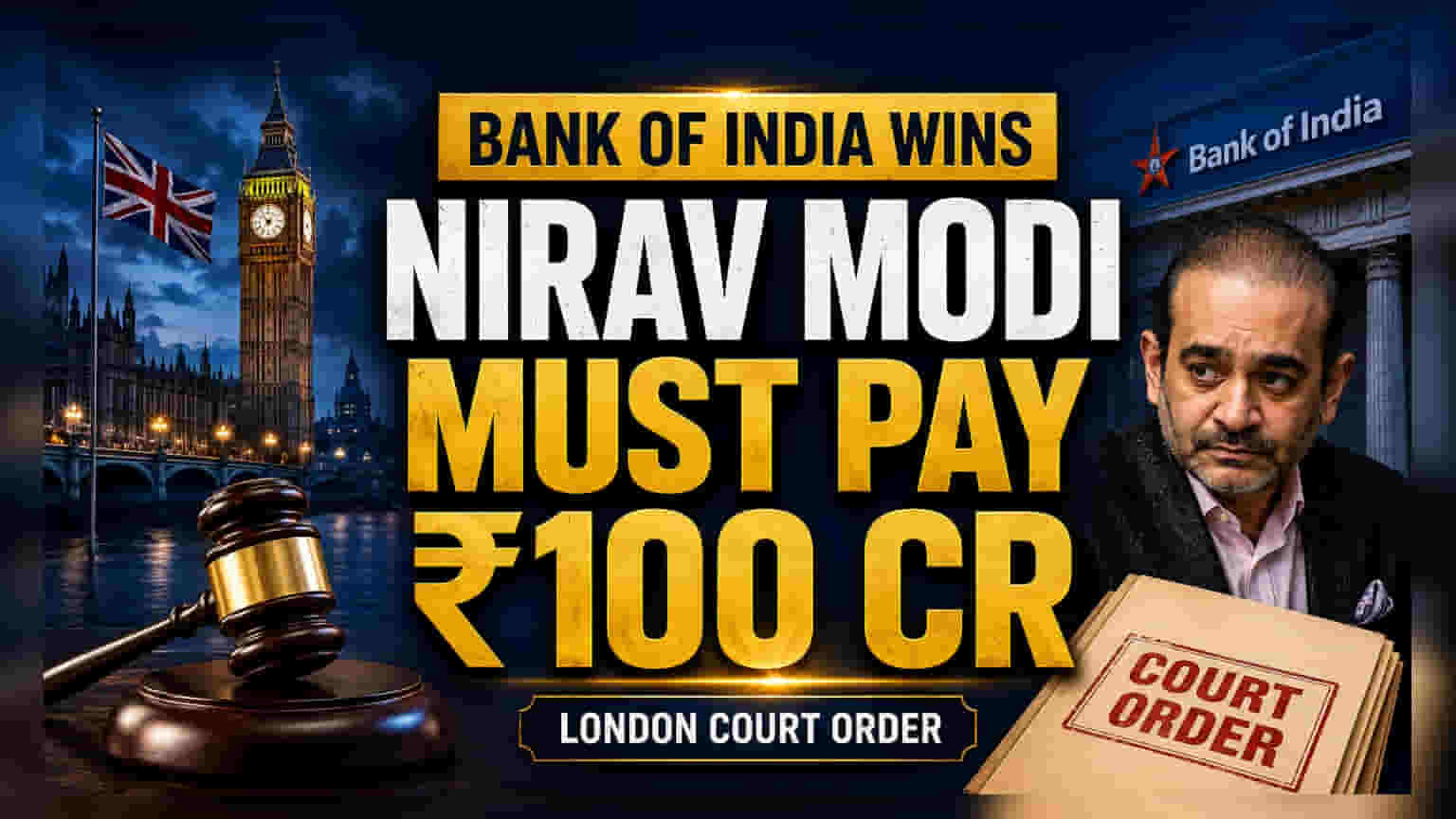
The London High Court has ruled that fugitive diamantaire Nirav Modi is personally liable to repay Bank of India over $10.7 million (approximately ₹100 crore). This decision reinforces the bank's efforts to recover dues linked to a 2012 loan facility provided to the Dubai-based Firestar Group.
What Happened
The London Circuit Commercial Court has issued a ruling against fugitive businessman Nirav Modi, directing him to pay Bank of India more than $10.7 million, which is equivalent to over ₹100 crore. Justice Simon Tinkler, who presided over the case, dismissed arguments presented by Modi’s legal team and confirmed his personal liability regarding the unpaid dues. The court order enforces a personal guarantee signed by Modi in 2013 for a credit facility extended to his Dubai-based company, Firestar Diamond FZE, back in 2012.
Why It Matters For Investors
For Indian banking investors, this ruling represents a tangible step in the long-drawn-out recovery process following the major financial irregularities that surfaced in 2018. While the amount of ₹100 crore is a small fraction of the total losses associated with the various banking fraud cases, the legal victory is significant. It demonstrates the ability of Indian public sector banks to pursue and enforce recovery claims in international jurisdictions against fugitive economic offenders. The court’s rejection of Modi's defense—which claimed he never received valid repayment notices—strengthens the bank's position in ongoing asset recovery efforts.
Legal Context and Previous Developments
The path to this judgment involved several stages. Bank of India had previously secured a summary judgment for the principal amount of $4.1 million in March 2024. The latest proceedings focused on the enforcement of the personal guarantee that Modi had signed. Throughout the trial, Modi’s defense team attempted to argue that the guarantee was unenforceable and that the termination of the loan agreement was unjustified. The court, however, sided with the bank, noting that by early 2018, it was reasonable to infer that the financial operations of the Firestar Group were severely impacted by the investigations, effectively impairing the value of the guarantees.
Broader Recovery Environment
Nirav Modi remains in a UK prison, where he has been detained since March 2019 while fighting extradition to India. His legal challenges, including a recent petition to reopen extradition proceedings based on the 'Bhandari judgment,' have been rejected by the London High Court. The ongoing legal battles in both the UK and India highlight the complexity of repatriating funds and individuals involved in major financial fraud cases. Banks like Bank of India continue to utilize international legal frameworks to attempt the recovery of outstanding loans from mortgaged assets and personal guarantees.
What Investors Should Track
Investors will continue to watch for updates on the actual realization of these funds. While legal victories are positive, the real value for shareholders lies in the successful auction or liquidation of assets to turn these court orders into cash on the bank's balance sheet. Furthermore, the extradition status of the accused remains a critical monitorable, as his physical presence in India would be a key development in the broader PNB-related cases.