 Whalesbook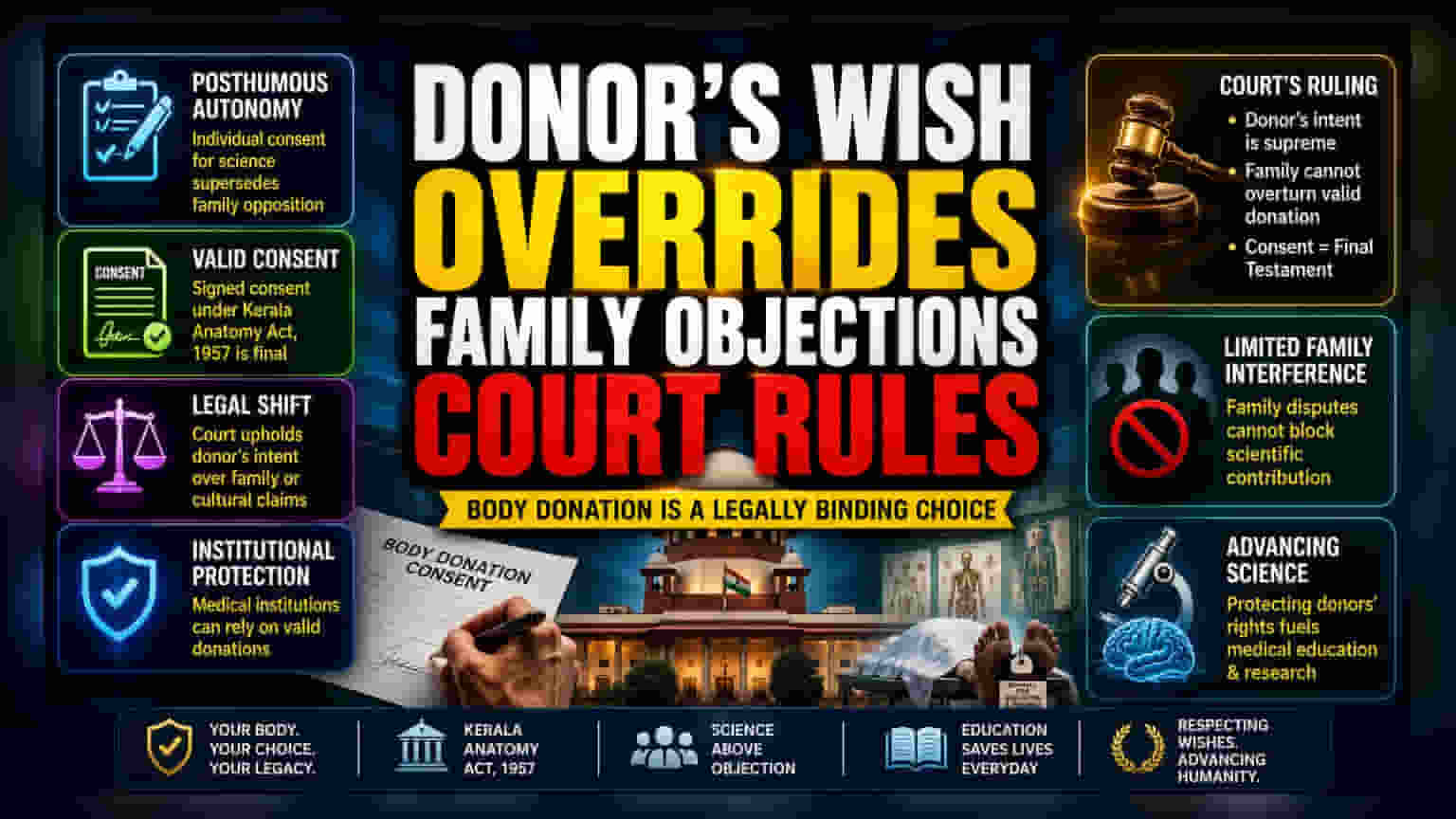


Establishing Posthumous Autonomy
The judiciary has solidified a critical stance on personal agency, ruling that a formal commitment to donate remains for scientific advancement outweighs the religious or cultural objections raised by surviving kin. By upholding the Division Bench decision, the court has effectively shielded the deceased's intent from being overruled by the subjective demands of legal heirs. The focus remains fixed on the validity of consent provided under the Kerala Anatomy Act of 1957, which serves as the statutory backbone for medical institutions acquiring cadavers for educational purposes.
The Anatomy of the Dispute
The legal friction arose when a segment of the deceased's family challenged the donation of their mother’s remains, arguing that the decision lacked transparency among all legal heirs. While the dissenting children sought to reclaim the body for customary burial, the existence of a signed consent letter acted as the primary evidence. This document successfully moved the case out of the domain of familial negotiation and into the realm of contractual obligation. The court essentially treated the consent form as a final testament, effectively preventing third-party interference in a legally binding directive.
The Legal Shift
Historically, the disposition of human remains has often been subject to the influence of family consensus. However, the ruling by Justice AK Jayasankaran Nambiar and Justice Preeta AK shifts the burden of proof onto those who wish to challenge such donations. This creates a clear signal for medical institutions that once a valid legal donation instrument is verified, the institutional right to utilize the remains for anatomical study is ironclad. It diminishes the capacity for family disputes to paralyze the scientific contributions of individuals, ensuring that personal wishes are protected from the volatility of internal family conflicts.
Future Implications for Medical Institutions
The judgment provides a layer of legal certainty for medical colleges and researchers who have often faced litigation when families attempt to reverse donor requests. By formalizing that an individual's right to their own body survives their physical death, the court has effectively reduced the operational risk associated with body procurement. Organizations relying on anatomical donations can now rely on the precedent that, provided the statutory requirements of the 1957 Act are met, the intent of the donor constitutes a final authority that even direct kin cannot easily overturn.