

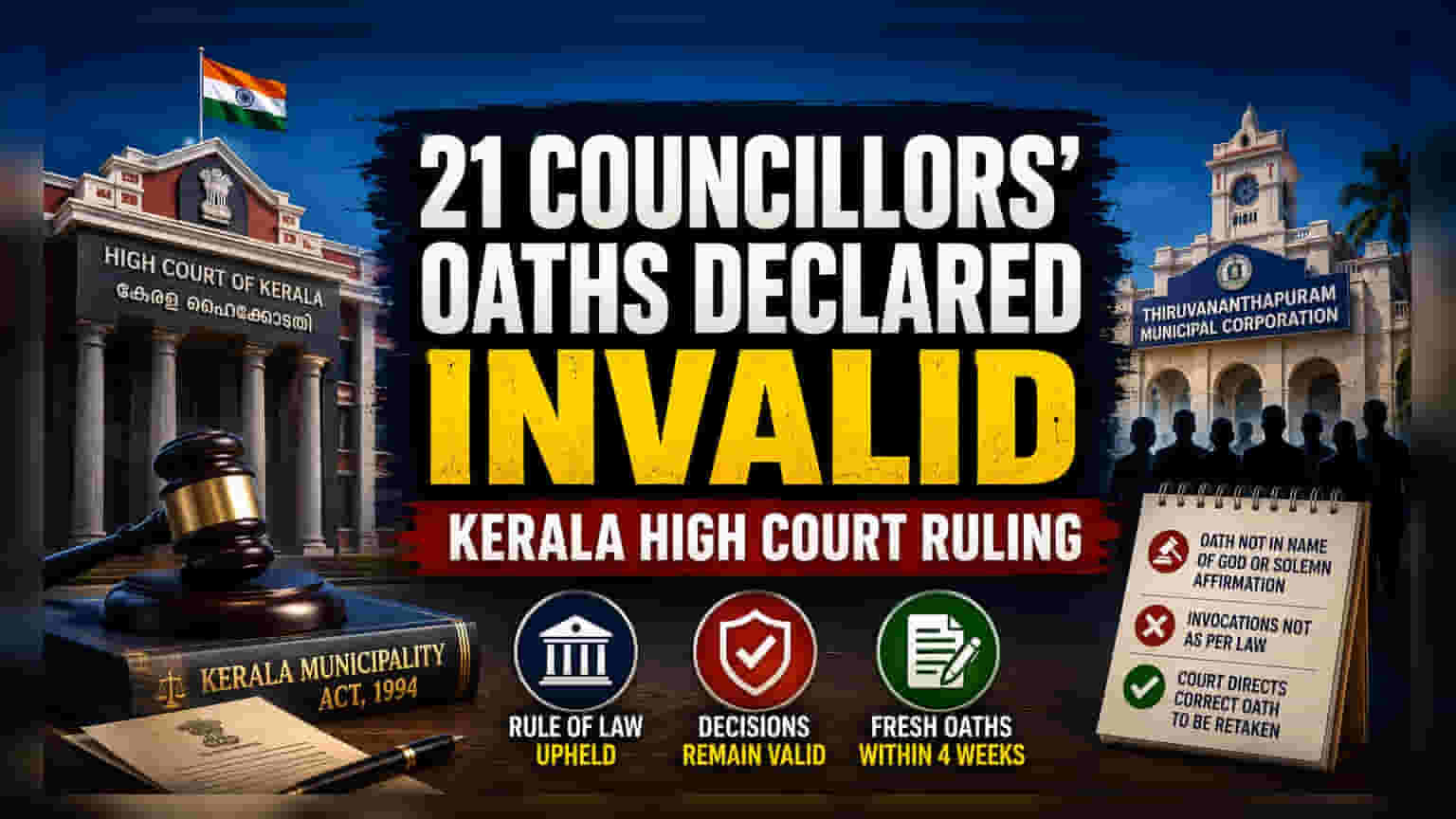
The Kerala High Court has nullified the oaths of 20 BJP councillors and one Congress member in the Thiruvananthapuram Municipal Corporation. The court ruled that the oaths did not follow the legal format prescribed by the Kerala Municipality Act. The members must retake their oaths within four weeks, though the court confirmed that previous administrative decisions remain valid.
What Happened
The Kerala High Court has declared the oaths taken by 21 councillors in the Thiruvananthapuram Municipal Corporation as invalid. This ruling affects 20 councillors from the Bharatiya Janata Party (BJP) and one member from the Congress party. Justice PV Kunhikrishnan presided over the matter, ruling that the elected officials failed to adhere to the legally mandated format for taking an oath.
Under the Kerala Municipality Act, 1994, elected representatives are required to swear their oath in the name of God or through a solemn affirmation. The court found that these councillors had instead invoked the names of deities, political martyrs, specific movements, or individuals, which does not comply with the statutory requirement.
Why This Matters for Local Governance
For citizens and stakeholders, the primary concern in such legal challenges is whether the administration of the municipal body will face disruption. The court’s order addresses this by providing clear guidance on the continuity of local governance.
The ruling emphasizes that the function of an oath in a democracy is to commit the elected representative to the Constitution and the rule of law. By replacing the standard statutory terminology with names of deities or political figures, the members deviated from the legal process required for public office.
The Legal Safety Net
To prevent administrative chaos, the court cited Section 531 of the Kerala Municipality Act, 1994. This provision is designed to protect the validity of acts performed by a local body or its members even if there is a procedural defect in their appointment or oath-taking.
This means that all decisions, resolutions, and administrative actions taken by these councillors up to this point remain legally valid. The ruling does not void the work done by the municipal body; it only addresses the procedural validity of the councillors' oaths themselves.
What Happens Next
The court has directed the State Election Commission to make the necessary arrangements for the affected councillors to retake their oaths in the correct format. The members are required to complete this process within four weeks.
For those monitoring the stability of the municipal administration, the key monitorable will be the completion of this fresh oath-taking ceremony within the stipulated timeline to ensure full compliance with the law and smooth continued functioning of the municipal corporation.