

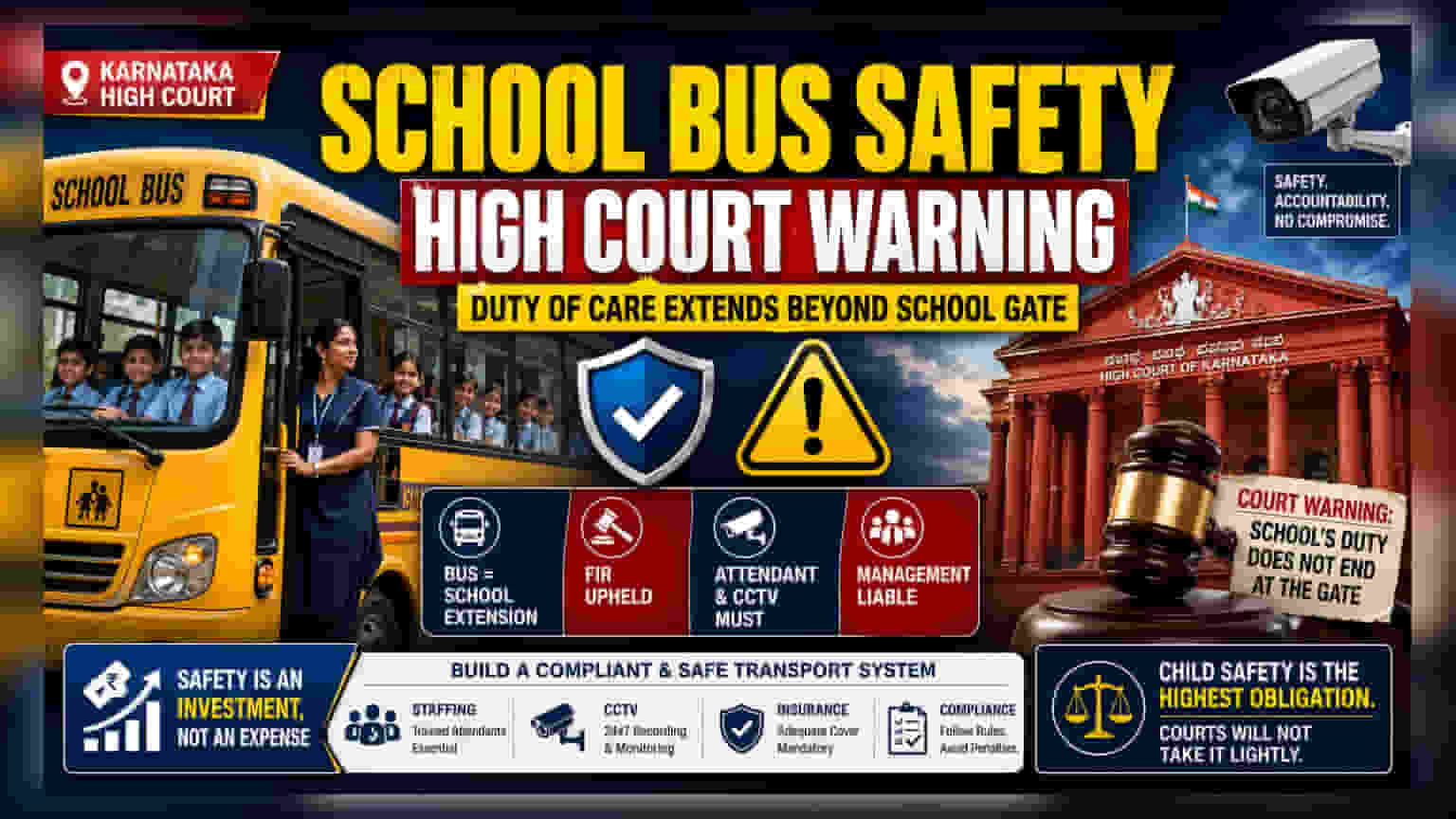
The Karnataka High Court has ruled that a school's legal responsibility for student safety extends to the entire journey on its buses, treating the vehicle as an extension of school premises. This decision, which upheld an FIR against a private school in Mandya, sets a strict compliance precedent. Education providers may now face higher operational and oversight costs to mitigate legal risks.
What The High Court Ruled
The Karnataka High Court has established a firm legal precedent regarding student safety. In a recent decision, the court affirmed that the 'duty of care' educational institutions owe to their students does not end at the school gate. Instead, it extends to the entire commute on school buses. Justice M. Nagaprasanna explicitly stated that a school bus must be considered an extension of the school premises, requiring consistent supervision by teachers or designated attendants.
This ruling came as the court refused to quash a First Information Report (FIR) filed against the management of Divyajyothi School in Mandya. The case stems from an incident on August 1, 2025, where a Class IV student suffered a serious eye injury due to a mishap involving other students on the bus. The court observed that safety protocols are a statutory obligation, not a matter of convenience or charity.
Legal Liability And School Responsibility
The court’s decision to uphold the FIR highlights the growing legal risks for school management. The FIR cited the school for failing to ensure adequate supervision, provide an attendant, and maintain functional CCTV cameras. By rejecting the management's plea to dismiss the case, the court clarified that schools cannot simply shift blame to the actions of other students if the management itself failed to provide a safe environment.
The case invokes Section 125(a) of the Bharatiya Nyaya Sanhita (BNS), which addresses rash or negligent acts that endanger human life or personal safety. This signals that management can be held accountable for lapses in safety infrastructure and operational oversight, rather than just the direct culprits of an incident.
Operational Implications For Education Providers
For companies and institutions operating in the education sector, this ruling shifts the focus toward stricter operational compliance. Managing a fleet of school buses is now a high-stakes responsibility where negligence can lead to direct legal action against management. Schools and education providers may need to re-evaluate their safety expenditures, including the hiring of trained attendants for every bus, the installation and monitoring of high-definition CCTV systems, and the implementation of rigorous student conduct monitoring.
What This Means For Compliance Costs
While essential for student safety, these measures bring financial and administrative implications. Education providers may see increased operational costs related to:
- Staffing: Hiring and training dedicated bus attendants.
- Technology: Investing in robust CCTV and tracking systems that must remain functional at all times.
- Insurance: Potential adjustments in liability insurance premiums as insurers adjust to higher legal risks for educational institutions.
- Administrative Oversight: Increased time and resources dedicated to auditing safety protocols to ensure compliance with court expectations.
What Investors Should Track
Investors tracking the education sector should monitor how institutions manage these operational pressures. The key indicator will be the consistency of safety compliance and whether rising overheads impact profit margins for large education chains. Future updates from regulatory bodies and state education departments on bus safety mandates will be important to watch, as they may lead to more standardized and stringent safety regulations across the country.