 Whalesbook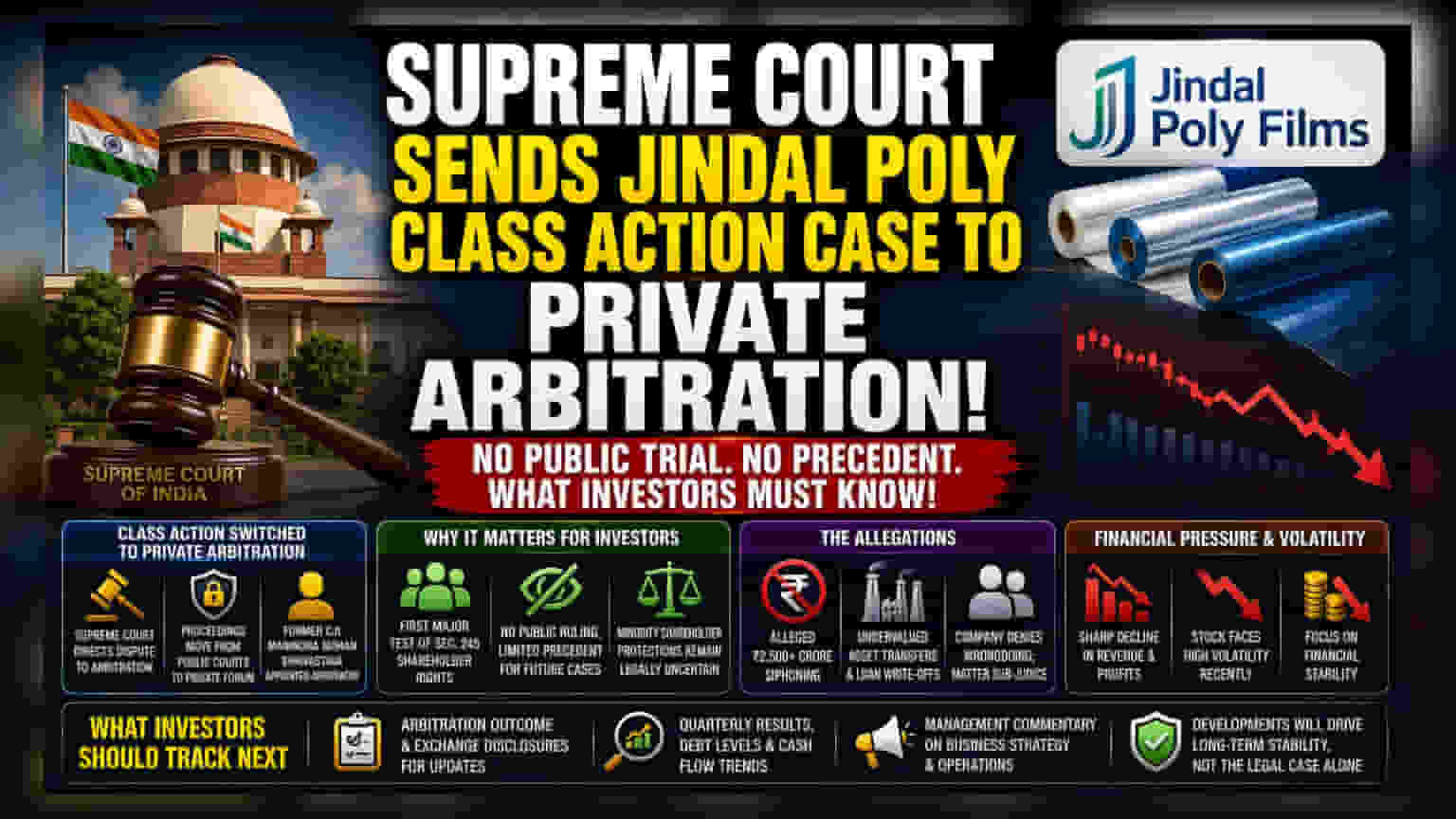


What Happened
The Supreme Court of India has directed that the corporate class action lawsuit against Jindal Poly Films Ltd. be moved from public legal proceedings to private arbitration. A bench comprising Justices Prashant Kumar Mishra and Atul S. Chandurkar accepted a joint request to resolve the dispute this way, appointing former Chief Justice Manindra Mohan Shrivastava as the sole arbitrator. This order effectively sets aside earlier rulings by the National Company Law Tribunal (NCLT) and the National Company Law Appellate Tribunal (NCLAT), which had previously deemed the case maintainable under Section 245 of the Companies Act, 2013.
Why This Matters for Investors
This case was widely followed as the first major test of India’s corporate class action framework. Section 245 of the Companies Act was designed to empower minority shareholders to collectively seek remedies against management for conduct prejudicial to their interests. By moving the dispute to private arbitration, the legal proceedings will now take place behind closed doors rather than in a public court forum. This means that the high-profile case will not set a public legal precedent for how similar disputes might be handled in the future. For investors, the shift marks the end of a high-visibility public trial that could have clarified the extent of minority shareholder protections in the country.
The Allegations and Company Stance
The legal action, initially brought by minority shareholders, alleged that promoter-linked entities had siphoned more than ₹2,500 crore from the company. The petition claimed this was achieved through undervalued asset transfers, specifically concerning investments in Jindal Powertech and Jindal Thermal, alongside loan write-offs and related-party transactions. Jindal Poly Films has consistently denied these allegations, maintaining that its business decisions were guided by commercial wisdom and complied with relevant legal and regulatory frameworks. The company has informed shareholders that the matter remains sub-judice and that no financial implications can be determined at this stage.
Understanding the Financial Context
Investors looking at this situation should also consider the company's recent performance. Jindal Poly Films has faced significant financial pressure, with recent reports highlighting sharp declines in revenue and net losses in recent quarters. The stock has also experienced high volatility over the past few months. While the legal battle focuses on governance and past transactions, the company’s ability to stabilize its operational performance and manage its financial health remains a key area of interest for shareholders, independent of the ongoing legal dispute.
What Investors Should Track Next
The outcome of the arbitration process will be the most critical development to watch. Because the case is now private, public updates may be limited to formal disclosures required by stock exchanges. Investors should continue to monitor these exchange filings for any material updates regarding the arbitration outcome. Additionally, tracking the company's quarterly financial results, debt levels, and overall management commentary on business strategy will be important, as these factors provide a clearer picture of the company's long-term stability and operational health, separate from the legal proceedings.