 Whalesbook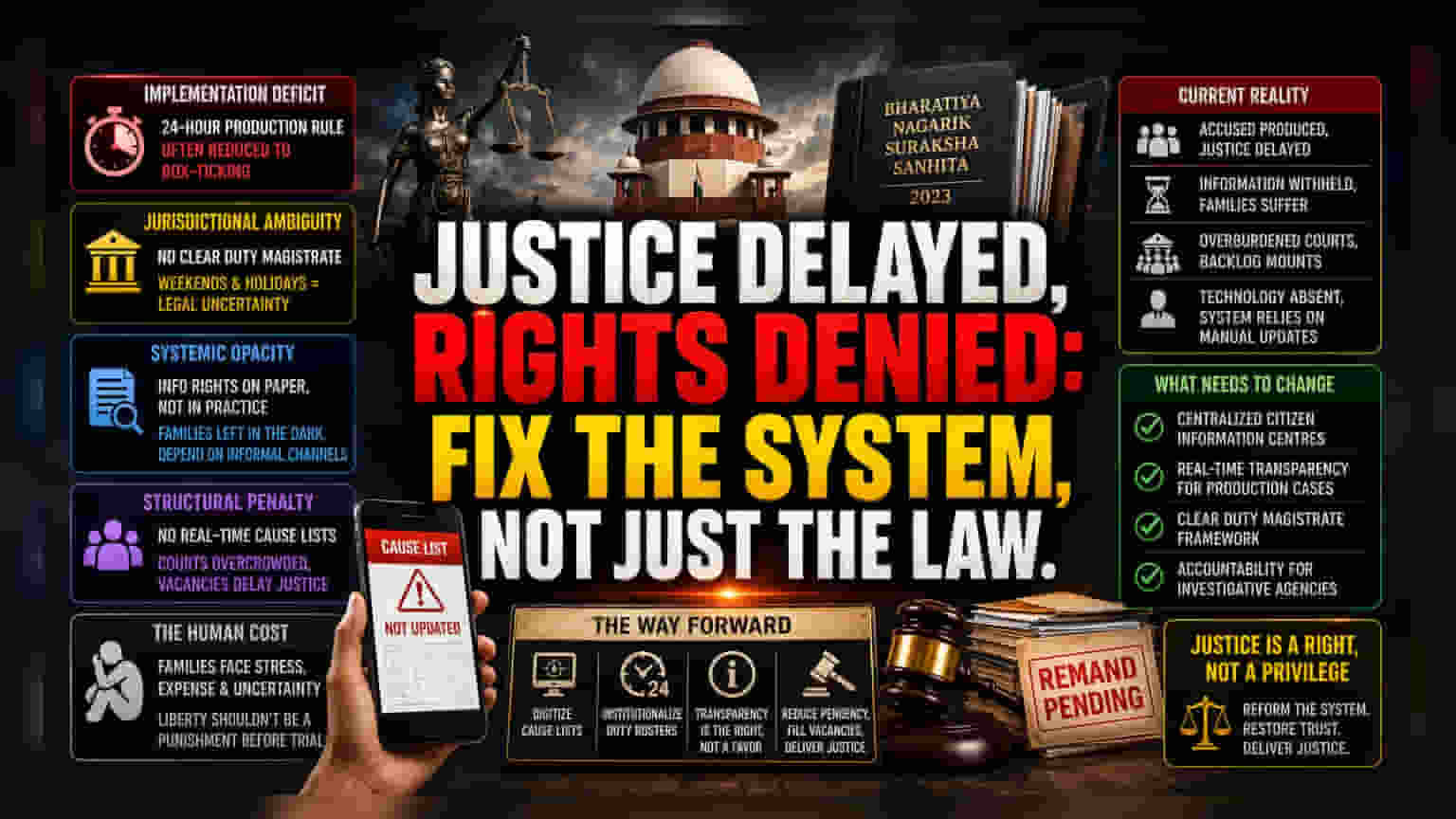


The Implementation Deficit
Recent legislative shifts under the Bharatiya Nagarik Suraksha Sanhita (BNSS), 2023, were intended to streamline the criminal justice lifecycle. However, the transition has exposed a recurring friction between theoretical legal safeguards and the operational realities of the lower judiciary. While the statute mandates that the state produce an accused before a magistrate within 24 hours, this requirement is frequently reduced to a box-ticking exercise. The focus remains heavily on satisfying technical compliance rather than facilitating a robust judicial review of the detention.
Jurisdictional Ambiguity and the Duty Magistrate
The reliance on district court websites to determine jurisdictional magistrates often fails when arrests occur outside standard business hours. The BNSS provides little clarity on the status or scope of the 'duty magistrate' role. This lack of explicit statutory definition creates a fragmented system where legal counsel must navigate ad-hoc roster changes. Consequently, defendants arrested on weekends or public holidays face extended uncertainty, as the legal framework lacks a standardized, transparent mechanism for off-hours production.
Systemic Opacity and Information Asymmetry
Although Section 36(c) and Section 230 of the BNSS ostensibly empower the accused and their families with information rights, the reality on the ground is starkly different. Investigative agencies frequently control the flow of data, often limiting notifications to basic alerts while withholding critical remand documentation. This creates a reliance on informal communication channels and local intermediaries. For families, this lack of institutionalized transparency transforms the simple act of locating an accused relative into an expensive and time-consuming administrative burden.
The Structural Penalty
The absence of digitized, real-time cause lists for production cases acts as a primary bottleneck. Because production matters are handled sporadically among regular dockets, court premises remain overcrowded, and families are left in constant limbo. This operational inefficiency is compounded by chronic judicial vacancies that prevent the court system from processing remand applications with the necessary speed or scrutiny.
The Future Outlook
Proposals to establish 'Nagarik Soochana Kendras'—centralized inquiry desks—suggest a path forward, but these are mere palliatives if the underlying issues of case pendency remain unaddressed. Future judicial performance will hinge not on the enactment of new codes, but on the digitization of cause lists and the institutionalization of duty rosters. Until the judiciary moves away from reliance on manual updates and informal staff communication, the administrative burden of the law will continue to act as a hidden penalty for the accused, regardless of their eventual day in court.