 Whalesbook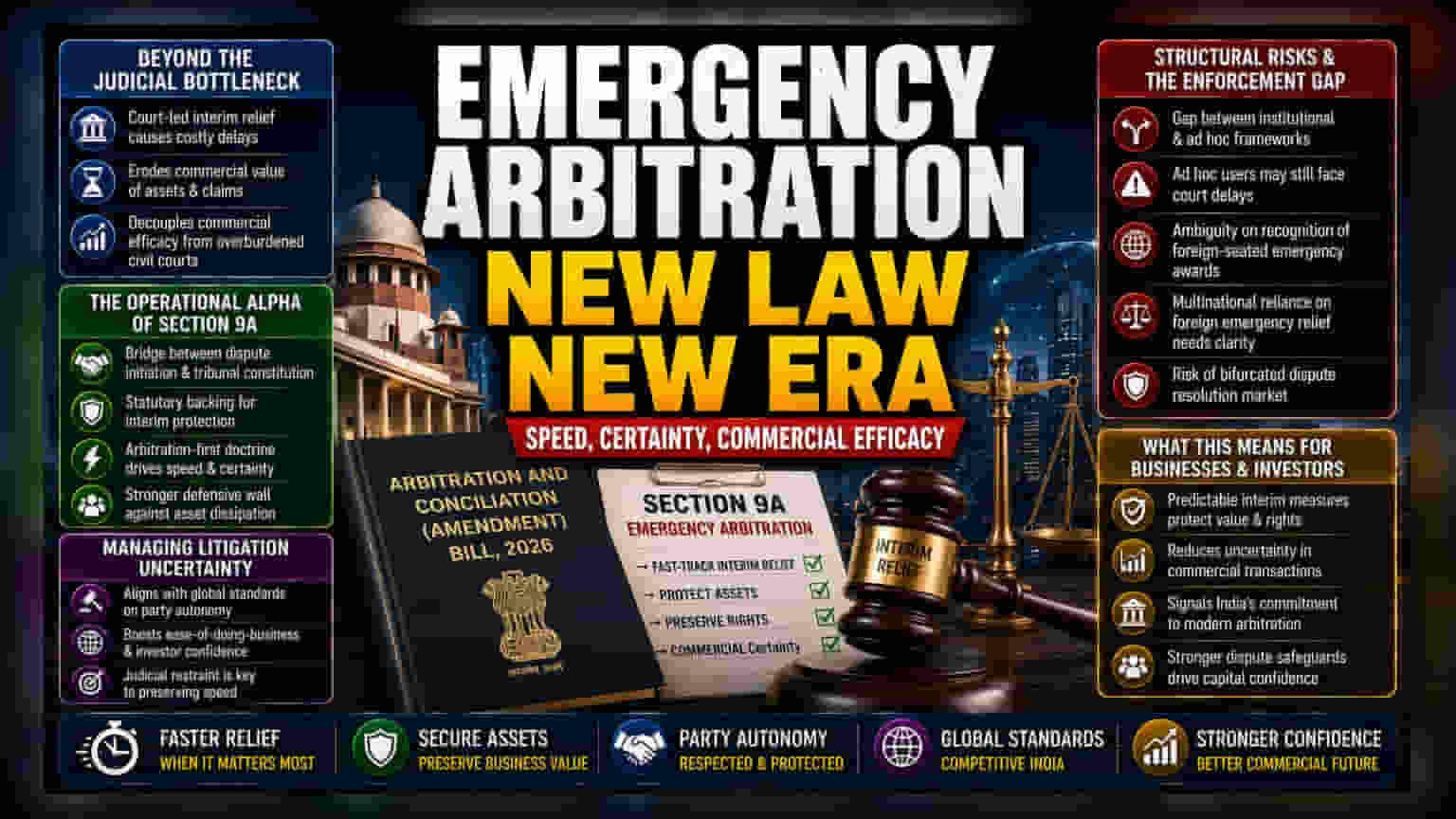


Beyond the Judicial Bottleneck
The move toward formalizing emergency arbitration represents a structural pivot in India’s commercial dispute resolution framework. Historically, the enforcement of interim relief was tethered to court oversight, often resulting in prolonged injunction hearings that eroded the commercial value of the underlying assets. By embedding emergency arbitration directly into the Arbitration and Conciliation Act, the legislative body is attempting to decouple commercial efficacy from overburdened civil courts.
The Operational Alpha of Section 9A
The proposed Section 9A introduces a standardized mechanism that effectively creates a bridge during the dangerous gap between the initiation of a dispute and the constitution of a formal tribunal. While previous judicial precedents, such as the Supreme Court’s stance in the Future Retail saga, provided stop-gap enforcement, they lacked the permanence of statutory law. This new legislative intent suggests a shift toward an 'arbitration-first' doctrine, which significantly reduces the uncertainty currently inherent in ad hoc proceedings. Investors and corporations stand to benefit from the predictability of these interim measures, as they provide a defensive wall against the dissipation of assets before the main arbitral proceedings commence.
Structural Risks and the Enforcement Gap
While the amendment promises increased efficiency, it introduces significant risks regarding the interplay between institutional arbitration and ad hoc frameworks. Much of the commercial dispute volume in India remains outside the scope of standardized institutional rules. If the final iteration of this law remains strictly focused on institutional bodies, a bifurcation of the market may occur, where ad hoc users remain vulnerable to the very court-led delays the bill seeks to solve. Furthermore, the legislative ambiguity surrounding the recognition of foreign-seated emergency awards remains a potential flashpoint. Multinational entities often rely on foreign-seated emergency relief, and until the law provides a clear pathway for the enforcement of these international orders, foreign investors may view the local statutory progress as incomplete.
Managing Litigation Uncertainty
The institutional push toward statutory recognition is a direct response to the global demand for India to improve its standing in ease-of-doing-business indices. By aligning with international standards that prioritize party autonomy and fast-track relief, the government is signaling a reduced tolerance for court-room interference in private contractual matters. However, the success of this transition will depend heavily on whether the judiciary adopts a hands-off approach to reviewing these emergency orders. If courts continue to exercise excessive appellate oversight on these temporary measures, the intended speed of the process will effectively be nullified, leaving investors back at square one.