 Whalesbook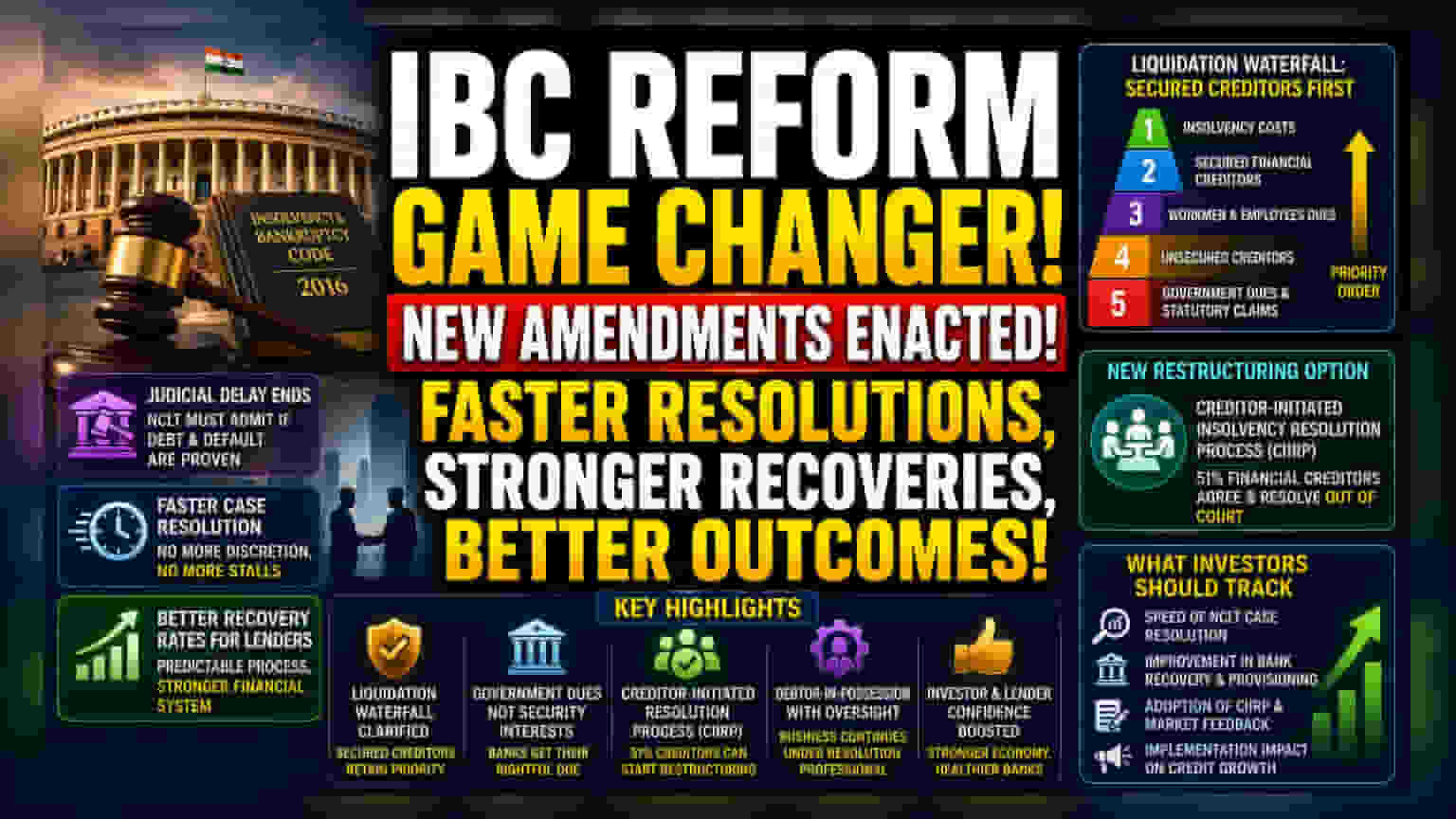
Parliament has amended the IBC 2016 to speed up insolvency cases and fix previous legal hurdles. The changes clarify the order of payment, restricting government claims and limiting court discretion on case admissions. This is a significant move for banks and financial institutions, as it aims to improve recovery timelines and strengthen creditor rights in India.
What Happened
India's Parliament has officially amended the Insolvency and Bankruptcy Code (IBC), 2016, to streamline the process of resolving corporate debt. The updates, enacted on April 6, 2026, focus on clearing legal roadblocks that previously slowed down insolvency cases. These changes address how courts handle new cases, how creditors can restructure debt, and the priority order for payouts when a company is liquidated.
Clearing the Liquidation Waterfall
One of the most important changes for investors and lenders involves the "liquidation waterfall." In simple terms, this is the rulebook for who gets paid first when a company goes bankrupt. Previously, certain court rulings had created confusion by suggesting that government statutory dues should be treated almost equally to the claims of secured financial creditors, such as banks. This often resulted in banks receiving less money during the recovery process. The new amendment clarifies that government dues do not count as "security interests." This restoration ensures that secured creditors, including banks and financial institutions, retain their priority in the repayment hierarchy, which is designed to boost overall recovery rates.
Limiting Judicial Discretion
Before this amendment, courts sometimes used their discretion to delay the admission of insolvency cases, even when the debt and default were clearly proven. This often gave defaulting companies an opportunity to use procedural delays to stall the process. The new law mandates that the National Company Law Tribunal (NCLT) must admit an insolvency application if the criteria for debt and default are met. By removing this discretion, the system aims to prevent debtors from using technicalities to avoid or delay the resolution process.
New Restructuring Option for Creditors
To provide more flexibility, the government has introduced a Creditor-Initiated Insolvency Resolution Process (CIIRP). This acts as a pre-insolvency restructuring mechanism. If financial creditors holding at least 51% of the total debt agree, they can start an out-of-court process. In this setup, the company’s management stays in control but works under the oversight of a Resolution Professional. This approach is intended to provide a middle ground between keeping a company afloat and liquidating it entirely, which can often destroy asset value.
How Investors May Read This
For investors, particularly those tracking the banking and financial sector, these changes are generally viewed as a positive structural reform. Faster resolutions often mean banks can recover bad loans more quickly and efficiently. When the legal process is predictable and swift, it reduces the need for banks to set aside excessive funds as provisions for potential losses. The clarity on the payment waterfall is specifically helpful for lenders, as it removes the uncertainty regarding government claims over their assets. However, the true impact will depend on how efficiently the NCLT implements these changes and handles the potential increase in case filings.
What Investors Should Track
Going forward, the key monitorable will be the speed of case resolution in the NCLT. Investors may look for updates on whether these amendments lead to a faster pace of recovery for banks with significant corporate loan books. Additionally, any feedback from the financial sector on the implementation of the new creditor-initiated process will be important to watch, as this could change how distressed companies are handled before they become full-blown insolvency cases.

