

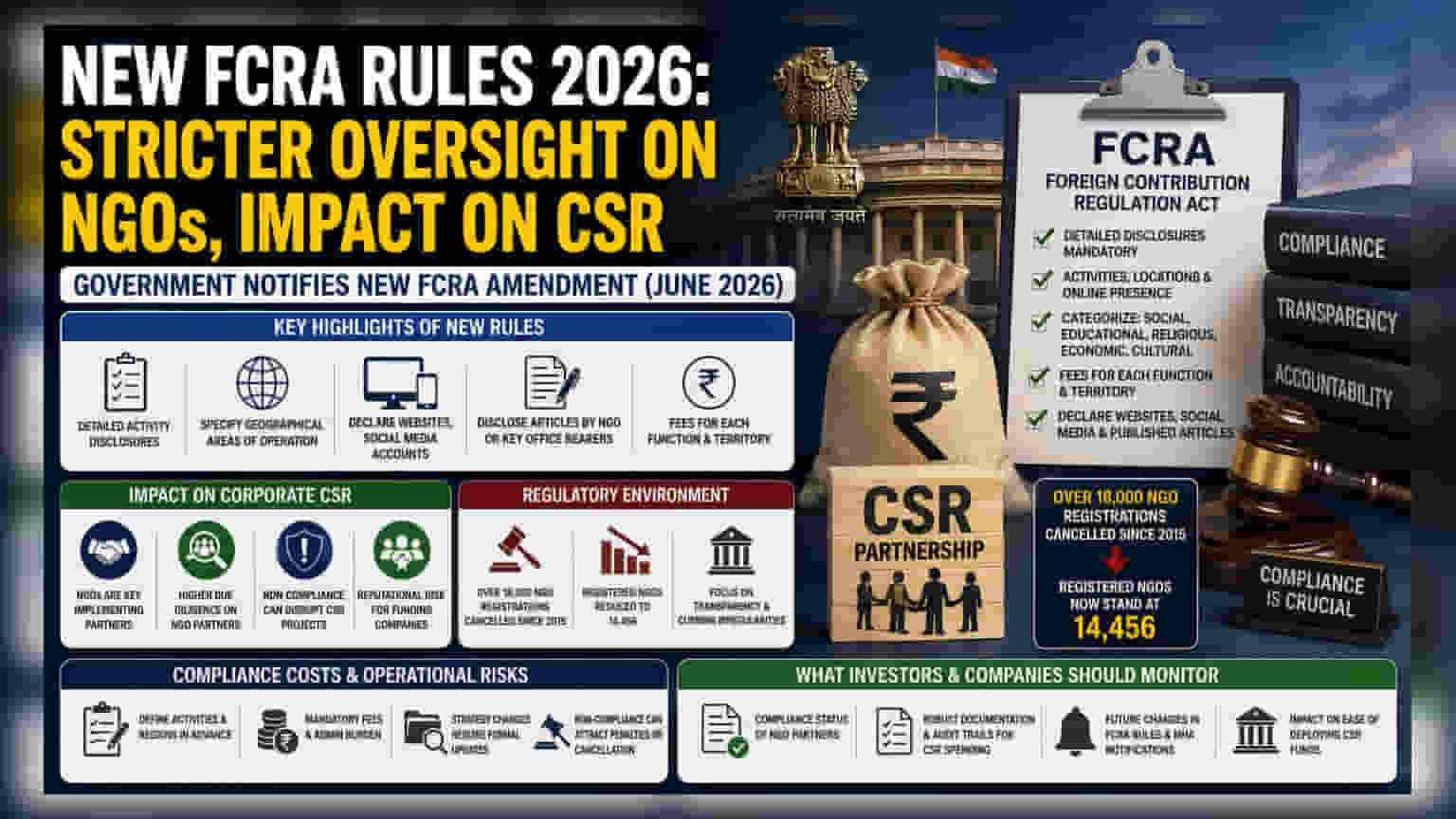
New Foreign Contribution Regulation Act (FCRA) rules now require NGOs to submit detailed disclosures on their operations, geography, and social media presence. These updates aim to increase transparency in foreign funding but add significant compliance costs and administrative steps, which may influence how companies manage their corporate social responsibility (CSR) partnerships.
What Happened
The Indian government has introduced new regulations under the Foreign Contribution Regulation Act (FCRA) as of June 2026, marking a further step in monitoring organizations that receive foreign funds. The latest amendment mandates that non-governmental organizations (NGOs) provide highly detailed disclosures regarding their specific activities, the geographical areas where they operate, and their online presence. Organizations must now categorize their work into specific groups such as social, educational, religious, economic, or cultural, and pay associated fees for each registered function and territory. The new rules also require NGOs to declare details about their social media accounts, websites, and any articles published by the organization or its key officials.
Impact on Corporate CSR Partnerships
While these rules apply directly to NGOs, they hold indirect significance for the corporate sector. Many large companies in India rely on NGOs as implementing partners to execute their Corporate Social Responsibility (CSR) projects. With stricter oversight and a higher probability of license reviews, companies may need to increase their due diligence processes when selecting NGOs for CSR funding. A partner NGO failing to comply with these updated FCRA norms could face registration cancellation, potentially disrupting ongoing CSR initiatives or causing reputational issues for the funding company. Investors and companies may now need to treat compliance with FCRA regulations as a key filter in their partner selection criteria.
The Regulatory Environment
The government has been steadily increasing its oversight of foreign funding in the non-profit sector. Since 2015, over 18,000 NGO registrations have been cancelled, reducing the total count of registered organizations in the country to 14,456. The stated objective behind these repeated amendments is to ensure transparency and curb financial irregularities in organizations receiving foreign contributions. However, the increased administrative requirements and the risk of penalties for minor deviations, such as administrative spending limits or changes in geographical plans, have created a more challenging environment for operational autonomy.
Compliance Costs and Operational Risks
The requirement to define activities and regions in advance, combined with mandatory fees and extensive digital footprint disclosure, adds a layer of operational rigidity. For NGOs, this means that any pivot in strategy, expansion into new areas, or changes in project focus will likely require formal administrative updates. Failure to maintain this level of precision can attract penalties or threaten the organization's ability to receive foreign funds. The current regulatory environment emphasizes strict adherence to declared objectives, which limits the flexibility of organizations to respond quickly to changing field conditions.
What Investors and Companies Should Monitor
The primary monitorable for businesses with significant CSR operations is the compliance status of their partner organizations. Companies will likely need to ensure their documentation and audit trails for CSR spending are robust to withstand potential regulatory scrutiny. Furthermore, any further changes to the FCRA framework or subsequent notifications from the Ministry of Home Affairs regarding documentation standards will remain important to track, as these directly impact the ease of deploying CSR funds across the country.