

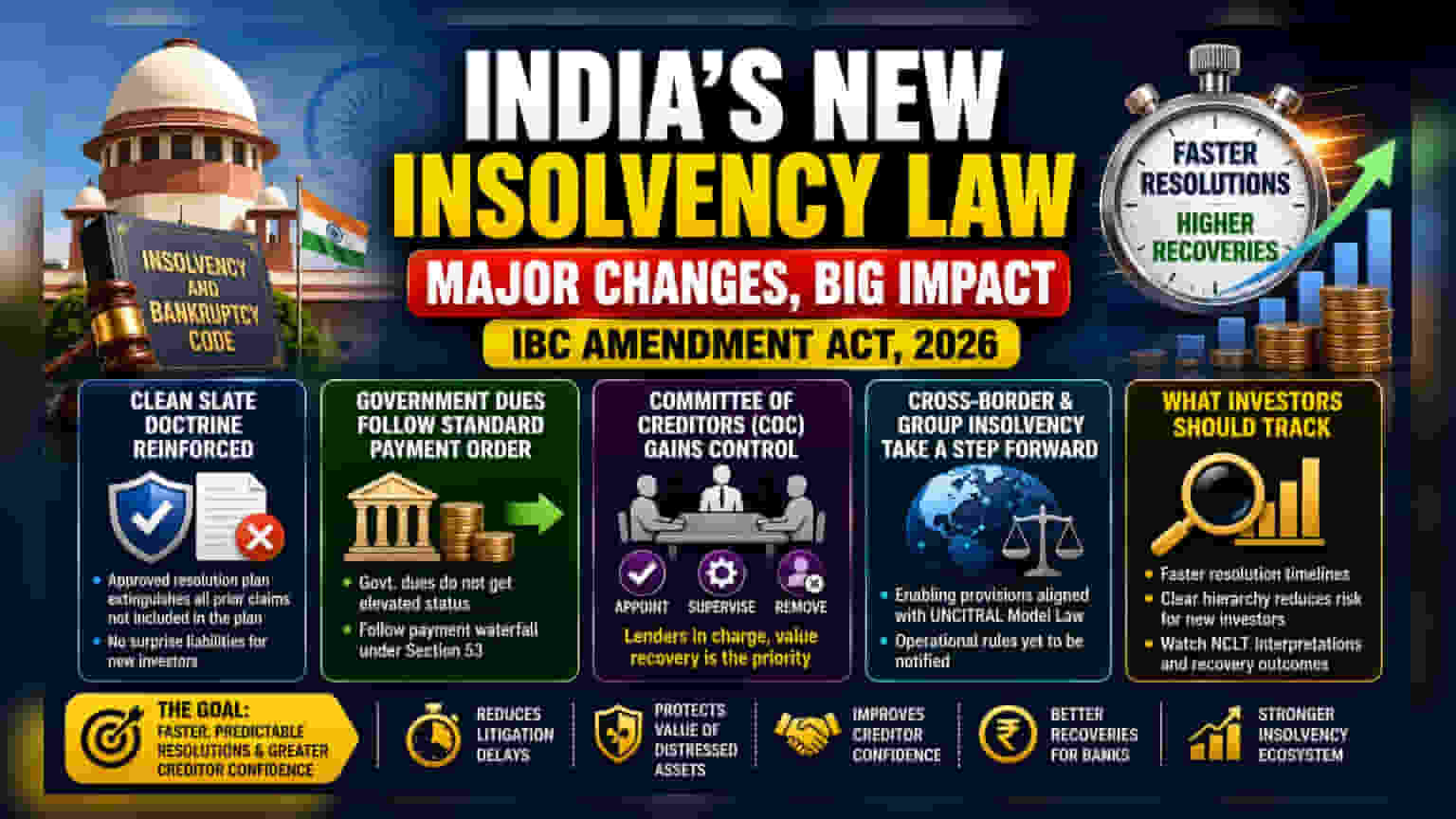
The Insolvency and Bankruptcy Code (IBC) Amendment Act, 2026, has been passed to streamline company resolutions. It clarifies the 'clean slate' rule for new owners, settles the status of government dues, and boosts the power of the Committee of Creditors. For investors, this aims to provide more predictable recovery timelines, though specific rules for cross-border cases are still pending.
What Happened
India has updated its insolvency framework with the Insolvency and Bankruptcy Code (IBC) Amendment Act, 2026. The new law aims to make the process of resolving bankrupt companies faster and more predictable for all parties involved. By formalizing several key legal principles and clarifying the rights of creditors, the government intends to reduce the time spent in court disputes, which often leads to value erosion in distressed assets.
The 'Clean Slate' Benefit
One of the most important updates is the reinforcement of the 'clean slate' doctrine. Previously, successful bidders for distressed companies sometimes faced unexpected claims from old creditors that were not included in the original resolution plan. The amendment now explicitly states that once a resolution plan is approved, all prior claims not mentioned in that plan are effectively extinguished. This removes a significant layer of uncertainty for companies looking to acquire distressed assets, as they can now operate the business without the risk of surprise liabilities from the past.
Fixing Government Dues
There has historically been confusion regarding how government statutory dues rank against bank loans during bankruptcy. The amendment clarifies that government dues do not automatically get elevated status. Instead, they must follow the standard payment order under Section 53 of the IBC. By placing these dues in the regular queue, the law provides greater certainty to financial lenders. This helps ensure that the recovery value for financial creditors is not reduced by unexpected government claims that jump ahead in the payment line.
Committee of Creditors Gains Control
The amendment gives the Committee of Creditors (CoC) more direct control over the liquidation process. The CoC now has the power to appoint, supervise, and remove the liquidator. This change shifts the oversight from a purely legal-led model to one managed by the commercial stakeholders—the lenders—who have the most to lose. By giving lenders more authority, the process aims to prioritize value recovery and speed.
Cross-Border Progress
The law introduces enabling provisions for group and cross-border insolvency, which aligns with global standards like the UNCITRAL Model Law. While this is a step toward making India’s insolvency regime more internationally compatible, the actual operational rules needed to run these cross-border processes are not yet in place. International investors and creditors will need to track when these secondary rules are finalized to understand how they can participate in global insolvency cases.
What Investors Should Track
Investors may look for faster resolution timelines as legal ambiguity is reduced. The clear rule on government dues and the 'clean slate' doctrine should, in theory, lower the risks for new investors entering distressed companies. The key monitorable will be how these new provisions are interpreted in the National Company Law Tribunal (NCLT) and whether they successfully lead to faster asset recoveries for banks.