

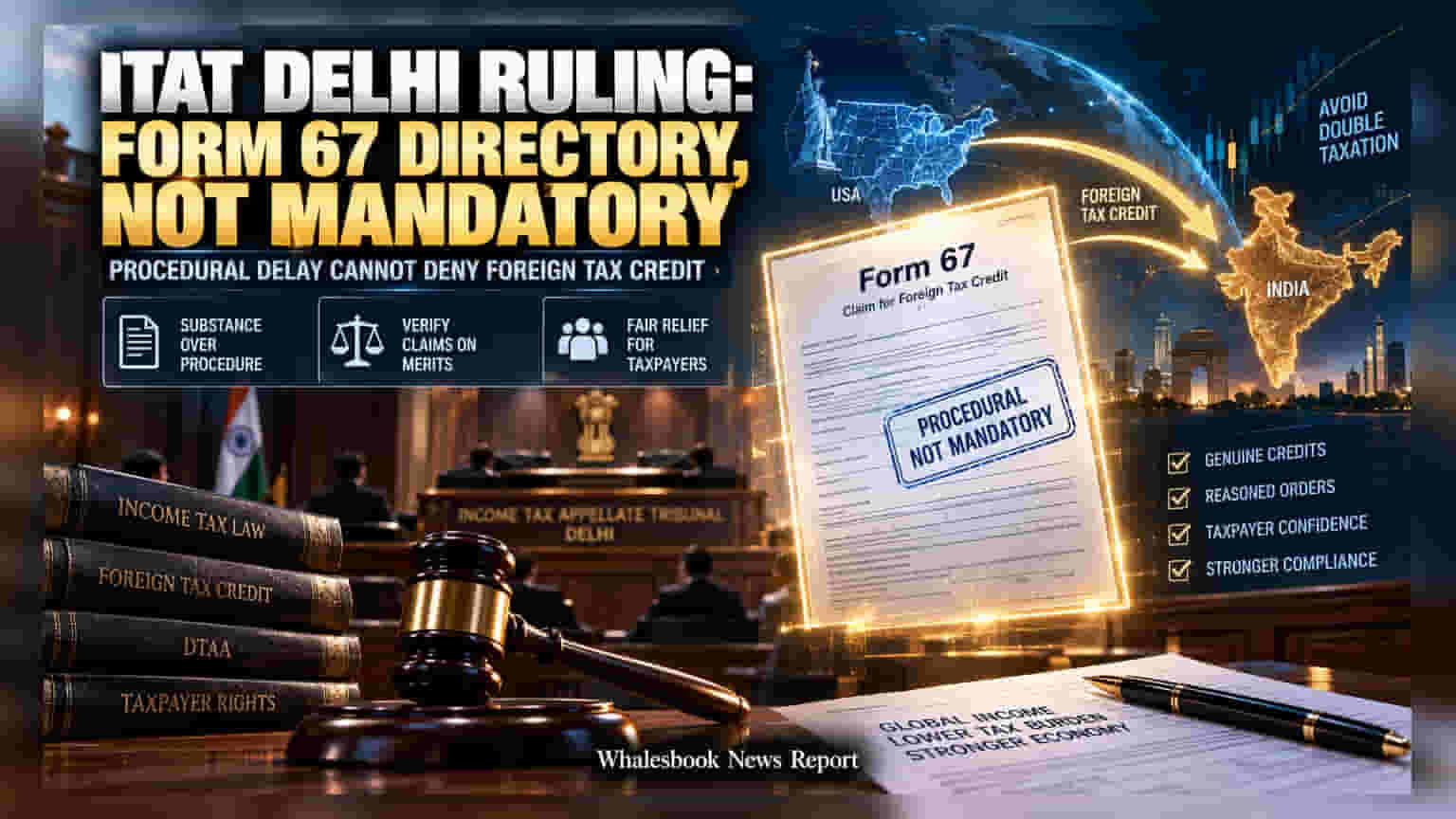
The Income Tax Appellate Tribunal (ITAT) Delhi has ruled that filing Form 67 to claim Foreign Tax Credit is a directory requirement, not mandatory. This decision brings relief to a taxpayer facing a Rs 30 lakh demand due to a procedural lapse. The ruling reinforces that valid tax credits should not be denied solely because of technical delays, setting a key precedent for cross-border income tax claims.
The Income Tax Appellate Tribunal (ITAT) in Delhi has issued a significant ruling regarding the procedural norms for claiming Foreign Tax Credit (FTC). The tribunal clarified that the filing of Form 67, which is required to claim credit for taxes paid outside India, is a directory requirement rather than a mandatory one. This distinction is vital for taxpayers, as it prevents the denial of substantive tax benefits based on technical or procedural delays.
The case involved a taxpayer who earned income in the United States and sought to claim a tax credit of Rs 23.48 lakh to avoid double taxation. However, the tax department raised a demand of Rs 30 lakh, primarily because the taxpayer failed to submit Form 67 alongside the Income Tax Return (ITR). Under the Double Taxation Avoidance Agreement (DTAA) framework, Indian residents are entitled to claim credit for taxes already paid in foreign jurisdictions to ensure they are not taxed twice on the same income. The failure to file the form had led the tax department's automated system to reject the claim.
Tribunal Focuses on Verification over Procedure
The ITAT reviewed the process followed by the Central Processing Centre (CPC) and the Assessing Officer (AO). It noted that the CPC had referred the case to the jurisdictional AO due to unverified credits, but a proper verification process was never conducted. Instead, the department had rejected the claim summarily. The tribunal emphasized that the tax authorities have a duty to conduct an inquiry into the merits of the credit claim rather than dismissing it simply because of a procedural lapse regarding Form 67.
Citing the precedent set by the Delhi High Court in the case of Real Time Data Services (P.) Ltd. v. PCIT, the tribunal reiterated that tax laws should be interpreted in a way that provides fair relief to taxpayers. The ruling clarifies that the requirement to file Form 67 is procedural and should not act as a barrier to claiming genuine tax credits. If the tax department finds any issue with the credit claim, it is required to verify the details and, if it decides to reject the claim, must issue a reasoned order explaining the basis for its decision.
This decision serves as a safeguard for individuals managing complex cross-border tax liabilities. For investors and taxpayers, the key monitorable remains the verification process. The ITAT has now directed the Assessing Officer to perform a fresh review of the Rs 23.48 lakh credit claim. This case highlights that while compliance with filing norms is important, tax authorities are expected to prioritize the substantive validity of tax claims over technical formalities.