 Whalesbook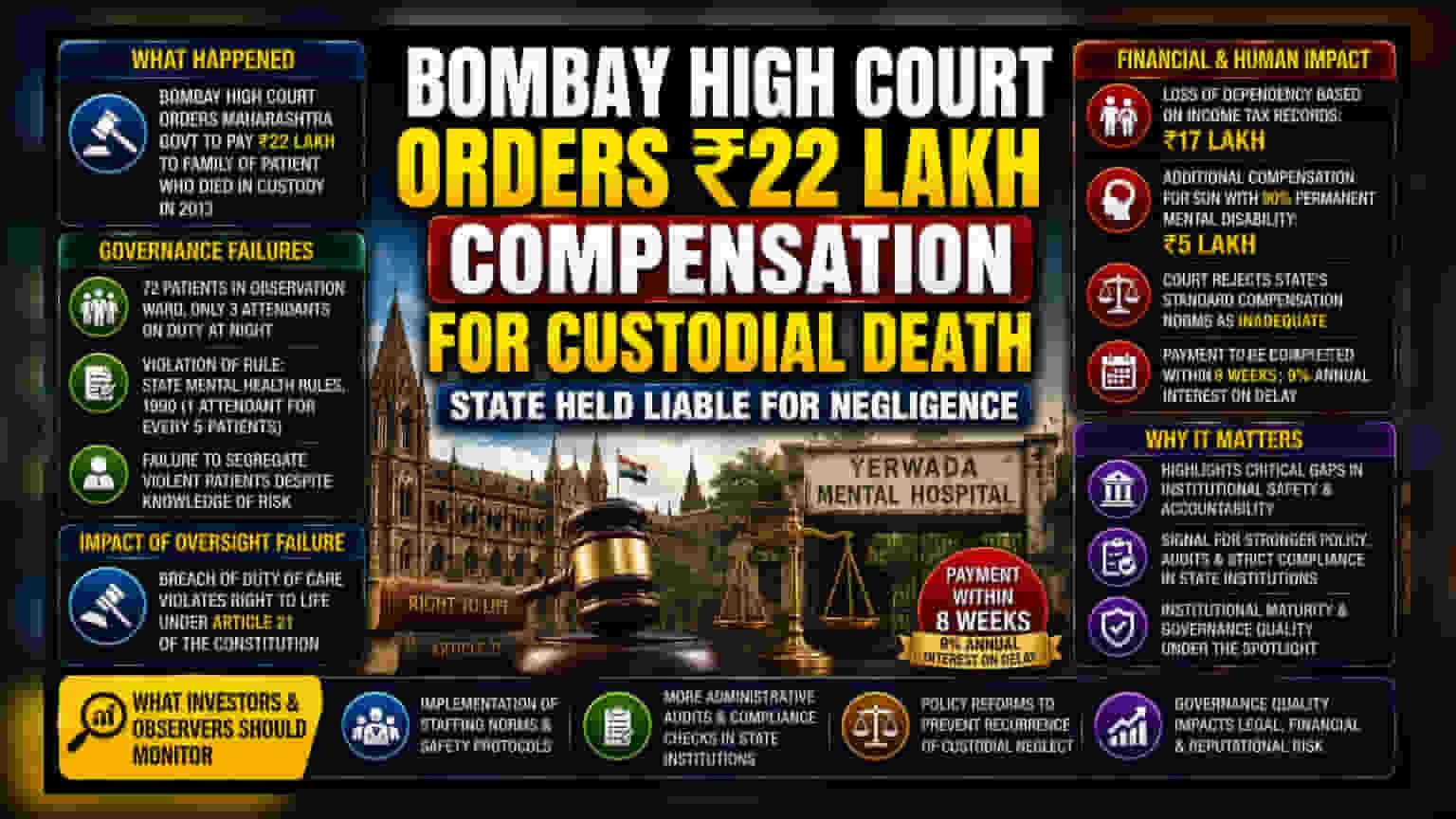


What Happened
The Bombay High Court has held the Maharashtra government accountable for a custodial death at the Yerwada Mental Hospital. The court ordered the state to pay ₹22 lakh in compensation to the family of a patient who was beaten to death by another inmate in 2013. This amount is in addition to ₹1 lakh already provided following an earlier order by the Lokayukta. The bench, led by Justices Manish Pitale and Shreeram V Shirsat, rejected the hospital's claims of no lapse, ruling that the incident was a direct result of institutional negligence.
Governance and Compliance Failures
The court’s ruling sheds light on severe operational gaps within the institution. The hospital, which housed 72 patients in the observation ward, had only three attendants on duty during the night of the incident. This staffing level was in direct violation of the State Mental Health Rules, 1990, which mandate one attendant for every five patients. The court described this staffing strength as woefully inadequate and concluded that the hospital failed to provide the most basic facilities, effectively breaching its duty of care toward the patients.
The Impact of Oversight Failure
For those who study public governance and institutional reliability, this case serves as a sharp reminder of the risks associated with inadequate oversight. The court specifically criticized the authorities for failing to segregate violent patients from others, despite knowing about their aggressive tendencies. This operational failure was identified as the primary cause of the incident. The ruling emphasizes that such failures represent a violation of the right to life under Article 21 of the Constitution, creating clear legal and financial liability for the state.
Financial and Human Considerations
The compensation was calculated based on the victim's income tax records, establishing a loss of dependency of ₹17 lakh. Furthermore, the court added ₹5 lakh to the award because the victim's son suffers from a 90% permanent mental disability. The bench explicitly rejected the state’s standard compensation norms of ₹2 lakh for loss of life and ₹5 lakh for custodial deaths, terming them inadequate given the specific circumstances of the tragedy. The state has been ordered to complete the payment within eight weeks, with a 9% annual interest rate applied to any delays.
What Investors and Observers Should Monitor
The core monitorable here is the implementation of safety protocols and staffing norms across state-run institutions. Institutional failure, whether in public or private entities, often stems from a lack of strict adherence to established rules. Observers of regulatory compliance may look for potential policy shifts or increased administrative audits in state institutions following this verdict to ensure that such lapses are not repeated. The ability of public bodies to uphold basic human safety standards remains a key indicator of governance quality and institutional maturity.