

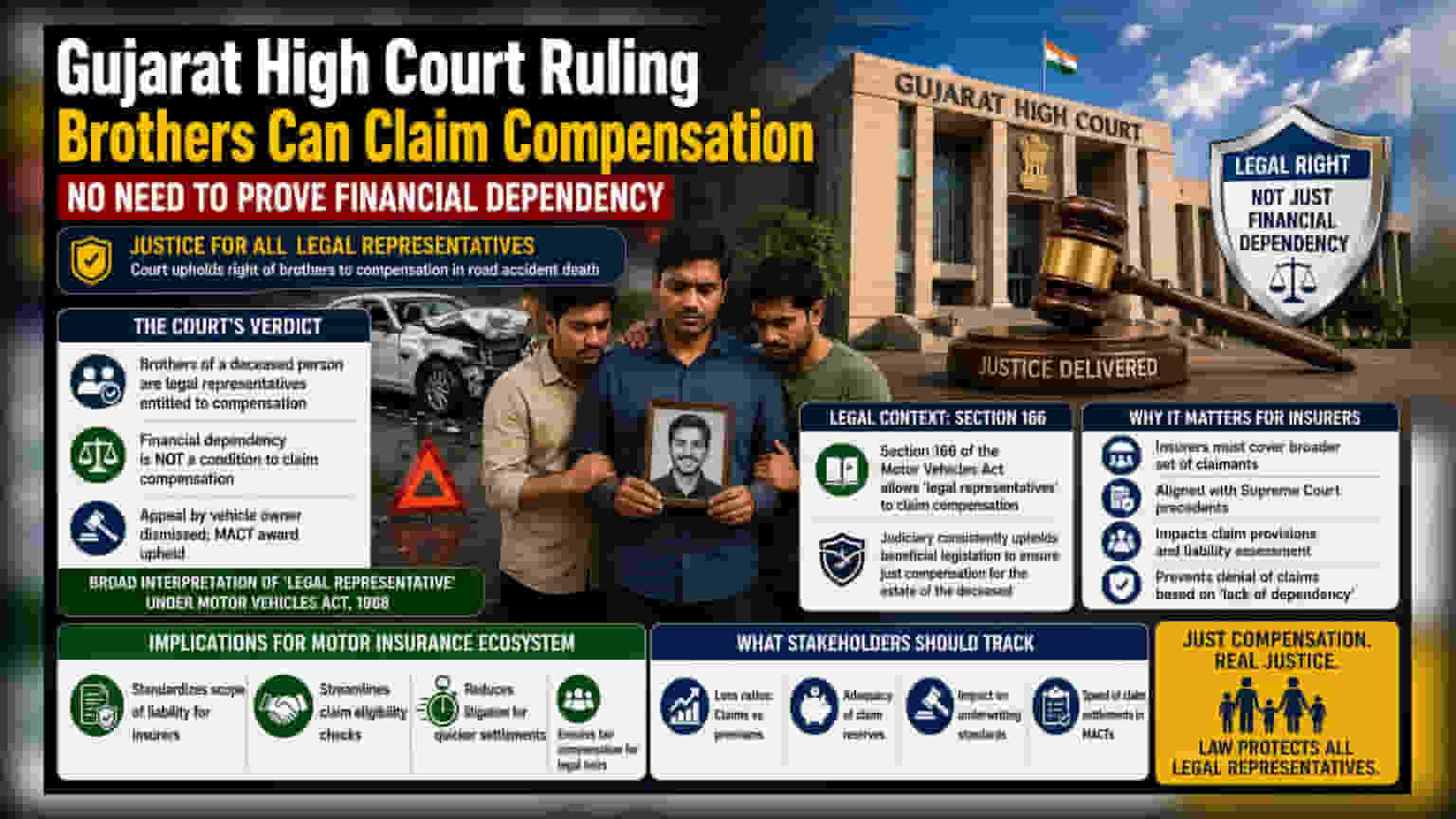
The Gujarat High Court has clarified that siblings of a deceased individual can claim motor accident compensation under the Motor Vehicles Act, irrespective of financial dependency. This ruling reinforces the broad definition of 'legal representatives,' impacting how general insurance companies assess and settle third-party liability claims.
What Happened
The Gujarat High Court has affirmed that the brothers of a person killed in a road accident are entitled to claim compensation, even if they were not financially dependent on the deceased. In a recent order, the Court dismissed an appeal by a vehicle owner who had contested a Motor Accident Claims Tribunal (MACT) award on the grounds that the claimants (the brothers) were not financially reliant on the victim.
Justice Mool Chand Tyagi, while delivering the ruling, emphasized that the term 'legal representative' under the Motor Vehicles Act, 1988, holds a broad legal meaning. The decision confirms that compensation rights are not restricted solely to a spouse, parents, or children, but extend to other legal representatives who represent the estate of the deceased.
Why It Matters For Insurers
For the Indian general insurance sector, which provides the vast majority of motor third-party liability covers, this ruling serves as a vital clarification on liability scope. Insurance companies are mandated to pay compensation for road accident deaths, and these payouts are determined by the MACT.
When tribunals expand the definition of eligible claimants, it impacts how insurers calculate their long-term claim provisions. This judgment aligns with several Supreme Court precedents that mandate a wide, flexible interpretation of the Motor Vehicles Act, ensuring that compensation reaches those who represent the deceased’s interests, rather than restricting it to a narrow set of dependents. For insurers, this means the legal framework for assessing 'just compensation' is standardized, reducing the scope for arbitrary denial of claims based on dependency status.
The Legal Context: Section 166
The ruling centers on Section 166 of the Motor Vehicles Act, which allows 'legal representatives' of a deceased person to file for compensation. Over the years, the judiciary has consistently interpreted this section to ensure that the Act functions as a piece of 'beneficial legislation.'
By dismissing the appeal, the High Court reinforced that the right to claim compensation is a statutory right for legal heirs, regardless of their financial status. This prevents insurance companies and vehicle owners from using 'lack of dependency' as a technical argument to avoid or reduce legitimate compensation payouts in fatal accident cases.
Implications For The Motor Insurance Ecosystem
While the ruling does not create a new law, it reaffirms the existing legal standing that insurance companies must account for in their claim settlement processes. For stakeholders, this helps in streamlining the documentation and eligibility checks required during the claim filing process. By preventing protracted litigation over the 'dependency' status of claimants, such rulings can eventually lead to more efficient claim settlements, though they also ensure that the full scope of liability is acknowledged by the insurers.
What Stakeholders Should Track
Investors and stakeholders in the insurance space may track trends in 'loss ratios'—a metric that compares premiums earned against claims paid. As legal interpretations increasingly favor the broad rights of claimants under the Motor Vehicles Act, insurance companies must continue to maintain adequate reserves to cover potential third-party liabilities. The key focus for the sector remains the impact of these court mandates on underwriting standards and the overall speed of claim processing in the Motor Accident Claims Tribunals.